







Why your AC runs all day in Indiana summers

After this form, you can stop searching for an air conditioner pro.

RepairCentral ACIndiana
Step 1 of 2

What ZIP code is the job in?

Why does my AC run all day in the summer?

You notice the unit never shuts off once the afternoon heats up, and you're wondering if that means something's wrong or if it's just how it has to run when it's this muggy out. Either way, the electric bill makes you want an answer, not a guess.

It's sized for a normal day, not this one

An AC that runs most of the day isn't necessarily broken. Indiana summers push heat and humidity at a house for hours at a stretch, and a properly sized system is built to run long cycles to keep pace, not to shut off every few minutes like it does in April or October. The harder the air outside is pushing in, the longer the compressor has to work to hold the temperature where you set it. What matters more than how long it runs is whether the house actually cools down and whether the unit ever gets a break overnight when it's cooler. If it runs constantly even at night, or the house still feels warm, something in the system isn't keeping up the way it should.

A gray-haired man in a dark long-sleeve shirt sits on a gray sofa in a living room, looking toward a sunlit window with sheer curtains.
A gray-haired man in a dark green sweatshirt sits on a sofa in a living room, looking toward a bright window, with a houseplant, lamp, fireplace and framed art behind him.
A gray-haired bearded man in a dark green collared sweater sits on a sofa in a living room with a window, houseplant, floor lamp and bookshelves, looking off to the side.
A gray-haired man in a dark green sweater sits on a sofa in a sunlit living room, looking off to the side, with a framed landscape painting, dining table and shelving behind him.

What long run times do to the system

An AC that runs most of the day is working harder to pull moisture out of sticky air, and that extra load falls on the same parts no matter how new or old the unit is. The compressor cycles less often but stays on longer each time, so a weak capacitor or a low refrigerant charge shows up faster than it would in dry heat. The condenser coil outside has to shed more heat per hour, and if it's caked with grass clippings or cottonwood fluff, it can't let go of that heat fast enough. None of this means the unit is broken. It means there's less room for anything to be off.

When it points to a real problem

A long run time on its own is normal for Indiana in July and August. What isn't normal is the house staying warm anyway, ice forming on the indoor coil, or the outdoor unit shutting off and restarting every few minutes instead of running steady. Those signs mean something is making the system work past what long hours alone would explain, often low refrigerant, a failing capacitor, or airflow blocked somewhere between the return and the vents. A licensed contractor working in your area sees this pattern every summer and checks the parts that fail first before anything else, rather than guessing at the whole system.

An outdoor air conditioner condenser unit sits on a concrete pad beside a stucco wall, with refrigerant lines and conduit running to the wall and a shrub to the left.
Before you get your air conditioner repair
A gray outdoor air conditioner condenser unit on a concrete pad beside a house with dark horizontal siding and a stone base, surrounded by gravel, with a flowering shrub at left and a concrete walkway in front.
After you get your air conditioner repair
An outdoor air conditioning condenser unit on a concrete pad beside a house with horizontal lap siding, with a gray electrical disconnect box and conduit on the wall and green shrubs and trees to the left.

Hand off the search today

The pro who reaches out is licensed in Indiana.

One request and the search for a pro is handled.

Send my request

It costs nothing to send, and you don't have to hire anyone.

Long Runtime: Normal or a Problem

Normal for the weather

  • The system runs long once the dew point climbs, because it has more moisture to pull out of the air along with the heat.
  • A unit sized correctly for your house can still run most of the afternoon on the stickiest days without anything being wrong with it.
  • Shade on the outdoor unit, a clean filter, and closed blinds on the sun side can all shorten the run time some.
  • If the house still cools down to your setpoint overnight, the long runtime is the system keeping up, not falling behind.
  • Run time naturally eases off once the evening temperature drops and the humidity breaks.

Signs it needs a look

  • If the house never quite reaches the temperature on the thermostat no matter how long it runs, the system isn't keeping up.
  • A low refrigerant charge makes the compressor run constantly while barely lowering the indoor temperature.
  • Ice on the refrigerant lines or the indoor coil points to restricted airflow or a charge problem, not just hard weather.
  • A dirty outdoor coil can't shed heat the way it should, so the compressor stays on longer to do the same job.
  • A sudden jump in run time from one week to the next usually means something changed in the system, not the weather.
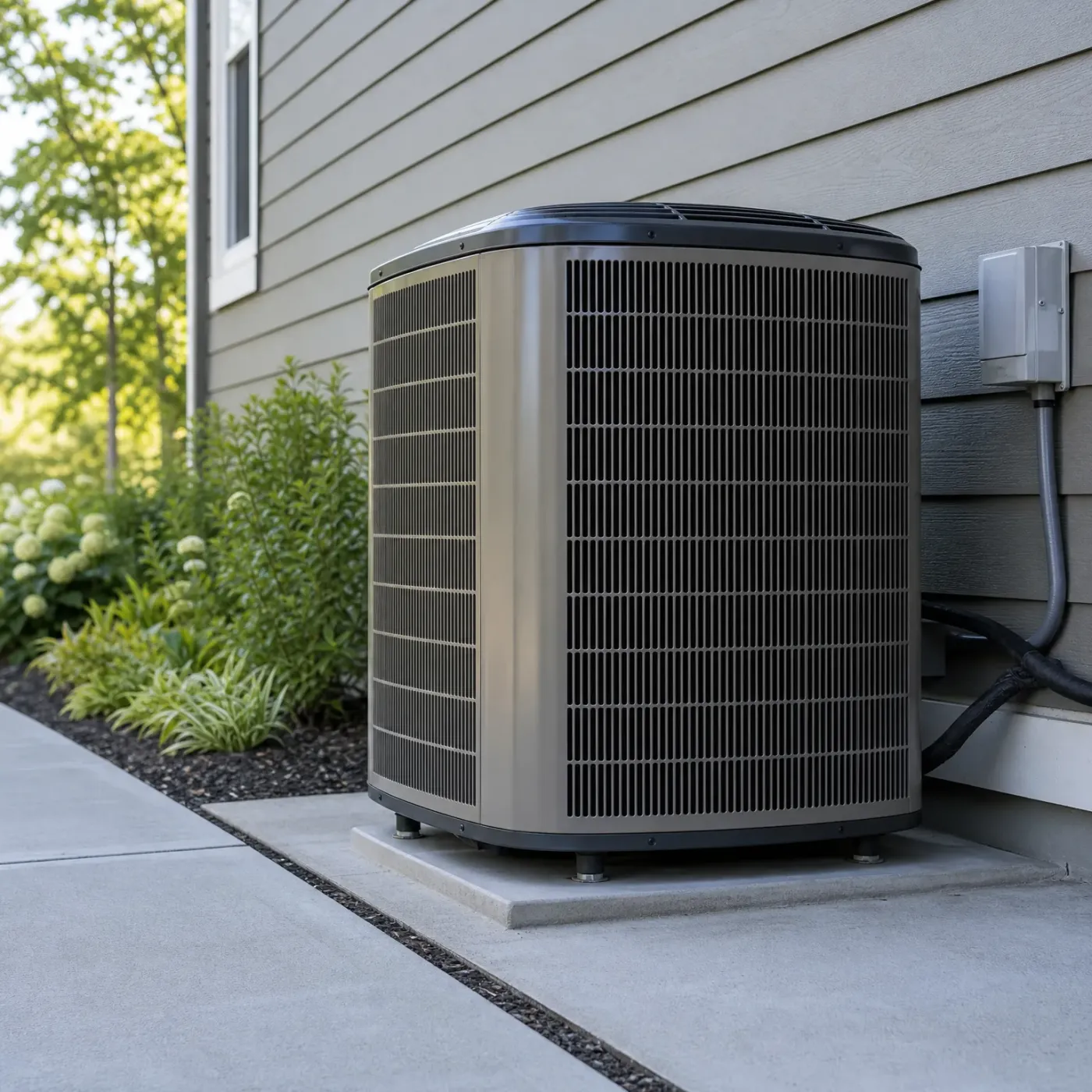
A gray outdoor air conditioner condenser unit on a concrete pad beside a house with horizontal lap siding, with a wall-mounted disconnect box and conduit, mulch bed, shrub, and lawn nearby.

Running long, cooling fine

The condenser outside stays on through the hottest part of the afternoon, and the house still hits the temperature on the thermostat. Refrigerant lines and the disconnect box show nothing unusual. A long run time by itself just means the unit is keeping up with a muggy day.


An outdoor air conditioner condenser unit sits on a gray pad beside a light vinyl-sided wall, on a concrete slab next to a gravel bed.

Running long, falling behind

The unit outside runs the same way, same conduit, same lines up the wall, but the house never quite gets there or the air coming out doesn't feel as cold as it should. That gap between how hard it's working and what it's delivering is worth having a licensed contractor look at.

A woman with shoulder-length dark brown hair in a cream knit cardigan sits in an upholstered armchair beside a window, looking off to the side, with a white bookshelf and potted plant blurred behind her.
A woman with dark hair in a bun sits wrapped in a chunky knit blanket on a couch with a child resting his head on her shoulder, eyes closed, beside a lit lamp and bookshelf indoors.

Power costs 15.96 cents per kilowatt-hour statewide

At 15.96 cents a kilowatt-hour, every extra hour your AC runs this summer shows up on the bill. A unit that's low on refrigerant or straining to push air through a dirty coil draws power the whole time it runs, not just at startup, so a long afternoon cycle costs more than it should.

EIA-861 2025 statewide residential average

What to take from this

  • A long afternoon run time by itself usually just means the system is keeping up with heat and humidity, not failing.
  • A short cycle that still leaves the house warm or clammy points to a real problem worth having checked.
  • A contractor who works on Indiana systems all summer knows which parts tend to give out under long run times.
  • Matching you with one local, licensed contractor means a single point of contact instead of several companies competing for your call.
  • Catching a weak capacitor or a low refrigerant charge now keeps a long run time from turning into a breakdown in August.
  • Once you send the request, finding the right contractor is off your plate.

A long run time on a muggy Indiana afternoon is usually the system doing its job. Pulling moisture out of thick air takes time, and a unit that stays on for hours while the house stays cool and dry is working the way it's supposed to. The problem isn't the hours on the clock. It's whether the house actually gets comfortable and whether the system shuts off once it does.

If yours runs long and never quite gets there, or shuts off and on in short bursts without cooling the place down, that's not the weather. That's a part giving out under the load, and parts under long run times tend to fail in the same handful of ways summer after summer. A contractor who services Indiana systems all season has seen which ones go first and knows where to look before guessing.

Sending the request connects you with one contractor, licensed and local, not a handful of companies calling you back at once. That contractor can look at your specific system, tell you whether the long runs are normal for your house or a sign something's wearing out, and take care of it before a weak part turns into a system that can't keep up at all. From there, finding someone to look at it is no longer something you have to manage yourself.

Kitchen corner with cream upper cabinets, oak lower cabinets, white marble-look countertop, beige tile backsplash, a ceramic vase of greenery, a wooden cutting board and bowl, and a black-framed window at right.
Interior corner of a room with a white-framed window and wide sill, beige walls with panel molding, a wooden cabinet holding a ceramic vase with a green leafy plant, and blurred shrubs and trees outside.
A wood-framed armchair with beige cushions and a woven lumbar pillow sits in a corner beside a large window overlooking green trees, with a tall ceramic vase holding leafy branches on the left and plaster walls and wood flooring.
Interior corner with a white-framed window above a sill, beige walls with baseboard molding, a greige shaker-style cabinet with brass knobs and a potted plant on top, light wood flooring and a woven jute rug.
A dark-framed six-pane window with white trim and sill set in gray horizontal lap siding, with hydrangea shrubs below and a white column and shingled roof section at left.

Stop chasing an air conditioner pro

Only one pro gets your request, so you hear from one company.

Find a licensed pro

No charge to send it. You decide if you hire them.





