Get the air conditioner repair search off your mind today.
By three in the afternoon on a muggy Muncie day, your air conditioner is running the whole time and the house still isn't cooling down past 78. That gap between what the thermostat is set to and what it actually reaches is the clearest sign something is wrong, not just the heat doing what heat does.
A system that can't keep up isn't always on its way out. It might be low on refrigerant, or the coil is dirty, or the blower isn't moving the air it should. Sometimes it's sized wrong for the house and never had the muscle to begin with. Which one it is matters, and it takes someone who works on these systems through a Delaware County summer to tell the difference by sound, by the air coming out of the vents, by what the unit outside is doing.
That's the kind of contractor this connects you with. Local, licensed, and someone who sees this exact problem on this exact kind of week, when the humidity sits heavy and every AC in the county is working harder than it was built to. You get matched with one contractor, not a handful of companies competing for your callback, so your phone isn't the one ringing off the hook with sales pitches.
Send the request and the search is done. You're not the one calling around, checking licenses, or waiting on hold to describe the problem twice. The contractor already knows what kind of day it is outside and what that does to a struggling system. From here, getting your house cool again is someone else's job to figure out, not yours.
When your AC runs nonstop on a 90-degree Muncie afternoon and the house still sits at 78, the system is losing a fight it used to win. Heat moves into the house faster than the unit can pull it back out. That usually means the AC is working at a fraction of its real capacity. A dirty coil, a low refrigerant charge, or a weak capacitor can all cut cooling output without stopping the system outright, so it keeps running, keeps sounding normal, and keeps falling behind. The outdoor unit also has to shed that heat somewhere, and on the hottest days it has the least room to do it, which is why the gap between the thermostat setting and the actual temperature shows up most on days like this one. It is rarely the thermostat and rarely something you can fix by lowering the setting further. It's a sign the unit needs to be looked at before the next heat wave asks more of it than it has left to give.
A system keeping up handles a 90-degree afternoon by cycling off now and then, the house holding steady at the thermostat setting.
A system losing ground runs without stopping and the house still climbs past what the thermostat is set to.
Your AC cools by moving heat out of the house, not by making cold air out of nothing. That takes refrigerant at the right charge, a clean path for air across the indoor coil, and a condenser outside that can actually shed the heat it is carrying. On a 90-degree Muncie afternoon, any weak link in that chain shows up fast. A compressor fighting a low charge or a dirty outdoor coil runs continuously and still falls behind. Weak airflow lets the indoor coil frost over, and ice does not cool anything, it blocks the air entirely. A capacitor past its prime makes the compressor start slow and run longer for the same result. None of this is random. A contractor who works on these systems all summer checks the charge, the coil, the capacitor and the ducts in that order, because that is usually where the problem sits. Once whichever one of these is found, the fix is often quick. Finding it is the part that takes someone who knows where to look.
What's actually going wrong inside
Refrigerant moves heat out of the house, so a system low on charge can run all day and still lose ground once outdoor temps hit the 90s.
A condenser coil caked with cottonwood fluff and cut grass cannot shed heat outside, so the compressor works harder and the house still climbs.
Low airflow across the indoor coil lets it ice over, and a frozen coil blocks the very air it is supposed to be cooling.
An undersized or weak capacitor makes the compressor cycle on sluggishly, so it runs longer each time to do the same job.
Ductwork that leaks pushes cooled air into the attic or crawlspace instead of the rooms it was meant to reach.
A thermostat sensor reading the wrong temperature can keep the system running past the point where the house has already reached setpoint.
Done looking for an air conditioner pro
A licensed pro who repairs air conditioners in Delaware County gets your request.
Once you send the form, finding a pro is off your list.
No charge to send it. You decide if you hire them.
Why does my AC struggle only on the hottest days?
Why does my AC struggle only on the hottest days?
Because the margin it runs on shrinks as the outdoor temperature climbs
A central AC is sized to move a set amount of heat out of the house per hour, and that job gets harder as it gets hotter outside. At 80 degrees, a system with a weak capacitor or a coil that's half-covered in grass clippings can still keep up, because the gap between indoor and outdoor temperature is small. At 95, that same system is asking the compressor to push against a much bigger difference, and whatever margin it had is gone. A properly running system has room to spare on a 95-degree day in Muncie. One that's already compromised only shows it when the temperature pushes it past what it can still cover.
1
Heat from inside the house moves into the refrigerant at the indoor coil
2
Refrigerant carries that heat through the lines out to the condenser
3
The condenser coil and fan dump the heat into the outside air
4
Cooled refrigerant cycles back inside to pick up more heat
Call Now or Wait It Out
Call for repair now
The system runs nonstop and the house still climbs past what the thermostat is set to, which points to a real fault rather than normal strain.
A refrigerant leak or a failing capacitor gets worse under load, so the hottest days are when it shows up and when it does the most damage.
A licensed contractor can check the charge and the coil and find what's actually failing instead of guessing.
Waiting through a string of 90-degree days asks a weakened system to keep working at the point it's already losing ground.
A local contractor who services Delaware County systems all summer has seen this same pattern on this same kind of equipment before.
Wait and watch
If the gap between the thermostat setting and the actual temperature only shows up on the worst afternoons, it may ease once the heat breaks.
A dirty coil or a clogged filter can cause the same symptom and sometimes clears up once it's cleaned, without a repair.
If the house still gets close to the set temperature overnight when it's cooler out, the system may just be outmatched on the extremes, not broken.
Holding off costs nothing if the system is still cycling off at some point and not running every single hour of the day.
A system that's kept up on every day but the hottest few may not be in the kind of trouble that needs attention right away.
The air here doesn't just get hot, it gets heavy. Delaware County averages a 63°F dew point through June, July and August, according to NOAA climate data. That's thick enough to feel on your skin the moment you step outside. Your air conditioner has to pull that moisture out of the air before the house feels cool, not just drop the temperature. On a dry 90-degree day the unit would have an easier time of it. Here it's wearing down the same compressor to do two jobs at once, and that's why the house can still feel damp and warm even while the system runs without stopping.
NASA POWER T2MDEW
Before you get your air conditioner repairAfter you get your air conditioner repair
Running clean
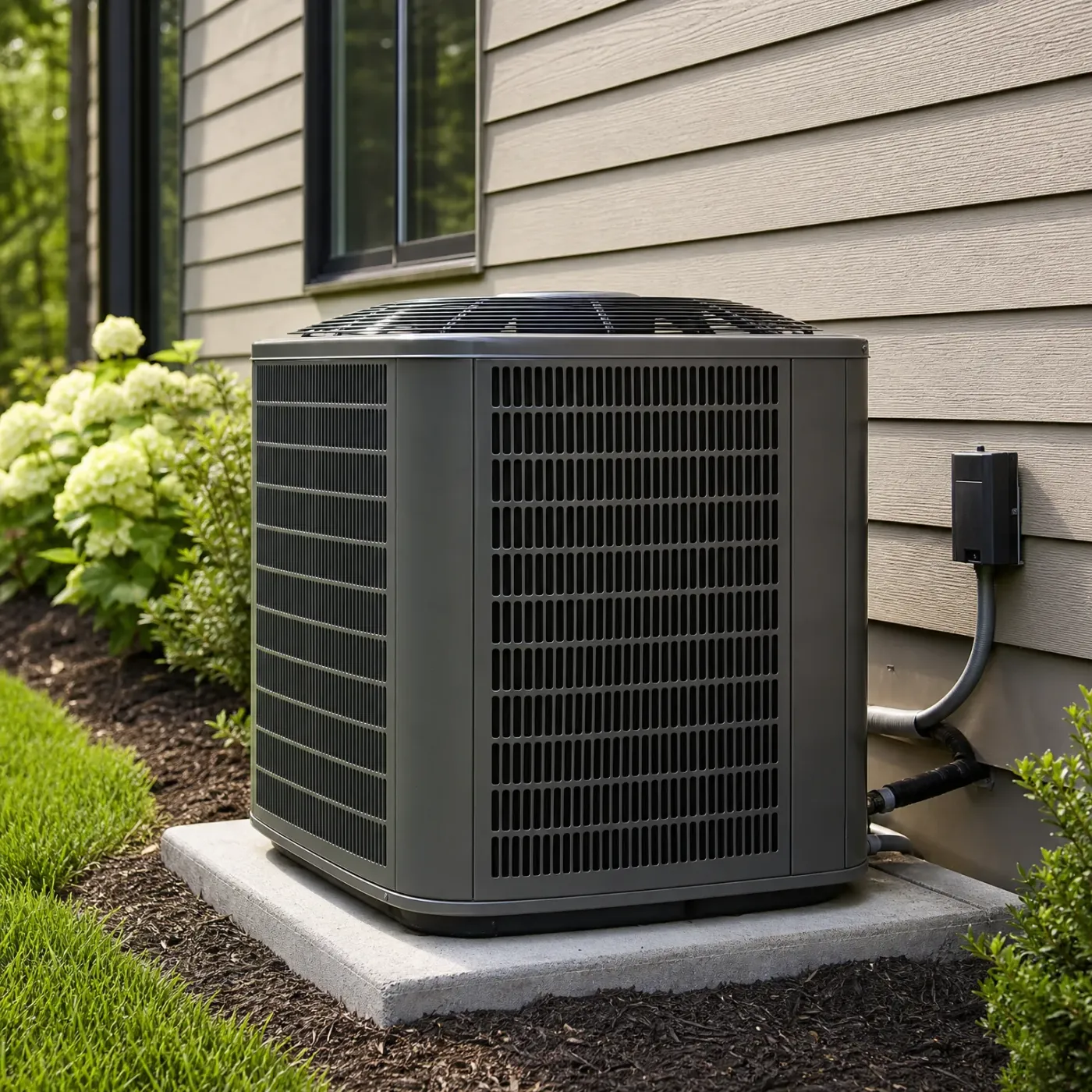
This condenser cycles on, runs, and shuts off again, the way it was built to. Shrubs stay clear of the coil and the pad stays level. Air moves through the fins without having to push past dirt or grass clippings, so the compressor isn't working harder than it has to.
Running into trouble
This condenser never gets the break a working system gets. It stays on through the afternoon and into the evening, straining to move heat out of a house it can't keep up with. Whatever is wrong, a tech who works on these units all summer can usually spot it by what it's doing, before the inside of the cabinet ever comes off.
Cooling runs June through August
Three months is all your AC gets to prove itself, June through August. There's no mild stretch to coast through before the hard days hit. Any weakness in the system shows up fast, right when you need it least.
NOAA nClimDiv 1991-2020
What to Do When Your AC Can't Keep Up
A central air conditioner running nonstop while the house sits above the thermostat setting on a 90-degree day is a real fault, not normal strain.
The most common causes are a refrigerant leak, a dirty condenser coil, or a capacitor that is failing under load.
Delaware County summers give a system only June through August to prove itself, with no mild stretch to mask a weak repair.
A licensed local contractor who works on this equipment every summer knows which of these failures is most likely before they even test the unit.
Waiting rarely helps, since the same conditions that expose the fault also tend to push it further toward a full breakdown.
One contractor means one visit and one diagnosis, instead of sorting through competing opinions while the house stays hot.
An air conditioner that runs all afternoon and still can't hold 78 isn't struggling with the heat the way you might think it is. A healthy system cycles off now and then even on a 90-degree day. One that doesn't is telling you something inside it has already failed, whether that's refrigerant leaking out slowly, a condenser coil too caked with debris to shed heat, or a capacitor that can't keep the compressor running under load. None of these get better in Muncie's summer. June through August is the only stretch your system has to prove it works, and there's no cooler week coming to cover for a weak repair or a part that's halfway gone. Whatever is wrong now will likely be more wrong in July than it is today.
This is a job for someone who sees this exact failure every summer in this exact county, not a general handyman guessing at it. A contractor who works on central air in Delaware County all season has usually already seen the coil caked with cottonwood fluff, the capacitor that tests weak, the charge that's a few pounds low, before the diagnostic even starts. That's the kind of familiarity that gets a house back to 72 instead of just back to running.
You don't have to figure out which of these it is yourself. Once you've sent the request, the job of finding someone qualified is no longer sitting on your shoulders, and you'll hear from one licensed local contractor, not a handful of competing bids while your house sits hot.
Air Conditioner Repair
It's off your list after this
The pro who gets in touch is licensed in Indiana and works in Delaware County.