A white wall-mounted split air conditioner on a blue-grey wall, with a moonlit night sky visible through a nearby window.

Mini Split Installation in Marion, IN

Tell us about the job

Takes about a minute. No obligation.

New system or replacementMini-splitGrant County, IN
Step 1 of 2

What ZIP code is the job in?

Most of Marion heats with gas

Utility gas heats 55.7% of homes in Grant County, with electric furnaces or heat pumps in most of what's left. A mini split here usually goes in alongside an existing gas furnace rather than replacing the only source of heat.

That changes what the installer needs to know

If gas already heats the house, the mini split's job is to cover the rooms the ductwork doesn't reach well, or to take over cooling. Worth telling the installer what's heating the house now, since that decides whether the mini split is the backup or the main system.

8 months
October through May, your system heats
3 months
June through August, it cools
22°F
the average winter night it heats against
83°F
the average summer afternoon it cools against
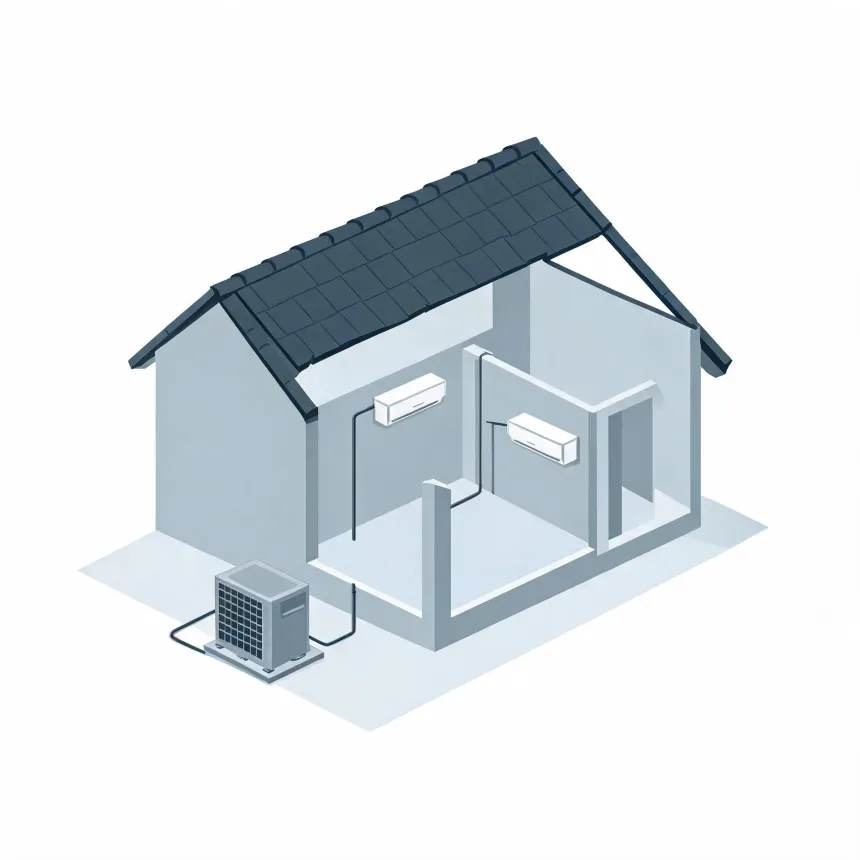
Isometric illustration of a cutaway house with a dark tiled gable roof, showing two wall-mounted indoor split air conditioning units connected by lines to an outdoor condenser unit on the ground outside.
Your system heats October through May and cools June through August.

NOAA nClimDiv, 1991–2020 normals

A mini split's rated output doesn't change because Indiana electricity runs 14.77 cents a kilowatthour.

The sizing for your rooms comes from their square footage and insulation, not the power rate.

Three months of cooling a year, so the mini split doesn't have to work hard to keep up

Cooling runs June through August
Summer afternoons average 83°F
43 damaging wind events from 2015 to 2024
Get it in before JuneCooling starts in June here and runs through August, so May is the month to have it ready.

Half the homes in Grant County were built in 1963 or earlier. A house that age wasn't built with a mini split in mind, and whatever heating or cooling got added over the years went in to fit the walls and rooms as they were. That matters when you're sizing a new system now. An installer measures the room, the windows, and what insulation is actually there rather than going by the square footage alone, because an older wall and a newer wall don't hold heat the same way. Get that wrong and the unit either short cycles or runs constantly without catching up.

Any new system here has to hit zone 5A efficiency minimums

Grant County falls in climate zone 5A, a cool, humid zone where heating is the bigger job. A mini split installed now has to meet 14.3 SEER2 for cooling and 7.5 HSPF2 for heating, the same minimums that apply to any split-system heat pump. That standard narrows the field before you start comparing units. A federal tax credit is available on top of that for systems that qualify.

Find a contractor
A man in a cap, dark shirt and tan work pants, seen from behind carrying a worn canvas tool bag, steps up onto a porch toward an orange front door beside a potted shrub.
A white outdoor air conditioner condenser unit mounted on metal wall brackets against gray horizontal siding, with a blue sky and white clouds behind it.

Have the installer size it to your walls, not your square footage

Ask the installer to walk the rooms before they quote a number, not after. A load calculation on a house built around that time should take into account the actual windows and the actual walls, not a square footage chart built for new construction. Running the unit over years means the sizing has to be right once, at the start. If someone quotes a size over the phone without seeing the house, get a second quote.

Ask what the unit does at the coldest and hottest point

A mini split's output drops as the outdoor temperature drops, and the spec sheet shows that curve, not just one top number. Ask the installer for the capacity at the lowest temperature the system has to handle, not the rated capacity at a mild setting. A unit that looks big enough on paper can fall short on the coldest night if nobody checked that number.

Ask how the outdoor unit and indoor heads are matched

Outdoor units are paired with one or more indoor heads, and the combination has to be sized as a set. An oversized outdoor unit paired with small rooms will short cycle, turning on and off faster than it should and leaving the air damp. Ask for the model numbers of both pieces before you compare quotes, not just the total capacity.

Sizing a mini split is about matching the unit's output to the heat gain or loss of the specific room, not the house as a whole. Too big, and it cools the room fast then shuts off before it pulls the moisture out of the air, leaving the space cold and damp. Too small, and it runs flat out all day without ever reaching the set temperature, which wears on the compressor. A load calculation looks at the room's square footage, but also the windows, the ceiling height, and what's on the other side of each wall. A room with a lot of west-facing glass gains heat differently than one with no windows at all, even if both rooms are the same size. Getting the number right once, before the unit is bought, matters more than any feature on the spec sheet.

Installation day starts with the outdoor unit and where it sits. It needs clearance on all sides for airflow and a spot where the line set can reach each indoor head without too many bends. Inside, the installer mounts a bracket high on the wall, drills a small hole behind it, and runs the line set and drain line through to the outdoor unit. Then comes the part that decides whether the system runs well for years. The installer pulls a vacuum on the line set to clear out moisture and air before the refrigerant is released. Skip that step or rush it, and moisture left behind can damage the compressor down the road. Once the system is charged and running, the installer checks the temperature at each head and watches the condensate drain the way it should before calling the job done.