A row of illuminated two-story brick houses with front porches and mature trees photographed at twilight.

Mini Split Installation in Greenfield, IN

Tell us about the job

Takes about a minute. No obligation.

New system or replacementMini-splitHancock County, IN
Step 1 of 2

What ZIP code is the job in?

Most homes here run on gas

Utility gas heats 60.6% of homes in Hancock County, with electricity a distant second at 30.8%. A mini split going into one of these homes isn't replacing the furnace. It's taking on cooling, and maybe some of the heating, alongside it.

That changes what you're asking it to do

In a gas-heated house, a mini split can be sized for cooling and the milder stretches of the year, with the furnace still carrying the coldest days. That's a different job than a system meant to heat the house on its own.

8 months
October through May, your system heats
3 months
June through August, it cools
23°F
the average winter night it heats against
83°F
the average summer afternoon it cools against
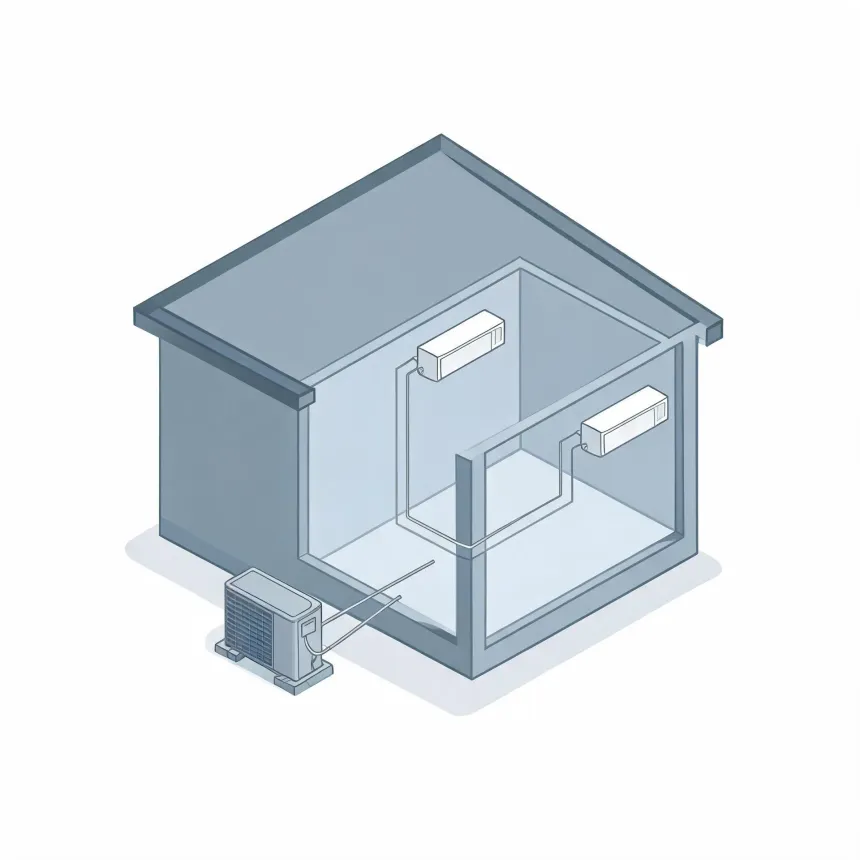
Isometric line illustration of a cutaway building interior with two wall-mounted indoor air conditioning units connected by piping to an outdoor condenser unit on the ground outside.
Your system heats October through May and cools June through August.

NOAA nClimDiv, 1991–2020 normals

Indiana homes paid 14.77 cents per kilowatthour in 2024.

A standard mini split sized for cooling and mild days keeps that electric load in check.

Three months of cooling, nothing extreme, is what this system has to handle

Cooling runs June through August
Summer afternoons average 83°F
53 damaging wind events from 2015 to 2024

Hancock County falls in climate zone 5A, a cool zone where heating carries more of the year's load than cooling. A mini split installed here still has to meet the federal minimum for a split-system heat pump. That means 14.3 SEER2 for cooling and 7.5 HSPF2 for heating. The standard does not set a separate rule for ductless systems, so this is the same floor any heat pump has to clear. It limits what a contractor can offer you, but it also means whatever goes in has already met a real efficiency bar before it reaches your wall.

Get it in before June

Cooling runs June through August here. Put the install in May or earlier and it's already running when the first hot week hits, instead of getting scheduled around one.

Find a contractor
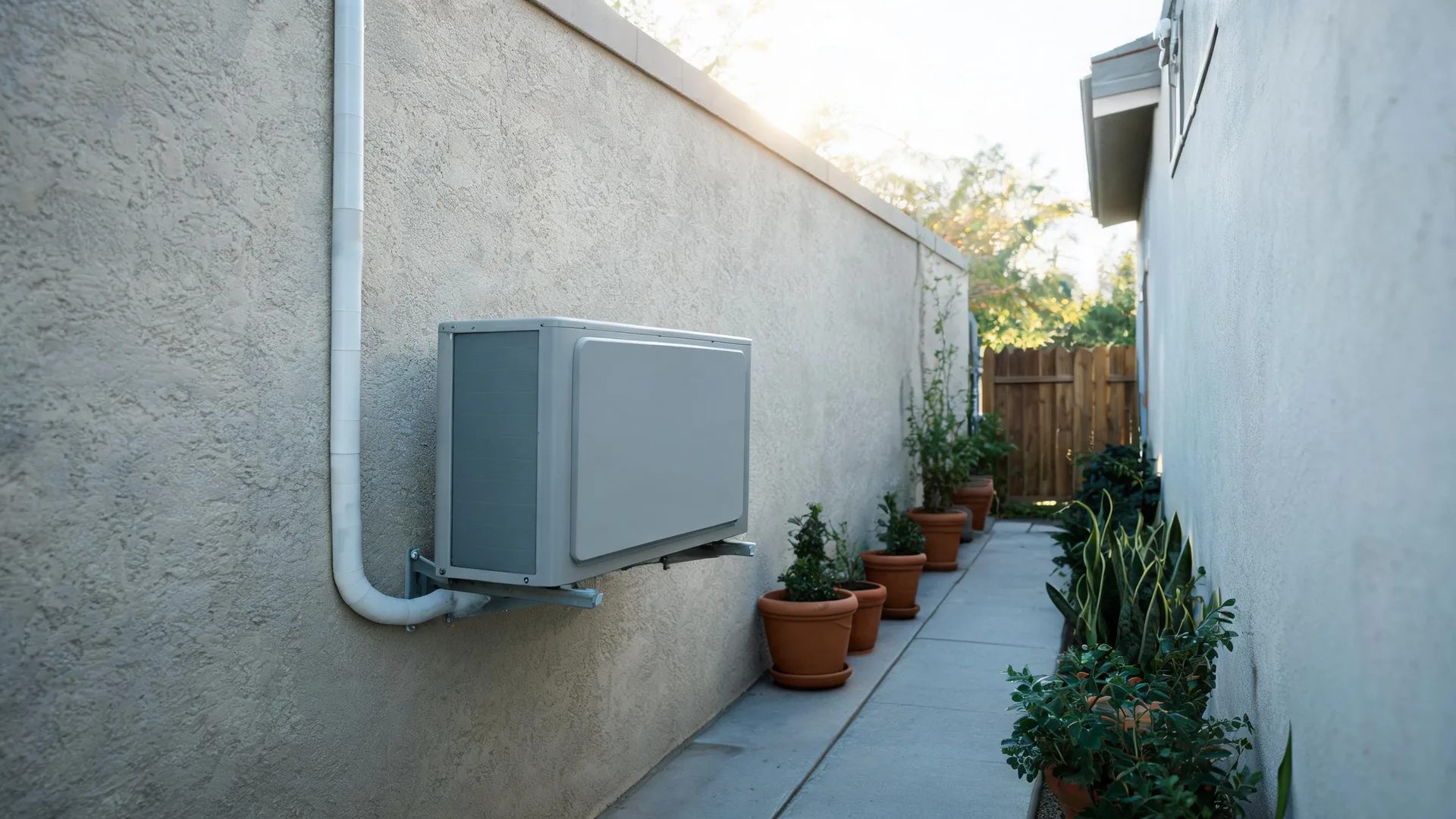
A white mini-split air conditioner outdoor condenser unit mounted on metal brackets against a beige stucco exterior wall, with a blue sky and scattered clouds in the background.

What a mini split asks for is the right fit, not a hard job

A mini split that runs for years without trouble had one thing done right at install. The right size for the space it's cooling. Oversized, it cools the room fast and shuts off before it pulls the moisture out of the air. The room ends up cold and damp instead of just comfortable. It also cycles on and off more, and that stop-start wears a compressor faster than running steady does. Undersized, it runs constantly trying to catch up and never quite gets there. Either mistake shows up as wear years before it should. The other thing worth asking about is the line set. How long it runs and how many bends it takes getting from the outdoor unit to the indoor head. A longer run with more turns makes the compressor work harder to move refrigerant through the system, on top of whatever the room itself is asking of it.

Most of it stays

Adding a mini split doesn't mean anything gets torn out. The furnace and ductwork stay exactly as they are, still doing the heavy lifting on the coldest days. The mini split is new equipment added alongside what's already there, not a replacement for it.

Only if something's being replaced

If an old window unit or an existing ductless system is coming out, a contractor handles removing it as part of the job and disposes of the refrigerant properly rather than venting it. If there's nothing being swapped out, there's nothing to haul away.

What drives the cost on a mini split job is mostly what has to happen before the unit goes on the wall. Running the line set between the outdoor condenser and the indoor head takes time, and the farther apart they sit, the more refrigerant line, wiring and conduit a contractor has to run. A wall sleeve has to be cut and sealed for the lines to pass through, and that work changes with wall thickness and what's behind it. Multiple indoor heads off one outdoor unit cost more than a single zone, since each head needs its own line set and its own mounting work. Where the outdoor unit can sit matters too. A spot with easy access costs less to finish than one that needs a stand, extra bracket work, or a longer path for the lines to travel.

Installation starts outside, not at the wall. The outdoor condenser gets set on a pad or mounted on brackets, leveled, and given clear space around it for airflow. From there the line set runs to where the indoor head will hang, usually through a hole cut straight through the exterior wall. That hole gets sealed tight once the lines are in, so nothing lets water or air track through later. The indoor head mounts on a bracket against the wall, and the refrigerant lines, a drain line, and electrical wiring all feed into it through that same opening. Once everything's connected, the lines get purged and pressure tested before refrigerant is released into the system, and the whole thing gets run through its paces, heating and cooling, before anyone calls it done.