A dark, minimalist bedroom featuring a sleeping cat on a grey-quilted bed, a wall-mounted air-conditioning unit, warm cove ceiling lighting, and a pendant lamp illuminating the bedside table.

Mini Split Installation in Fort Wayne, IN

Tell us about the job

Takes about a minute. No obligation.

New system or replacementMini-splitAllen County, IN
Step 1 of 2

What ZIP code is the job in?

Allen County sees real storm numbers

Allen County logged 241 severe weather events between 2015 and 2024, including 166 damaging wind events, 56 hail events and 5 tornadoes. Statewide, 17% of Indiana households lost power for 24 hours or more in 2024.

An outdoor unit sits in that weather

A mini split's outdoor unit lives outside, through wind, hail and whatever a storm brings. An outage takes down the compressor along with everything else in the house, and that means no heat, no cooling and no hot water if your water heater is electric.

8 months
October through May, your system heats
3 months
June through August, it cools
21°F
the average winter night it heats against
82°F
the average summer afternoon it cools against
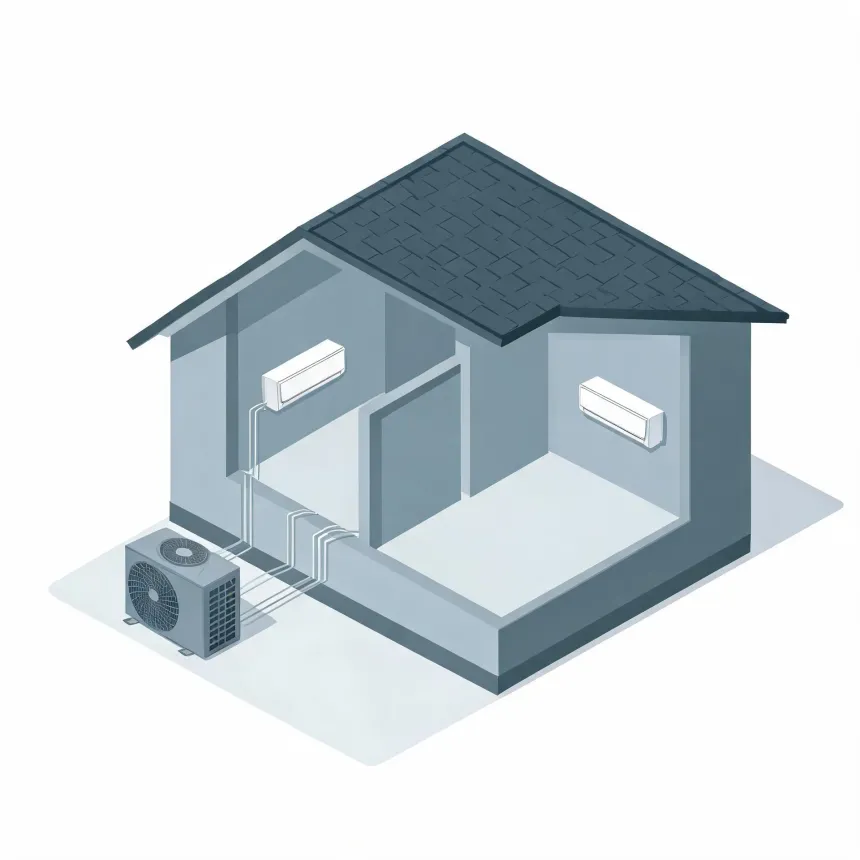
Isometric cutaway illustration of a small house showing two wall-mounted indoor air conditioning units connected by refrigerant lines to an outdoor condenser unit on the ground outside.
Your system heats October through May and cools June through August.

NOAA nClimDiv, 1991–2020 normals

Cooling runs June through August here.

May is the month to get a mini split installed, before the first hot stretch and before installers get booked solid.

Most of Allen County heats with gas, so a mini split takes on the cooling load, not the whole house

69.5% of homes heat with gas
Cooling runs June through August
Summer afternoons average 82°F

Allen County falls in climate zone 5A, a cool, fairly humid zone where the federal code treats heating as the bigger job for a home's system. A mini-split heat pump counts as a split system under the federal standard. Any unit built from January 2023 onward has to pull at least 14.3 Btu of heat out per watt-hour of electricity it uses in summer, and deliver at least 7.5 Btu of heat per watt-hour in winter. Those are floors, not targets, so a system installed here already clears them before a contractor even talks brands. A qualifying system may also open the door to the federal tax credit for heat pumps, worth checking into when you're comparing models.

Plan for the weather before the unit goes in

Where the installer sets the outdoor unit, and what's around it, is worth deciding before the work starts rather than after a storm. The same goes for backup: if the power drops, a gas furnace with a standing pilot keeps making heat, but a mini split and an electric water heater both stop until it's back on. Raise both with the contractor while you're planning the install.

Find a contractor
A man in a dark t-shirt and tan work pants walks up concrete steps toward a red front door, carrying a worn canvas tool bag, with a potted shrub beside the entry.
A beige split-system air conditioner outdoor condenser unit mounted on metal wall brackets atop a stucco wall.

Sizing isn't a guess, and getting it wrong wears the compressor

Sizing a mini split is not about matching the room's square footage to a chart. A contractor works out how fast the space loses heat in winter and gains it in summer, looking at the windows, the insulation, the walls that face outside and the ones that don't. That calculation decides which unit goes in. Too big and the compressor short cycles, kicking on, satisfying the thermostat fast, and shutting off again before it ever runs long enough to pull moisture out of the air. A room cools quickly but feels damp and clammy. Too small and the compressor runs flat out and still can't keep up on the hottest or coldest days, so it wears faster trying. Either mistake shortens the life of the compressor, since that part is built to run at a steady pace, not to constantly start and stop or strain nonstop. Getting the size right the first time is also what makes the heat pump's rated efficiency mean anything in practice. A unit can carry the industry's best efficiency number on paper and still run poorly if it's the wrong size for the space it's cooling and heating.

The old system doesn't just vanish from the wall

A wall-mounted or ducted system coming out means the indoor head, the line set running to the outdoor unit, and the electrical disconnect all have to come out too. If the old equipment used refrigerant, a contractor has to recover it rather than release it, since venting refrigerant into the air is against the law. Whatever mounting bracket or pad held the old outdoor unit may or may not work for the new one, depending on its size and weight.

What's left behind shapes the new install

An old line set can sometimes be reused if it's the right diameter and free of corrosion, but most installers replace it rather than risk a leak behind a wall. The same goes for the electrical circuit: a new mini-split may draw different power than what the old system used, so the breaker and wiring get checked against the new unit's specs, not assumed to carry over. Any wall penetration from the old line set gets inspected and resealed so it doesn't become a path for air or water once the new unit is in.

The efficiency number on the label is a ratio, not a guarantee. It tells you how much heat a unit moves per unit of electricity it draws, under set test conditions, nothing about how it will run in your house. Two units with the same rating can perform differently once one is sized right for the space and the other isn't, or once one gets installed with a properly charged line set and the other doesn't. The rating also assumes the system runs the way it's supposed to: steady cycles, clean coils, correct refrigerant charge. Let the coil get dirty or the charge drift low and the unit pulls more electricity to do the same job, no matter what the label says. So the number is worth comparing between models, but it only holds up after the install is done right and the system gets looked after.

Install day starts outside, with the contractor mounting a bracket on the exterior wall and running a line set through a small hole drilled to the indoor unit's location. That line set carries refrigerant lines, a drain line and electrical wiring together, usually wrapped in one jacket, so the hole only needs to be big enough for that bundle. Once the indoor head is mounted and the line set is connected on both ends, the contractor pulls a vacuum on the lines before any refrigerant moves. That step matters because any moisture or air left in the lines will mix with the refrigerant and cause the compressor to work harder, or fail early. After the vacuum holds, the system gets charged, powered up, and run through both heating and cooling to check that it switches modes correctly and the thermostat reads true. The outdoor unit gets set last, on a pad or bracket level enough that water drains away from it instead of pooling underneath.