Electricity here runs 19.78 cents a kilowatt-hour
That is higher than what most US counties pay. A mini-split runs on electricity alone, so every hour it works shows up on that rate.
Takes about a minute. No obligation.
That is higher than what most US counties pay. A mini-split runs on electricity alone, so every hour it works shows up on that rate.
Since power here costs more than most places, a unit that uses less electricity to move the same heat or cooling will cost less to run here than a less efficient one would. That difference matters more in a county with rates like this than in one with cheaper power.
NOAA nClimDiv, 1991–2020 normals
Half the homes in Vanderburgh County were built in 1970 or earlier.
A mini-split going into one of those homes has to match the house, not a catalog spec.



Most houses in Vanderburgh County heat with gas, 60 percent of them. A mini-split doesn't fit that pattern the way a furnace does. It runs on electricity, so it isn't replacing the gas furnace, it's working alongside it or taking over the rooms the furnace struggles to reach. Plenty of homes here already split the load that way, gas for the main heat and a mini-split for a room addition, a converted garage, or the part of the house the ductwork never served well. Knowing which job you need it to do is what decides the unit and the install, not just the square footage.
Power here costs more than most places pay. That cost doesn't go away once the unit is in, it shows up on every bill after. Get the efficiency rating right at install, since that's the number you're stuck with once it's running.
Find a contractor
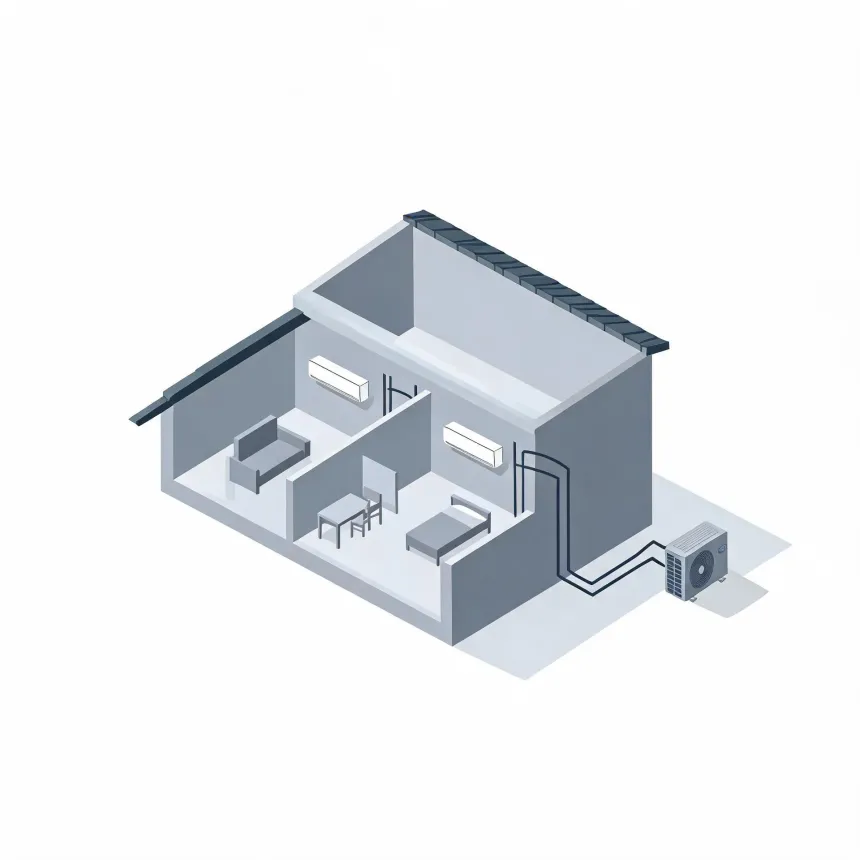
An installer sizing this for your house needs to know what's actually there, the wall construction, the windows, how the rooms are laid out. That means a load calculation, not a guess based on square footage off a listing. The unit also has to go in a spot that works with your walls and your existing electrical, not wherever a spec sheet assumes it will. Get that part right once and it runs the way it's supposed to for as long as you own it.
A mini-split that's too big for the room cycles on and off fast, cooling the air without pulling the moisture out of it, so the room feels clammy even at the right temperature. One that's too small runs flat out and never quite catches up on the hottest or coldest days. The number you want is a load calculation tied to that specific room, not a rule of thumb based on floor space.
Every mini-split has a point where the outdoor air gets too cold for the heat pump to keep up, and below that point heat output drops off. Some units hold their output much further down than others. If the plan is to lean on this for heat through the worst of winter, ask where that drop-off happens and what backup heat is supposed to cover it.
The efficiency rating on a mini-split tells you how much heat it moves for the electricity it uses. A higher rated unit pulls more heat out of the air per unit of power than a lower rated one, in both directions, cooling and heating. That rating is measured at set conditions in a lab, so it's a way to compare units against each other, not a promise of what you'll see on your own equipment. Two units can carry the same rating and still behave differently once installed, because duct losses don't apply here but placement, sizing, and the refrigerant line length all still affect how close the real unit gets to its rated number. The rating also tends to drop as outdoor temperatures move further from those test conditions, more so in heating than cooling. None of that makes the number meaningless. It's still the best single figure for comparing one unit against another before you buy.
Vanderburgh County falls under zone 4A, a climate code that expects real cooling load and real heating load out of the same system. Any split-system heat pump manufactured from 2023 onward has to clear federal minimums here, at least 14.3 Btu of cooling delivered per watt-hour over the summer and at least 7.5 Btu of heating per watt-hour over the winter. A mini-split counts as a split system under that standard, so it doesn't get a separate bar to clear. Those numbers aren't a ceiling, plenty of units sold today rate higher, but anything on the table has to meet them before it's legal to install. On top of that, a federal tax credit is available for qualifying heat pumps, worth checking against whatever unit you're considering before you settle on one.