A quiet residential street at dusk lined with illuminated two-story brick houses and mature trees.

Mini Split Installation in Columbus, IN

Tell us about the job

Takes about a minute. No obligation.

New system or replacementMini-splitBartholomew County, IN
Step 1 of 2

What ZIP code is the job in?

Gas heat is the default here

Just over half of homes in Bartholomew County heat with utility gas, and another chunk use propane. A mini split in a home like that usually isn't replacing the furnace. It's covering a room or two the ductwork doesn't reach well, or adding cooling where there isn't any.

Electric homes are a different job

Close to 4 in 10 homes here heat with electricity. In one of those, a mini split can end up doing more of the work, sometimes handling a whole zone's heating and cooling instead of just filling a gap. Worth knowing which case yours is before you size the unit.

7 months
October through April, your system heats
4 months
June through September, it cools
24°F
the average winter night it heats against
84°F
the average summer afternoon it cools against
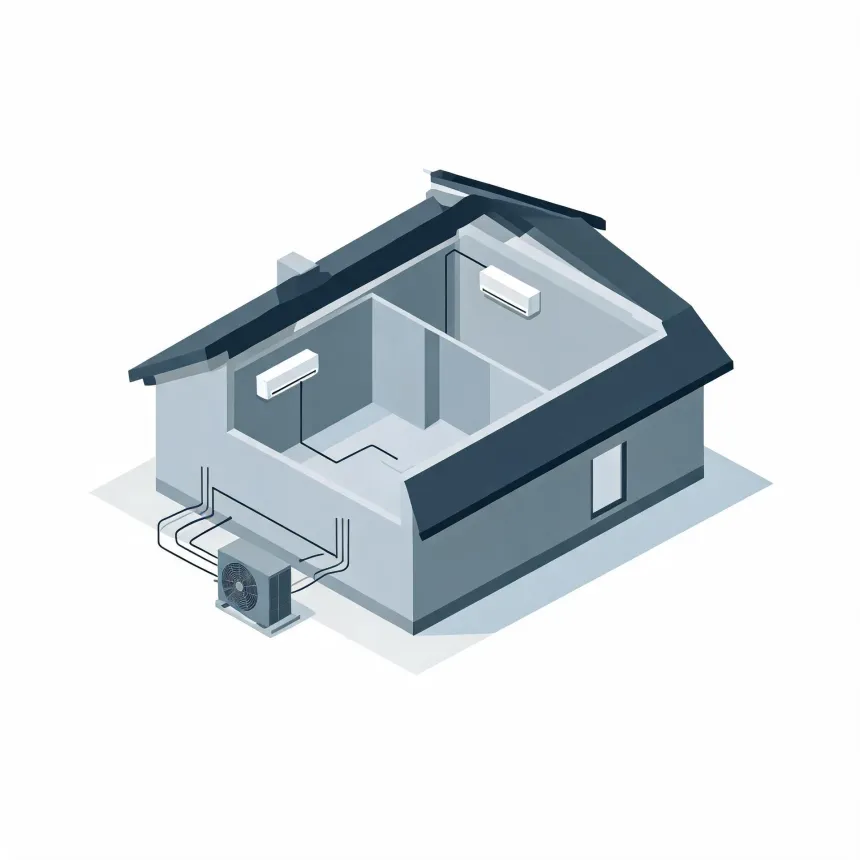
Isometric illustration of a cutaway house showing two wall-mounted indoor air conditioning units connected by line sets to an outdoor condenser unit on the ground outside.
Your system heats October through April and cools June through September.

NOAA nClimDiv, 1991–2020 normals

Cooling runs June through September here.

May is the month to get a mini split installed, before the first hot stretch hits.

Four months of cooling, 84 degree afternoons. A standard size and efficiency covers it.

Cooling runs June through September
Summer afternoons average 84°F
Power costs 14.77 cents a kWh statewide
A standard mini split covers thisIndiana homes paid 14.77 cents per kilowatthour in 2024, nothing here pushes you toward a bigger or pricier unit.

Columbus sits in climate zone 4A, which asks real work of both sides of a mini split, the heating and the cooling. Any ductless heat pump installed here has to meet the same federal minimum as other split-system heat pumps, 14.3 SEER2 for cooling and 7.5 HSPF2 for heating. There's no separate, looser rule for ductless systems. A unit that clears those numbers qualifies for the federal tax credit on top of whatever it's already saving on the electric bill. Worth checking the spec sheet against both numbers before you settle on a model.

Replace it before the season

Replace it before the season starts, so it happens on your schedule, not in a hurry.

Find a contractor
A man in a cap, long-sleeved shirt and work pants carries a canvas tool bag up concrete steps toward a wooden front door of a gray-sided house, with a shrub in a terracotta pot to the right.
A beige split-system air conditioner outdoor condenser unit mounted on metal wall brackets atop a stucco wall.

A system that runs year round wears differently than one that only runs part of it

A mini split that covers both heating and cooling runs on a different schedule than a furnace or a window unit ever did. It's not firing up for one season and going quiet the rest of the year. If it's doing both jobs, the compressor and fan motor are cycling on and off year round. More run hours means the parts that wear, the compressor bearings, the fan bearings, the reversing valve, get there sooner. It also means a dirty filter or a blocked outdoor coil costs you more, because the system has fewer idle months to hide behind. The indoor filter needs checking on its own schedule, not whenever you happen to think of it, since the unit is rarely fully off. Ask how the model you're looking at is rated to handle that kind of near constant cycling, not just how it performs at peak load, since that's closer to how it will actually run.

Sizing comes from a room by room count

The right size for a mini split comes from a heat loss and heat gain calculation, not a guess based on square footage. The contractor looks at wall area, window size and direction, ceiling height, and what's on the other side of each wall before settling on a unit. Rooms that look alike on paper can need different sized units depending on how much glass they have and which way they face.

Oversized cools the air without drying it

A unit sized too big for the space cools the room fast, then shuts off before it's pulled much moisture out of the air. That leaves the room cold and clammy instead of comfortable. A unit sized correctly runs longer, lower cycles, which is what actually brings the humidity down. Bigger isn't the safe choice here. It's the wrong one.

If the mini split is filling a gap, whatever heated or cooled that room before usually stays in service and keeps doing the rest of the house. A window unit pulled out of a room the mini split now covers just gets retired, there's no system tied to it. Where a mini split is taking over a whole zone from electric baseboard or a wall furnace, that old equipment can often be disconnected and left in place or removed, since it's not shared with any other room. It's a different story if the gap being filled was being covered by the main system straining to reach it. In that case the furnace or central air stays in service for the rest of the house, it just stops being asked to do a job it was never suited for. Either way, nothing about adding or replacing with a mini split requires tearing out ductwork or touching a system that's serving other rooms well.

Installation day starts with the lineset, not the indoor unit. The outdoor condenser gets its spot on a pad or wall bracket, and the installer runs the refrigerant lines, power, and condensate drain through a small hole in the wall to connect it to the indoor head. That line gets brazed, pressure tested, then pulled into a vacuum to clear out any moisture and air before the refrigerant ever flows. Skipping that step is what leads to a system that loses capacity or trips a fault code months later. Once everything holds vacuum, the lines get charged, the indoor unit gets mounted and leveled, and the whole system gets run through its paces, heating and cooling both, before anyone calls the job done. Most of the day is that pressure test and vacuum, not the mounting.