







Three lit brick homes on a tree-lined residential street photographed at dusk.

AC Repair in Muncie, IN

Tell us about the job

Takes about a minute. No obligation.

RepairCentral ACDelaware County, IN
Step 1 of 2

What ZIP code is the job in?

Summer here runs June through August, about three months, with afternoon highs averaging 83°F. That is not the kind of heat that runs a compressor into the ground. Delaware County sits in a cool climate zone where heating carries the bigger load all year, so your AC gets a shorter season and an easier one than units further south ever see. A system that breaks down here is more often showing its age or a part that failed on its own, not a machine that got run past what it can handle. That's good news if yours is acting up, because it usually means a repair will put it right.

3 months
June through August, your air conditioner is on duty
83°F
the average summer afternoon it cools against
16 hail events
in ten years, and hail bends the fins on outdoor coils
54 wind events
in ten years, and wind drives debris into outdoor units
Isometric cutaway illustration of a single-story house showing interior ductwork and an air handler connected by lines to an outdoor condenser unit on a pad beside the building.
Your air conditioner works hardest from June through August.

NOAA nClimDiv, 1991–2020 normals

Cooling in Delaware County starts in June.

Get your AC checked in May, before the first hot week finds the part that was already weak.

Half the homes in Delaware County were built in 1967 or earlier, and your AC is not as old as the house

Half the homes here were built by 1967
Cooling runs June through August
Summer afternoons average 83°F
A struggling AC still runs on Indiana electricity ratesIndiana homes paid 14.77 cents per kilowatt-hour in 2024, and a failing part makes your AC work harder for the same cool air.

A breakdown here usually points to one weak part, not a system worn out from overwork. A failed capacitor. A contactor with pitted contacts. A slow leak that finally dropped the charge too low. None of that happens because the unit got pushed past what it's built for. Delaware County has also seen its share of damaging wind and hail over the past decade, enough to bend a condenser fan blade or dent a coil on a unit that was otherwise fine. A technician who traces down the actual cause has a real shot at fixing it for good, not just buying a little time.

Know what you're repairing before you pay for it

The house may be from 1967 or earlier, but nothing says your AC is that old. Have a technician check its age and condition before you commit to another repair. If it's near the end, you'll want to know that going in.

Find a contractor
A man in a dark gray t-shirt and brown work pants, seen from behind, carries a worn leather tool bag up wooden porch steps toward an orange front door.
An outdoor air conditioning condenser unit mounted on a concrete pad surrounded by gravel, photographed against a partly cloudy blue sky.

What to check before the service call

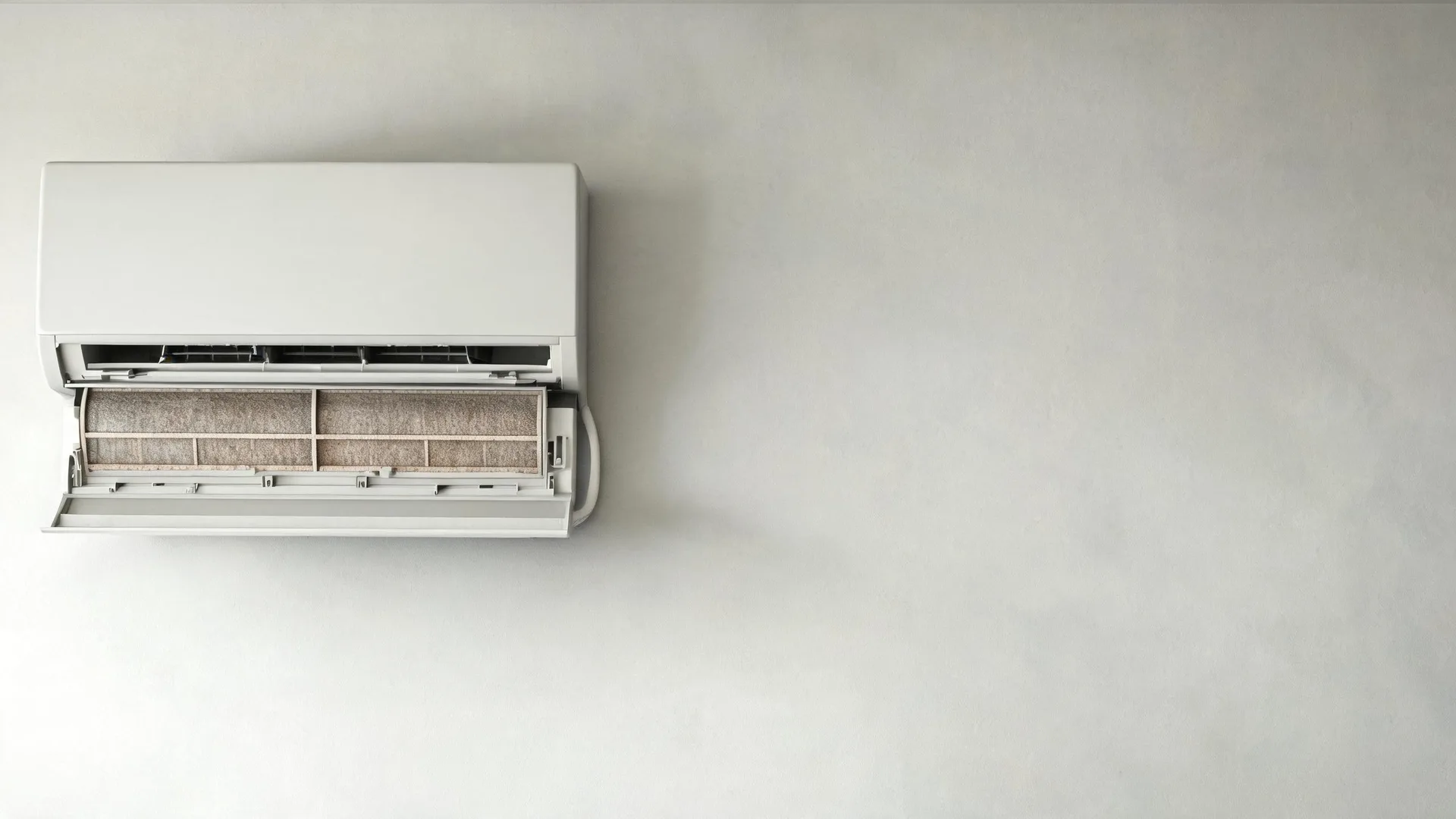
Before anyone comes out, there are a few things worth checking yourself. Look at the thermostat first. Make sure it is set to cool and set lower than the room temperature, and check the batteries if it has a screen that looks dim. Next, go find the outdoor unit. If the fan isn't spinning at all, check the breaker panel for a tripped breaker before assuming the worst. While you're outside, look at the coil, the metal fins wrapped around the unit. If they're packed with grass clippings, cottonwood or dirt, the system can't shed heat the way it needs to, and clearing debris away from the coil is safe to do yourself. Inside, pull the air filter and hold it up to a light. If you can't see light through it, swap it. A clogged filter starves the system of airflow and can cause ice to form on the indoor coil, and if you see ice on the lines or the indoor unit, turn the system off and let it thaw completely before anyone tries to diagnose anything further. None of this tells you what part failed, but it rules out the simple causes before you pay someone to find them.

What actually wears out

The capacitor and the contactor take the hit cycle after cycle. Every start and stop runs current through them. Capacitors dry out and lose their charge over time. Contactor points pit and burn until they stick or stop making contact at all. Fan motor bearings wear the same slow way. None of these fail because of one bad day. They fail because they have opened and closed thousands of times.

What that means for a repair

A part that fails from normal wear is a straightforward fix. Swap the capacitor, clean or replace the contactor, and the unit runs like it did before. Refrigerant is a harder call. A system does not use up refrigerant on its own, so a low charge always means a leak somewhere in the coil or line set. Topping it off without finding the leak just means the same call again before long.

An outdoor air conditioning condenser unit installed beside the exterior wall of a blue vinyl-sided house at sunset.

A new air conditioner would save little on running costs in Delaware County, so the repair decision comes down to the unit's condition.

  • A new one at the federal minimum, 13.4 SEER2$230 a year
  • An older air conditioner$240 a year

Estimates for a typical Delaware County home, compared with an older unit built to the previous federal minimum, from EIA household energy data, Indiana fuel prices and NOAA climate normals. Your home will differ.

Repair makes sense when a part like a capacitor or contactor has failed.

Replacement makes sense when the compressor has failed or the system uses R-22 refrigerant, which is no longer made.

A diagnostic visit starts before any panel comes off. A technician asks what the unit is doing, when it started, and whether anything changed right before it did. Then the gauges and meters come out. Refrigerant pressure gets checked at the service ports. The capacitor gets tested under load, not just looked at. Contactor points get checked for pitting. Amp draw on the compressor and fan motor gets measured against what that motor is rated for. Each reading rules something in or out, and together they point to one failed part rather than a guess at several. That is what separates a repair that holds from one where the same problem comes back in a month.