





A row of dark gray gabled houses behind a trimmed hedge and mowed lawn, framed by large leafy trees under an overcast sky.

AC Repair in Indianapolis, IN

Tell us about the job

Takes about a minute. No obligation.

RepairCentral ACMarion County, IN
Step 1 of 2

What ZIP code is the job in?

Marion County saw 227 severe weather events between 2015 and 2024. That includes 140 cases of damaging wind, 67 hail events, and 4 tornadoes. An outdoor AC unit sits outside through all of it, with nowhere to hide from hail or flying debris. A bent fin or a cracked fan blade does not always stop the unit from running, so it can keep going for weeks after a storm while losing efficiency or wearing down a part that was already struck. If a storm has come through your yard, that is reason enough to have the unit looked at, whether or not it still turns on.

4 months
June through September, your air conditioner is on duty
83°F
the average summer afternoon it cools against
67 hail events
in ten years, and hail bends the fins on outdoor coils
140 wind events
in ten years, and wind drives debris into outdoor units
Isometric line illustration of a cutaway house showing interior rooms with furniture, ceiling ductwork, an indoor air handler, and an outdoor condenser unit connected by lines.
Your air conditioner works hardest from June through August.

NOAA nClimDiv, 1991–2020 normals

Cooling runs June through September here, starting with a jump from May.

That first hot stretch finds whatever in your AC was already weak.

Half these homes were built in 1973 or earlier, and the AC in them is not that old

Half the homes here were built by 1973
Cooling runs June through September
Summer afternoons average 83°F

Before you call anyone, check the thermostat is set to cool and the temperature is actually below room temperature. Go to the breaker box and look for a tripped breaker on the AC circuit. Check the outdoor unit for anything blocking it, leaves, grass clippings, a fallen branch, and clear them away. Look at the filter. If it is gray and clogged, replace it, since a blocked filter starves the system of airflow and can ice up the coil. If you see ice on the refrigerant lines or the indoor coil, turn the system off and let it thaw completely before anyone touches it further. Check that the outdoor unit is actually running, the fan turning and the unit humming, not silent or buzzing without movement. None of this fixes a failed capacitor or a refrigerant leak, but it rules out the simple causes first.

If a storm came through, get the unit checked before you assume it's fine

If your yard took wind or hail this year, that unit sat outside for all of it. A bent fin or a hit fan blade will not always stop it from running, so it is worth having someone check the unit even if the air coming out is still cold.

Find a contractor
An outdoor air conditioning condenser unit mounted on a concrete pad surrounded by gravel, photographed against a partly cloudy blue sky.

What a summer of running does to the parts inside

A compressor does not fail out of nowhere. It fails because something made it work harder than it was built to, for longer than it should have. Low refrigerant from a slow leak makes it run hotter on every cycle. A dirty outdoor coil, caked with grass and dust, keeps heat from leaving the system, so the compressor fights to do a job the coil should be helping with. A capacitor that's gone weak makes the motor strain every time it starts, and that strain adds up across a season. None of this happens on one hot day. It happens over the length of a summer, cycle after cycle, until the part that was already struggling gives out.

Warm air, weak air, or a smell when it starts

Air that comes out warm or barely moving usually points to the compressor, a refrigerant leak, or a blower motor that's quit pulling its weight. A musty smell means water sitting somewhere it shouldn't, often a clogged condensate drain. A burning smell means get it off and call someone, don't run it again until it's looked at.

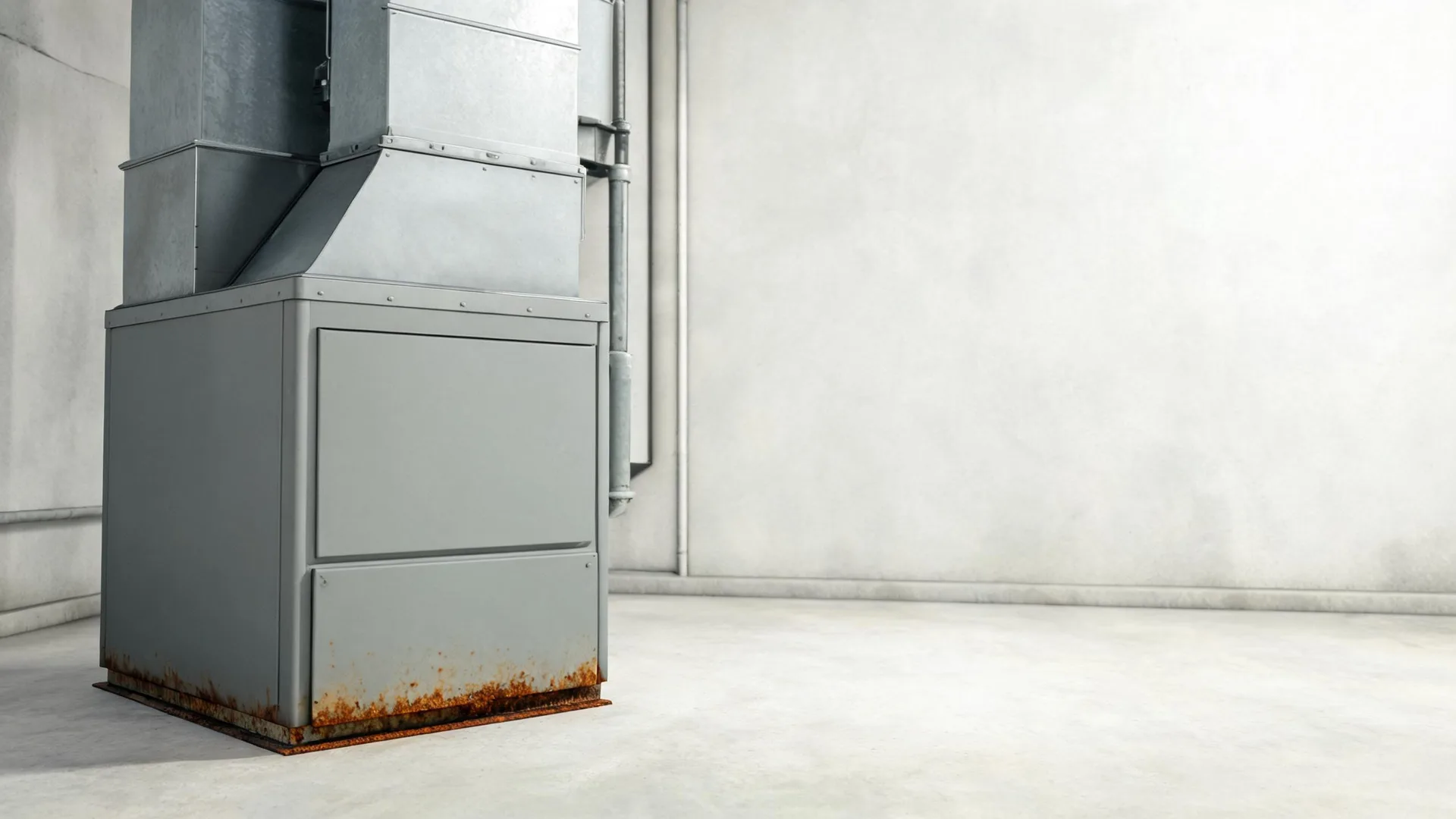
A sound that wasn't there before

A grinding or screeching sound usually means a motor bearing wearing out. A clicking that repeats without the unit starting often means a failed capacitor or a relay stuck partway. A hissing or bubbling sound near the lines can mean refrigerant escaping. None of these get quieter on their own, and most get louder and more expensive the longer the unit keeps running on a failing part.

Overhead view of a gray residential air conditioning condenser unit mounted on a concrete pad beside a house with asphalt shingle roofing.

A new air conditioner would save little on running costs in Marion County, so the repair decision comes down to the unit's condition.

  • A new one at the federal minimum, 13.4 SEER2$250 a year
  • An older air conditioner$270 a year

Estimates for a typical Marion County home, compared with an older unit built to the previous federal minimum, from EIA household energy data, Indiana fuel prices and NOAA climate normals. Your home will differ.

Repair makes sense when a part like a capacitor or contactor has failed.

Replacement makes sense when the compressor has failed or the system uses R-22 refrigerant, which is no longer made.

A diagnostic visit starts before any panel comes off. A tech asks what the system is doing, when it started, and what changes, since that narrows things down faster than guessing. Then comes the gauges, checking refrigerant pressure against what the system should be running. Electrical readings come next: voltage to the compressor, amp draw on the motors, a check on the capacitor to see if it's holding its rating or has drifted weak. The condenser coil and evaporator coil both get a look, since a coil caked with dirt changes every reading downstream of it. Airflow gets checked too, because a system can be perfectly charged and still cool badly if air isn't moving through it. Only once all that's in hand does a tech say what's actually wrong, rather than guessing from one symptom.