June is the first full month of work
Your air conditioner in Warsaw sits idle, then starts running daily in June. There's no easing into it. Whatever is wrong with it going in, it runs with that problem for the next three months.
Takes about a minute. No obligation.
Your air conditioner in Warsaw sits idle, then starts running daily in June. There's no easing into it. Whatever is wrong with it going in, it runs with that problem for the next three months.
A contractor can check your system while it's still off duty. Weak parts show up before they fail, and anything found in May gets fixed before the house needs cooling at all.
NOAA nClimDiv, 1991–2020 normals
Three months of real heat a year, June through August, is not a hard season for a central air conditioner.
One check before June covers what this county asks of the machine.




Half the homes in Kosciusko County were built in 1979 or later. If yours is one of them, or your system was swapped out more recently than the house itself, it probably has plenty of working life left in it. A unit that age isn't failing from wear. It's failing, when it fails, from something small that got missed. A yearly check is what keeps a newer system newer longer, catching the one weak part before it takes out the rest.
If your house or your unit is on the newer side, a check this spring is what keeps it that way. Catching the one small part now is cheaper than replacing the system it would have taken down.
Find a contractor
The refrigerant charge is the one thing you can't eyeball. Too little and the system loses its capacity to pull heat out of the house. Too much and it puts a strain on the compressor that shows up later as a failure, not now. A gauge set catches this. Your eyes don't. Same with the capacitor that gets the compressor and fan motors started. It can test weak and still start the system every time, right up until the morning it doesn't. A contractor checks it under load, not by whether it's working today. The condensate drain is another one: a little algae in there and it backs up slow, so slow you don't notice until the pan overflows. And the contactor that switches power to the compressor pits a little more each season it runs. None of these announce themselves. They just work, until the day they don't.
The coil can only pull heat out of air that reaches it. A dirty filter blocks that air, and a coil starved of airflow does less with every cycle it runs. The system doesn't stop working. It just runs longer to get the house to the same temperature, and the compressor carries that extra run time.
As the system runs, the coil collects moisture and the condensate drain carries it off. A little algae in that line narrows it slowly, long before it stops draining altogether. Nothing about the system changes while that's happening. The first sign is usually water where it shouldn't be, in the pan or below it.
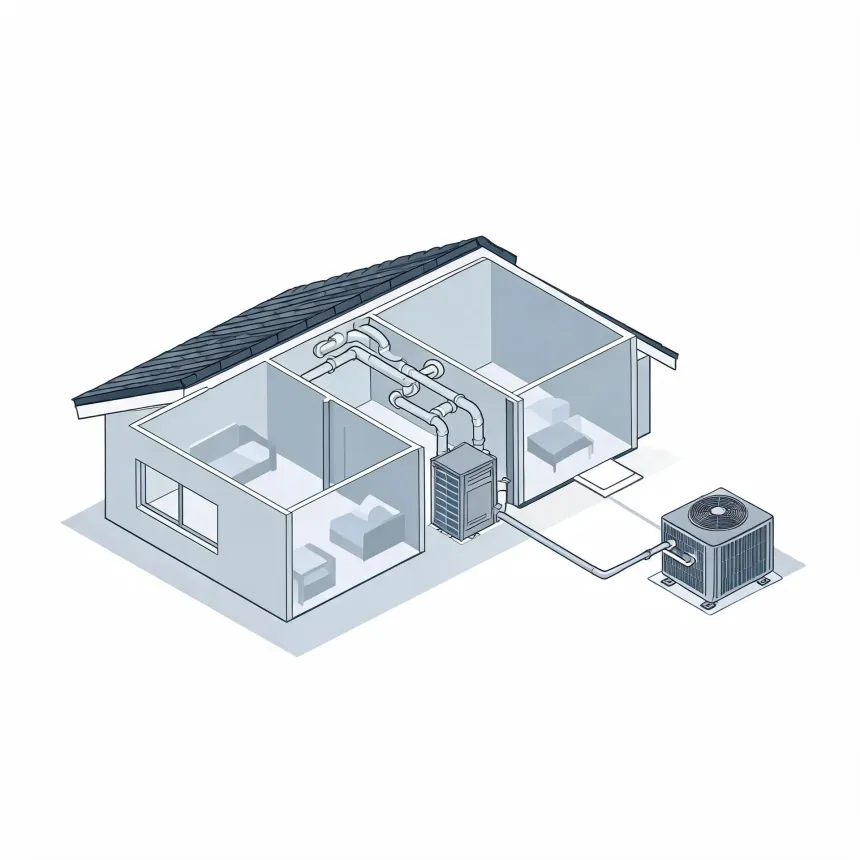
A tune-up checks the refrigerant charge, cleans the coils, tests the capacitor and tightens the electrical connections.
A tune-up is a fixed list, not a once-over. The contractor checks refrigerant charge against what the system calls for, because too much or too little both shorten the compressor's life. The capacitor and contactor get tested under load, since both can pass a quick glance and still be close to done. The coil gets inspected and cleaned if it needs it, and the condensate drain gets cleared so it can carry water out instead of backing up into the pan. Electrical connections get checked too, since a loose one generates heat right at the connection point. None of this is guesswork. It's the same list, checked the same way, every time.