


Running clean
A condenser that's been serviced moves heat out of the house without a fight. The coil is clear, the fan pulls air through easily, and the system holds its charge. On a 95 degree day it cycles the way it's supposed to and keeps up.
Skip calling around to set up an air conditioner tune-up.
Skip the callsWhen the temperature climbs into the 90s and sits there for days, the last thing you want is your AC giving out. You start thinking about the filter you haven't changed, the strange sound it made last week, whether it's working harder than it should. A heat wave is exactly the wrong time to find out your system has a problem it's been hiding all year.
A dirty filter makes your system pull harder to move the same amount of air, and in a stretch of 90-degree days that strain is what pushes a weak part past its limit. Check the filter and swap it if it's gray or clogged. Walk outside and look at the condenser unit too. Grass clippings, leaves, and anything piled against it block the airflow it needs to dump heat outside, and in Indiana's humid summers that unit is already working against thick air. Running your AC nonstop during a heat wave is normal and won't hurt it, but a system with a dirty filter, a blocked condenser, or a part already wearing out is the one that quits on the hottest day of the year.
A condenser that's been serviced moves heat out of the house without a fight. The coil is clear, the fan pulls air through easily, and the system holds its charge. On a 95 degree day it cycles the way it's supposed to and keeps up.

A unit caked in dirt and old grass clippings can't shed heat as well. The grille chokes airflow, the coil underneath stays coated, and the compressor works harder for the same result. That's when a heat wave is most likely to shut it down.
The contractor checks refrigerant charge against what the system needs.
The condenser coil gets washed clean so heat moves out freely.
The fan motor and blower get checked for weak airflow.
Electrical connections and capacitors get tested before the heat wave hits.

When your AC can't keep up, you notice it room by room. The upstairs bedrooms get warm first, then the thermostat reads 78 even though you set it at 72. Your power bill goes up because the system is running longer to do the same job, and if it's struggling hard enough, it can shut itself off in the middle of a 95 degree afternoon and leave you waiting for it to reset.
Finding someone to look at it before that happens usually means calling a few companies, explaining the same thing to each one, and waiting to see who can actually come out this week. Here you fill out one request and it goes to a contractor local to you who works on these systems all summer and knows what tends to give out first in weather like this. No comparing quotes, no repeating yourself on the phone.





You could spend the next hour calling around, explaining the same thing about your AC to three or four different companies, then waiting on quotes to compare before you even know who's showing up. During a heat wave, that's time your house doesn't have. Submit the request here and it goes to one licensed contractor working near you, not a handful of them competing for the callback. Someone who services Indiana systems all summer knows what a condenser does after weeks of 90 degree days, and what tends to fail first when a system's been pushed that hard. That's who looks at your AC, not whoever answers the phone fastest. You still have the heat to deal with and a system that needs real work. What you don't have to do is track down who can do it.
Your air conditioner doesn't make cold air. It moves heat from inside your house to the air outside, and refrigerant is what carries it. The compressor starts that trip, squeezing the refrigerant into a hot gas and sending it out to the condenser. Out there, the coil has to dump that heat into whatever temperature the air already is. On a mild day that's an easy job. At 95 degrees, the gap between the refrigerant and the outside air is smaller, so the coil has to work longer to push the same heat out. Once that heat is gone, the refrigerant turns back into a liquid and heads inside, cooled down and ready to pick up heat again. A metering device meters it into the indoor coil a little at a time, which is what lets it pull heat out of your house air instead of just sitting there. None of that matters if the air isn't moving. The blower pushes house air across that coil and back out through your ducts, and if the filter is clogged or the motor is weak, the refrigerant side never gets the chance to do its job. All of this runs on a loop set by your thermostat. In a normal week it cycles on and off. In a stretch of 90s, it barely stops, which is exactly when a part that was already wearing out gives up.


An air conditioner loses roughly 5 percent of its efficiency for every year it goes without maintenance, and that loss compounds as dirt builds up on the coil and the charge drifts off spec.
Five percent sounds small until it's July and your system is already working as hard as it can. A serviced unit has that capacity in reserve for the day it actually needs it.
At that rate, a struggling AC costs you more the moment it starts running long to keep up. A dirty coil or low charge makes it run longer for the same cooling, and every extra hour shows up on the bill at 15.96 cents a kilowatt-hour.
EIA-861 2025 statewide residential average
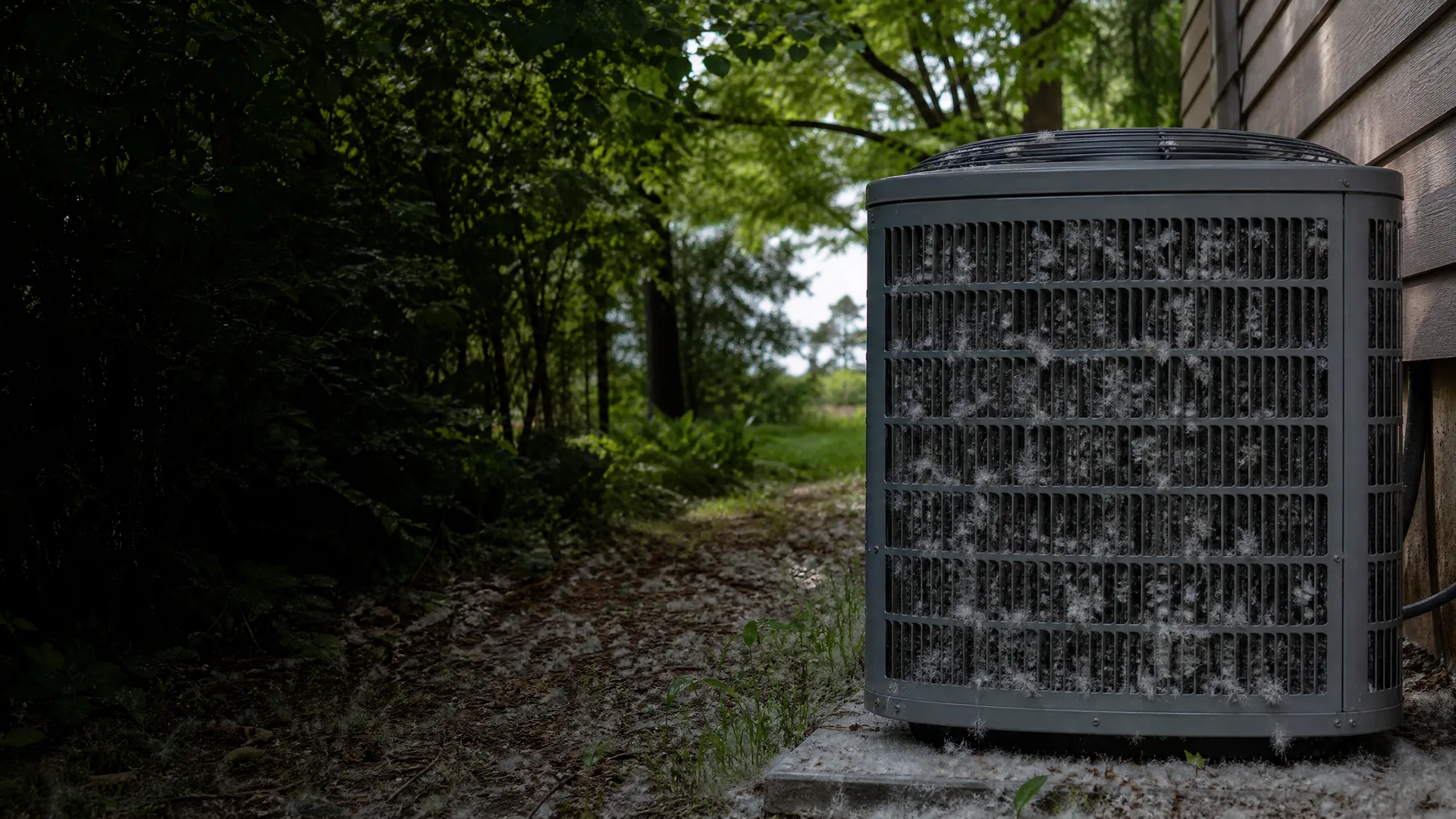
It's late May, warm enough that you've had the AC on for a few weeks now. You're out in the side yard dragging the hose past the condenser when you notice the fins look pale, almost frosted, except it isn't frost. The cottonwoods down the block have been shedding for days, and the fluff has caught on the coil and packed itself into the grille, matted down from the last rain. You crouch down and see how little of the metal is actually showing through. The unit is running right now, you can hear it, and you wonder how much of that air it's pulling through is actually getting past all that fluff to the coil underneath.
You notice it in small ways first. The air coming out of the vents doesn't feel as cold as it did last month. The system runs longer between cycles, sometimes it seems like it never really shuts off. You might hear it straining, a louder hum from the condenser outside, or a rattle that wasn't there before. Maybe there's a musty smell when it kicks on. Upstairs stays warmer than the thermostat says it should be. None of this means the system is finished, but a struggling AC during a stretch of 90 degree days is more likely to shut down when you need it most, and that leaves your house to hold the heat with no way to cool back down until it's fixed.

Averaged across Indiana summers, the dew point sits around 64°F through June, July and August, according to NOAA climate data. That's humid enough that your AC isn't just cooling the air, it's wringing water out of it too. On those sticky nights the system has to run longer to pull the moisture down before the house feels comfortable at all. A unit that's low on refrigerant or has a dirty coil falls behind fastest in air like that, since it was already losing ground on a dry day. You'll notice it as a house that feels cool on the thermostat but still damp, with the system cycling on again a few minutes after it shuts off.
NASA POWER T2MDEW county cells weighted by homes


A serviced AC gets through an Indiana heat wave because the coil is clean, the charge is right, and the parts that fail under strain have already been checked. That's the whole answer. When you request a match through this page, it goes to one licensed contractor working near you, not a handful of companies calling you back at once. The kind of contractor who gets this request is someone who services AC systems all summer in this same heat and humidity, and knows which part usually gives out first on a day like this. You won't spend the evening on the phone explaining your system to three different companies and sorting through quotes that don't quite match. You tell one contractor what's going on, once, and they already know the conditions it's running in because they're the same conditions on every call they run this week. Your house stays livable through the next stretch of 90s, and the system holds up because someone who knows it checked it before the heat forced the question.
Your request goes to one pro, not a list of companies.