






A illuminated two-story red brick house on a quiet residential street at dusk, flanked by mature trees under a deep blue evening sky.

AC Maintenance in Vincennes, IN

Tell us about the job

Takes about a minute. No obligation.

Tune-up, service, or cleaningCentral ACKnox County, IN
Step 1 of 2

What ZIP code is the job in?

Your air conditioner starts running in May here and keeps going through September. April is the month to have it looked at, before it has to work. A tune-up then catches a weak part while the system is still sitting idle, not after it has already run in the heat. Wait until the season starts and a check turns into a repair, often with other homeowners ahead of you for the same appointment.

5 months
May through September, your air conditioner is on duty
86°F
the average summer afternoon it cools against
27 hail events
in ten years, and hail bends the fins on outdoor coils
92 wind events
in ten years, and wind drives debris into outdoor units
Isometric grayscale illustration of a cutaway house showing interior rooms, ductwork, an indoor air handler, and an outdoor condenser unit on a pad connected by lines.
Your air conditioner works hardest from June through August.

NOAA nClimDiv, 1991–2020 normals

June through August, the afternoon runs near 86°F with a dew point around 67°F.

Five months of that load is what a yearly check gets your air conditioner ready for.

Half the homes here were built in 1962 or earlier

Half the homes here were built by 1962
Cooling runs May through September
Summer afternoons average 86°F

Knox County gets its share of rough weather. Between 2015 and 2024 the county logged 92 damaging wind events, 27 hail events, and 3 tornadoes. None of that targets an air conditioner specifically, and none of it means this unit needs more looking after than one anywhere else. It does mean a yearly check is worth keeping on the calendar rather than skipping. A branch knocked into the cabinet or hail driven into the coil fins is easier to catch while the system is being looked at anyway than to discover later, once it's already been running and the damage has had time to turn into a bigger repair.

One check a year, timed right, is enough

One visit a year is enough for this system. Electricity here runs about 14.92 cents a kilowatt-hour, close to typical, so there's no unusual power cost riding on how often it gets checked. The case for a yearly visit is timing, not frequency: get it looked at every spring, before the heat sets in, and let that one visit cover the season.

Find a contractor
A man in a dark shirt and brown pants, seen from behind, carries a waxed canvas tote bag up wooden porch steps toward an orange front door, with a potted shrub beside the entry.
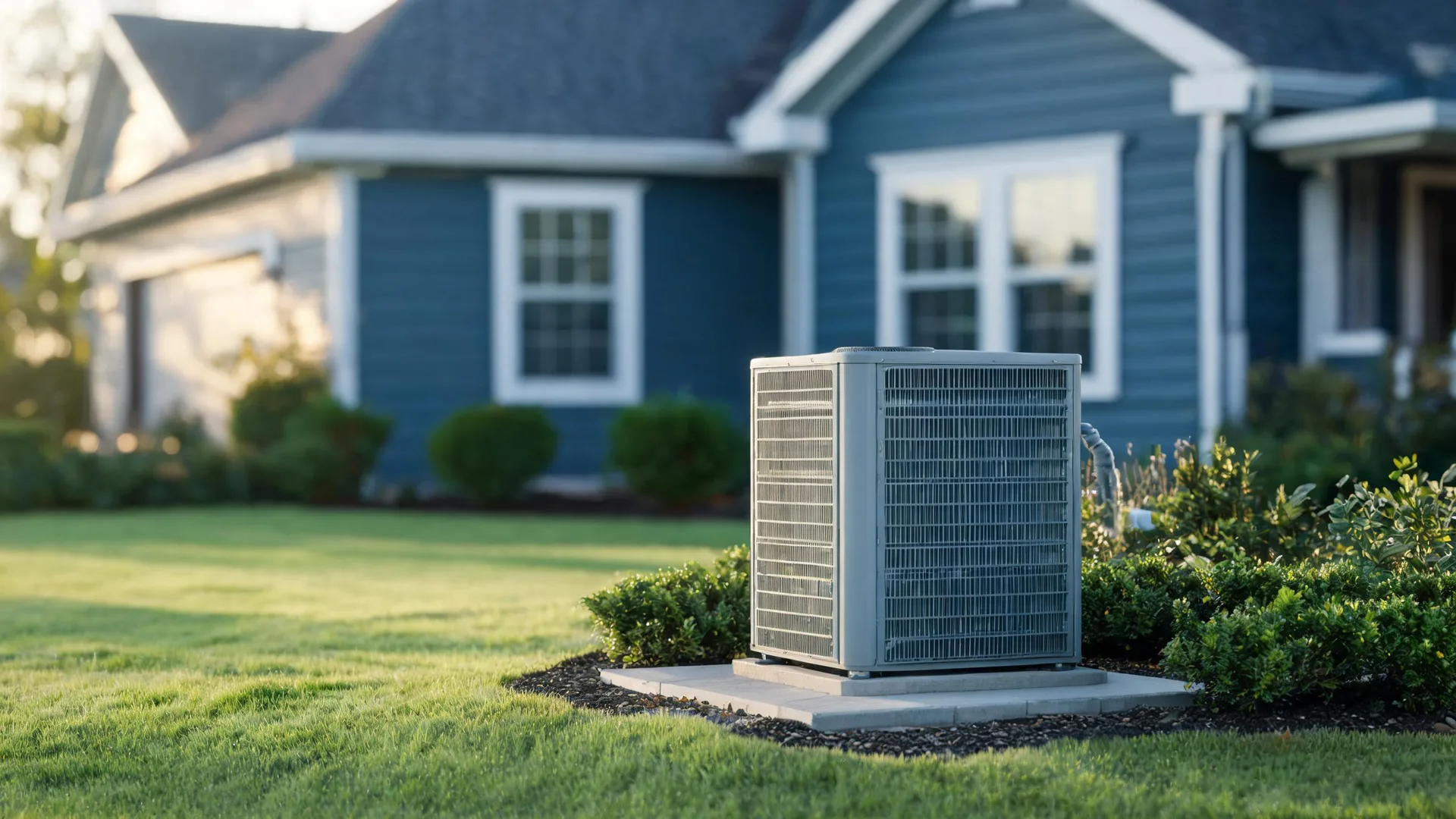
A gray cylindrical air conditioning condenser unit mounted on a concrete pad next to a light-colored vinyl-sided house exterior.

An older system, looked at once a year

If your system came with the house, a yearly check is how a tech catches a tired capacitor or a coil losing its fins before either one gives out on you. An older unit can still cool the house fine for years, but it depends more on someone actually looking at it rather than waiting for a sound or a warm room to say something's wrong. That's what the yearly visit is for: catch the small thing while the unit is sitting idle and there's time to deal with it.

Three things that decide whether the air moves and the heat leaves

The filter keeps dust and lint out of the system. The indoor coil absorbs heat from the air passing over it, and the outdoor coil has to release that heat outside. The condensate drain carries off the water the indoor coil pulls out of the air. Each one has one job, and the system depends on all three doing it.

What a tech is actually checking when they clean and clear these

A clogged filter chokes airflow across the indoor coil, and a coil that doesn't get enough air can ice over even on a hot day. Dirty coil fins hold onto heat instead of shedding it, so the system works harder to cool the same air. A blocked drain backs up and sends water into the cabinet instead of outside. None of these show up as a breakdown right away. They show up as a system that runs longer than it should and wears out sooner than it would otherwise.

Aerial view of a residential air conditioning condenser unit mounted on a concrete pad next to a house with vinyl siding and a sliding glass door.

Book your AC tune-up in April, before homes here start needing cooling in May.

  1. Jan
  2. Feb
  3. Mar
  4. Apr
  5. May
  6. Jun
  7. Jul
  8. Aug
  9. Sep
  10. Oct
  11. Nov
  12. Dec

A tune-up checks the refrigerant charge, cleans the coils, tests the capacitor and tightens the electrical connections.

A tune-up is a set routine, not a quick look under the cover. The tech checks refrigerant charge against what the system is supposed to hold, because too little or too much makes the compressor work harder than it should. Electrical connections get checked and tightened, since a loose connection builds heat and can fail outright. The capacitor gets tested under load, not just eyeballed, because a capacitor can read fine sitting still and still be too weak to start the compressor. Moving parts get lubricated where the system calls for it, and the contactor gets checked for pitting, since a pitted contactor is often what's behind a system that won't start on a hot afternoon. The thermostat gets checked against the actual temperature in the house, because a thermostat reading a few degrees off will run the system longer than it needs to. None of this fixes a problem that isn't there yet. It finds the part that's close to failing while it can still be replaced on a slow day instead of a hot one.