A row of dark-sided single-story houses behind a long trimmed hedge, with mown lawn, a paved path and large leafy trees under an overcast sky.

AC Maintenance in Seymour, IN

Tell us about the job

Takes about a minute. No obligation.

Tune-up, service, or cleaningCentral ACJackson County, IN
Step 1 of 2

What ZIP code is the job in?

The refrigerant pressures get checked, not just the filter

A quick visit gets the filter swapped and the outside coil hosed off, and that's it. A thorough one puts gauges on the lines to check the refrigerant charge, reads the capacitor against its rating, and checks the contactor for pitting. Those are the parts that leave you with a dead system on the hottest day of the year.

What this means for your AC

Low refrigerant and a weak capacitor don't show up by looking at the unit. They show up on a meter. If the tech never opens the electrical panel or never hooks up gauges to the lines, they're cleaning your AC, not servicing it.

4 months
June through September, your air conditioner is on duty
85°F
the average summer afternoon it cools against
15 hail events
in ten years, and hail bends the fins on outdoor coils
24 wind events
in ten years, and wind drives debris into outdoor units
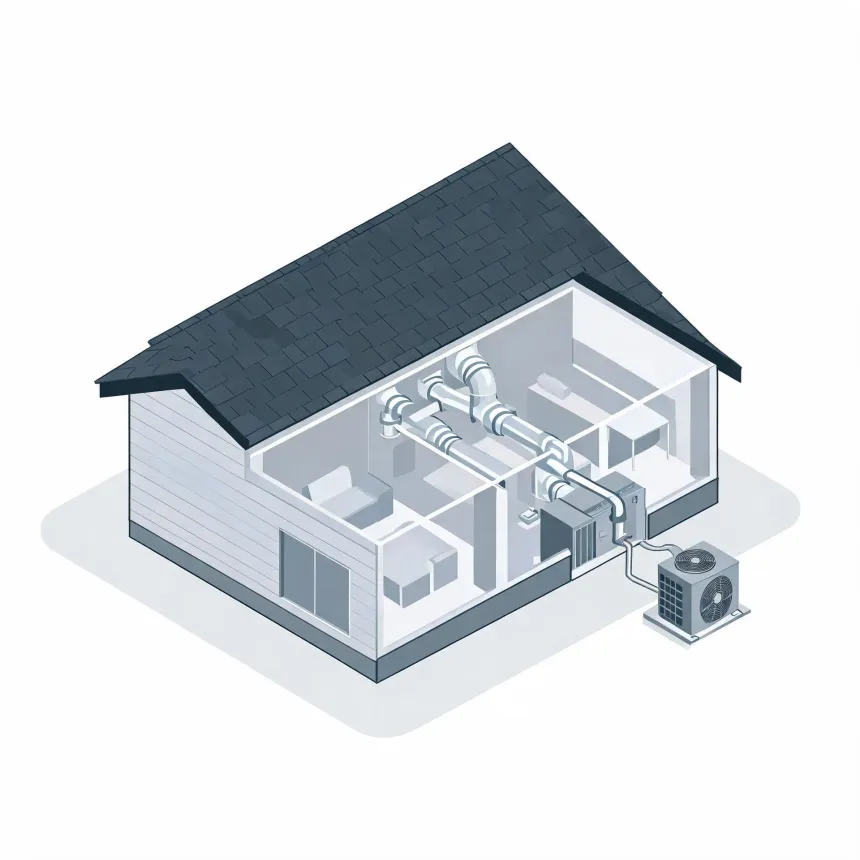
Isometric cutaway illustration of a house with a dark shingled roof, showing interior ductwork connected to an indoor air handler and an outdoor condenser unit beside the building.
Your air conditioner works hardest from June through August.

NOAA nClimDiv, 1991–2020 normals

The capacitor can test weak months before it fails outright

A reading now means it gets replaced on your schedule, not on the hottest day of the year when it finally quits.

Cooling starts in June here. Have it checked in May.

Cooling runs June through September
Summer afternoons average 85°F
15 hail events from 2015 to 2024
One visit a year covers itIndiana homes paid 14.77 cents per kilowatt-hour in 2024, and a clean, checked system is what keeps that bill from creeping higher.

Jackson County doesn't ask anything extra of an AC system. Half the homes here were built in 1978 or earlier, half in 1978 or later, and age alone doesn't wear out a compressor or a capacitor faster. A once-a-year check before the heat sets in is enough for most houses. Mobile homes make up a share of the housing here too, and those systems sit outside in the same sun and carry the same summer load. The yearly visit still applies either way, but it's worth telling the tech what kind of home you have before the appointment.

Book it before the season

It starts running hard in the first month of the season here. Book the check the month before.

Find a contractor
A gray residential air conditioning condenser unit mounted on a concrete pad outdoors, surrounded by green grass under a partly cloudy blue sky.

What you can check, and what needs a meter

Keep the area around the outdoor unit clear. Grass clippings, leaves and mulch block airflow through the coil, and a shrub growing in close does the same thing from the other side. Leave a couple feet of open space on every side. Check the filter and change it when it looks gray or clogged, not on a set schedule, since how fast it loads up depends on the filter itself and what's running in the house. A clogged filter starves the system of airflow and makes the coil behind it work harder than it should. Watch for ice on the copper lines or the indoor coil. That points to low airflow or low refrigerant, and running it that way stresses the compressor. Outside of that, leave the refrigerant lines, the capacitor and the electrical panel alone. Those take gauges and a meter to read correctly, and that's the part of the visit a homeowner can't do standing in the yard.

Dirt on the coil builds slowly

The outdoor coil sheds heat into the air. A thin coat of dust and pollen on the fins cuts into that, and most homeowners never see it happen because it's gradual. The system keeps running, just not at the charge it was built for, and the compressor pays for it every time it cycles on.

A skipped year doesn't fail politely

An AC that's never serviced tends to run fine right up until it doesn't. Weak airflow and a tired capacitor don't slow the system down first as a warning. They let it keep running under strain until the compressor gives out, usually on the day it's working hardest.

An overhead view of a residential air conditioning condenser unit mounted on a concrete pad next to a house with vinyl siding.

Book your AC tune-up in May, before homes here start needing cooling in June.

  1. Jan
  2. Feb
  3. Mar
  4. Apr
  5. May
  6. Jun
  7. Jul
  8. Aug
  9. Sep
  10. Oct
  11. Nov
  12. Dec

A tune-up checks the refrigerant charge, cleans the coils, tests the capacitor and tightens the electrical connections.

A real tune-up follows a checklist, not a feeling. The tech checks the temperature split between the air going into the system and the air coming out of it, since a weak split points to a problem even when the unit sounds fine. The blower wheel gets looked at too. Dust builds up on the blades over time and that alone can cut airflow without any part failing. The drain line gets checked for clogs, because a blocked drain backs up and can shut the system down or leak into the house. The outdoor fan motor gets tested under load, not just switched on and watched spin. None of this shows up from across the yard. It's why a tune-up and a quick filter change aren't the same visit.