





A row of dark-sided single-story houses among large deciduous trees, with a trimmed hedge in the foreground and a mown lawn crossed by a paved path.

AC Maintenance in Lafayette, IN

Tell us about the job

Takes about a minute. No obligation.

Tune-up, service, or cleaningCentral ACTippecanoe County, IN
Step 1 of 2

What ZIP code is the job in?

Between visits, the filter is the one thing worth your attention. A clogged filter starves the coil of airflow, and a starved coil can ice over even on a hot day. Check it, hold it up to a light, and swap it when you can't see through it. Outside, keep the condenser clear of grass clippings, leaves and anything piled against the cabinet, since that unit needs open air on all sides to shed heat. Inside, listen for a return vent that whistles or a room that won't cool like the others, and mention it at the next visit rather than waiting for the system to struggle. None of this replaces a real inspection, but it keeps small problems from turning into a breakdown.

3 months
June through August, your air conditioner is on duty
83°F
the average summer afternoon it cools against
26 hail events
in ten years, and hail bends the fins on outdoor coils
83 wind events
in ten years, and wind drives debris into outdoor units
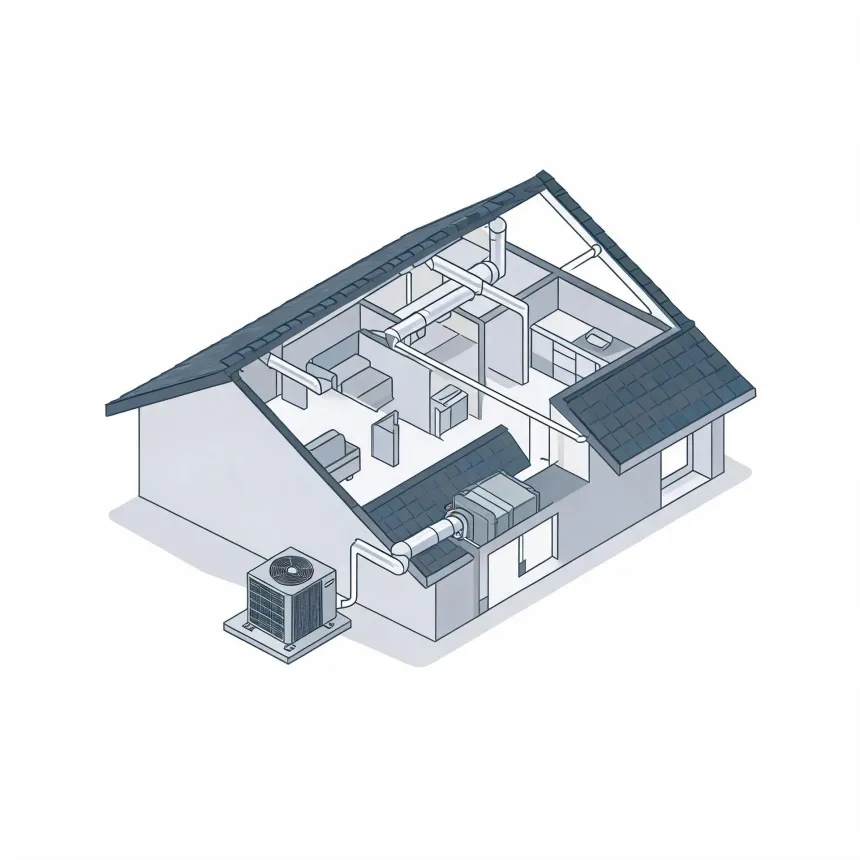
Isometric line illustration of a cutaway single-story house showing interior rooms, ceiling ductwork and an air handler, connected to an outdoor condenser unit on a pad beside the building.
Your air conditioner works hardest from June through August.

NOAA nClimDiv, 1991–2020 normals

June is when AC in Lafayette starts working its hardest.

May is when a check still has time to fix anything it finds.

Half the homes here were built by 1987, so plenty of these systems have years left to protect

Half the homes here were built by 1987
Cooling runs June through August
Summer afternoons average 83°F
Nothing here is hard on your AC. A yearly check still is the thing that keeps it running.126 severe weather events hit Tippecanoe County between 2015 and 2024, and none of them are what wears out a compressor.

One visit a year covers it. Lafayette doesn't run an AC year round, and it doesn't put the system through extremes that call for closer attention. What a yearly visit catches is ordinary wear. A capacitor going weak, a refrigerant charge drifting low, connections that loosened up after a season of running. A system with a full charge and clean coils uses less power to do the same job, and that matters at 14.77 cents a kilowatt-hour. Timed before the months it works hardest, once a year is enough to keep it running the way it was installed to run.

A newer system still needs its yearly check

If your system is one of the newer ones, a yearly check is what gets it to the end of its working life without a surprise failure. If it's older, the same visit tells you what shape it's really in. Either way, get it looked at before it has to work hard.

Find a contractor
A gray cylindrical air conditioning condenser unit mounted on a concrete pad next to a light-colored vinyl-sided house exterior.

Skip enough years and the wear doesn't stay small

A system that never gets looked at doesn't fail all at once. The refrigerant charge drifts down a little at a time, so the coil keeps cooling, just less of it. The compressor runs longer to make up the difference, and it's running hotter than it was built to. A dirty coil does the same thing from the other direction, insulating the refrigerant from the air it's supposed to pull heat out of. Neither shows up as a dead system. It shows up as a system that runs longer each cycle and is already partway to burning out the compressor before anyone notices anything wrong.

A real inspection means readings, not a glance

A thorough visit checks refrigerant pressure against what the system calls for, tests the capacitor under load, and measures the temperature drop across the coil. Each of those numbers tells a tech something the others can't. A quick visit skips the gauges and the meter, looks the unit over, and calls it done. The system can look fine either way. Only one of them tells you if it's running the way it was built to.


What gets skipped is what fails next

A capacitor that's starting to go doesn't look any different sitting in the unit. A refrigerant charge that's drifted low doesn't show on the outside either. Those only turn up when someone actually tests them, and they're also what's most likely to leave a system down on a hot day. Skip the testing part of the visit and the problems that find you later are the ones a real check would have caught now.

An outdoor air conditioning condenser unit positioned beside a blue-sided house at sunset.

Book your AC tune-up in May, before homes here start needing cooling in June.

  1. Jan
  2. Feb
  3. Mar
  4. Apr
  5. May
  6. Jun
  7. Jul
  8. Aug
  9. Sep
  10. Oct
  11. Nov
  12. Dec

A tune-up checks the refrigerant charge, cleans the coils, tests the capacitor and tightens the electrical connections.

A real tune-up starts outside, with the condenser fan and the coil itself. The coil gets washed clean, not just brushed off, because dirt packed between the fins blocks airflow the same way a dirty filter does. The fan motor gets checked for play in the bearings and for a wobble in the blade, since a blade that's out of balance will wear out its motor early. Inside, the tech checks the blower wheel for the fine dust that builds up on the blades over time and cuts the airflow moving across the coil. The refrigerant lines get looked over for oily residue, which is how a slow leak shows itself before it shows up as a system that won't get cold enough. Electrical connections at the disconnect and inside the unit get tightened, since a loose connection runs hotter than a tight one and that heat is what eventually takes out a contactor. None of this is guesswork. Every part of it is something that fails in a predictable way, and a proper visit checks each one before it does.