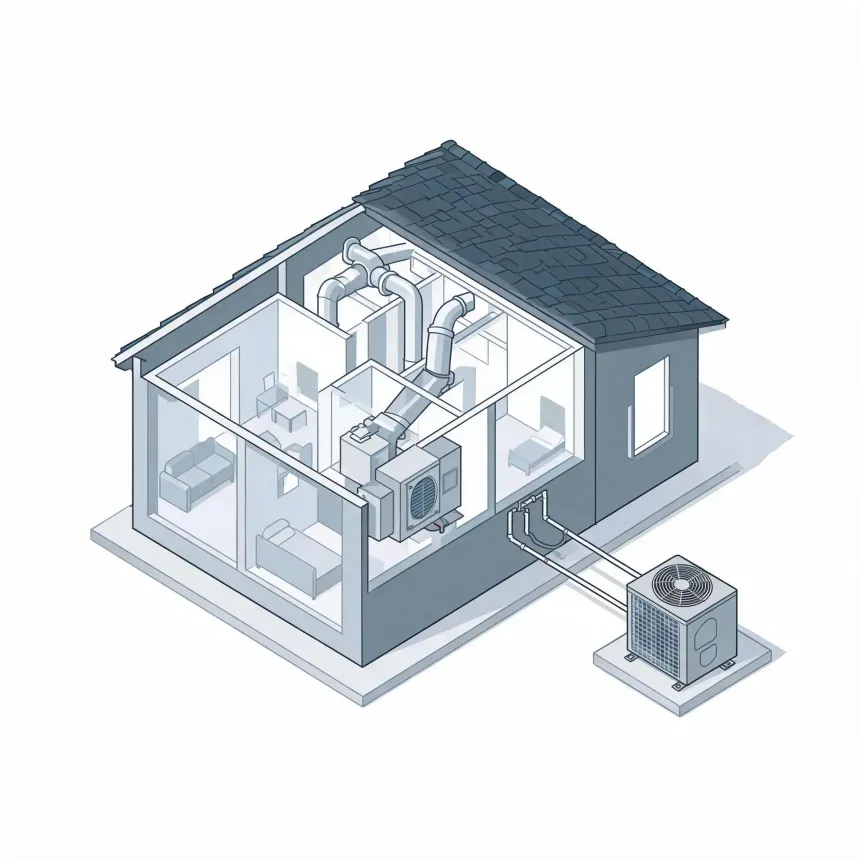
A dirty filter is the start of most service calls. Airflow drops, the evaporator coil gets less air moving across it, and the coil can ice over even on a hot day. Once that ice builds up, the system is cooling almost nothing while it keeps running. The outdoor coil matters just as much. It has to shed heat into the air outside, and when it's caked with dirt or grass clippings, the whole system works harder to do the same job. Then there's the drain line, which nobody thinks about until it's clogged and water is backing up into the pan or onto the floor below. None of these are complicated parts. They just need to be checked before they cause the breakdown instead of after.
4 months
June through September, your air conditioner is on duty
84°F
the average summer afternoon it cools against
32 hail events
in ten years, and hail bends the fins on outdoor coils
44 wind events
in ten years, and wind drives debris into outdoor units
Your air conditioner works hardest from June through August.
Jan
Feb
Mar
Apr
May
Jun
Jul
Aug
Sep
Oct
Nov
Dec
NOAA nClimDiv, 1991–2020 normals
Cooling runs about four months here, June through September.
One visit before June covers the season this system actually works.
Cooling starts in June and runs hard right away, so May is the time to get it checked
Cooling runs June through SeptemberSummer afternoons average 84°F32 hail events from 2015 to 2024
One visit a year covers itAt 14.77 cents a kilowatt-hour, a system that's been checked runs instead of straining.
Half the homes in Monroe County were built in 1986 or later, so there's a good chance the system in yours isn't old either. A newer AC still depends on the same yearly check. The capacitor, the refrigerant charge, the condenser coil all wear the same way no matter how new the unit is. Catching a weak capacitor or a slightly low charge early means it gets fixed on your schedule, not in the middle of a hot stretch when the system quits outright. A unit that's maintained from the start tends to stay reliable longer than one that only gets looked at after something breaks.
An AC that is starting to need attention does not usually just quit. It tells you first. Warm air coming out of vents that used to blow cold is the most common sign. It usually means the refrigerant charge has dropped or the compressor is struggling to keep up. A system that used to run for a while and shut off, now running almost constantly, is working harder to hit the same temperature it used to hit easily. Listen for anything new. A rattle, a squeal on startup, a click that repeats instead of one click and then quiet. Those sounds mean a part is wearing, not failing yet. Water pooling around the indoor unit means the drain line is clogged or the pan has rusted through. Any of these is worth a check before the system has to work through the hottest stretch of the year.
A refrigerant charge that's off doesn't announce itself
A system low on refrigerant will still blow cold air, just not cold enough, and most people won't notice the difference until a hot stretch pushes it past what it can do. A gauge check during a tune-up catches a charge that's drifted low before it shows up as a warm house.
Electrical connections loosen on their own
Every time a system cycles on and off, the metal in its wire connections heats and cools, and over seasons that can work a connection loose. A loose connection runs hotter than it should and can burn a contact or trip the system off. Tightening those connections is routine during a tune-up and invisible the rest of the year.
Book your AC tune-up in May, before homes here start needing cooling in June.
Jan
Feb
Mar
Apr
May
Jun
Jul
Aug
Sep
Oct
Nov
Dec
A tune-up checks the refrigerant charge, cleans the coils, tests the capacitor and tightens the electrical connections.
A tune-up starts with the electrical side. The contactor and capacitor get tested under load, not just looked at, because a capacitor can read fine sitting still and still fail once the compressor draws on it. The refrigerant charge gets checked against the pressures the system is supposed to run at, not just topped off by guess. The condenser fan motor gets checked for play in the bearing and for amp draw that's climbing past what it should be. Blower wheel, evaporator coil, drain line, all get a look, since any one of them restricts airflow or backs up water if left alone. The thermostat gets tested too, calling for cooling and confirming the system actually responds.