A row of dark-sided single-story buildings with gabled shingle roofs behind a tall trimmed hedge, with lawn, leafy trees and an overcast sky.

AC Maintenance in Auburn, IN

Tell us about the job

Takes about a minute. No obligation.

Tune-up, service, or cleaningCentral ACDeKalb County, IN
Step 1 of 2

What ZIP code is the job in?

Three months of real work

Auburn air conditioners run from June through August, with afternoon highs averaging 82°F. The rest of the year the compressor sits idle instead of straining against heat. That is a light load next to what homes further south ask of the same equipment.


Short runs still wear parts

A system that only works three months a year still has a capacitor, a contactor and a coil aging on their own schedule. On easy-duty equipment like this, trouble usually traces back to age or a skipped check, not overwork. A visit before June catches that early.

3 months
June through August, your air conditioner is on duty
82°F
the average summer afternoon it cools against
18 hail events
in ten years, and hail bends the fins on outdoor coils
38 wind events
in ten years, and wind drives debris into outdoor units
Isometric line illustration of a cutaway house showing interior rooms, ceiling ductwork connected to an indoor air handler, and an outdoor condenser unit linked by refrigerant lines.
Your air conditioner works hardest from June through August.

NOAA nClimDiv, 1991–2020 normals

A clean filter is the one thing a homeowner controls, and a clogged one is the top reason a contractor gets called for a system that isn't actually broken.

Check it monthly through the summer, and swap it when it's gray instead of white, since that's the airflow your coil depends on to keep from freezing up.

June asks a lot right away. May is when to get ahead of it.

Cooling runs June through August
Summer afternoons average 82°F
38 damaging wind events from 2015 to 2024
Auburn, INHalf the homes here were built in 1975 or earlier, half after. Either way, once a year covers it.

A few things point to a check before summer, even on a system that still seems fine. The air coming out feels warm, not cold, or it takes longer than it used to get the house there. The outdoor unit cycles on and off more than it used to, instead of running a steady stretch. There's a hum when it tries to start, or it doesn't start at all, which usually means a weak capacitor. Water pooled near the indoor unit means a drain line is clogged somewhere it shouldn't be. Any one of these is a reason to have it looked at, not just lived with until it quits outright.

Keep up the yearly check

Easy duty still wears parts. A yearly check keeps it going a long time.

Find a contractor
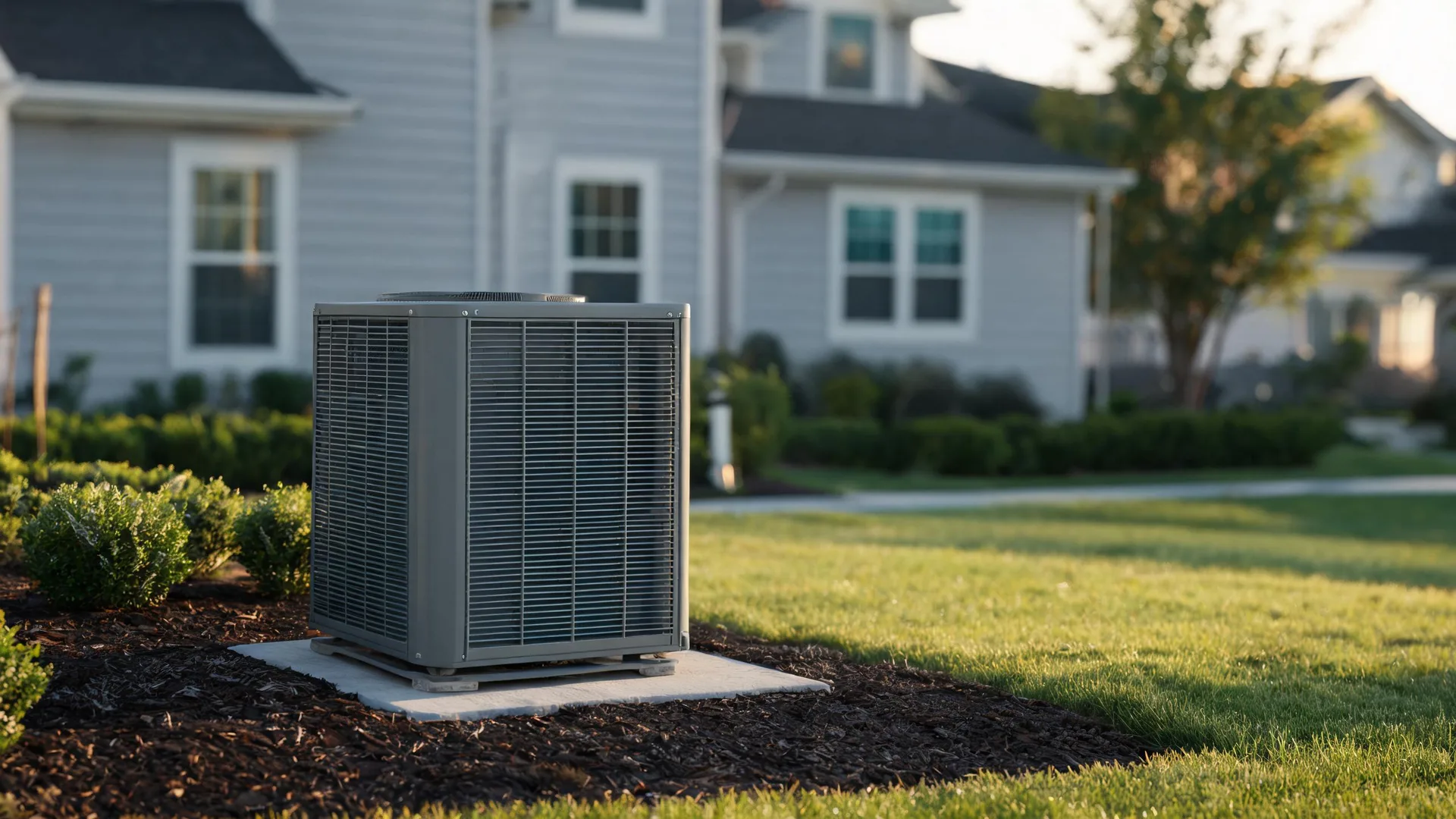
A gray residential air conditioning condenser unit mounted on a concrete pad outdoors, surrounded by green grass under a partly cloudy blue sky.

The filter, the coil and the drain depend on each other

The filter sets the pace for everything behind it. Air has to pull through it before it reaches the coil, and once dust builds up and chokes it off, the coil starts running colder than it should. Push that far enough and moisture in the air freezes onto the coil instead of draining away, which blocks airflow even more. A dirty filter starves the coil, the coil ices over, and now a fresh filter alone won't fix it until that ice melts off. The drain line is the quiet one, since nothing about it shows up in how the house feels until it backs up. Condensation has to go somewhere, and the pan and drain are built to carry it out. Algae and dust build up in that line the same as any drain, and when it clogs, water backs up into the pan and finds the nearest way out, usually down through a ceiling or onto a floor. None of this comes from the heat itself. It comes from being left alone too long.

What a skipped check misses

A refrigerant charge that's drifted low won't announce itself. The system still turns on, still blows cold enough to notice, but the compressor works harder for the same result and the coil runs at the wrong temperature the whole season. Nobody catches that without gauges on it.

What keeps running anyway

A failing capacitor doesn't always stop the system cold. Sometimes it just makes the compressor strain on every start, pulling more than it should until the day it finally can't start at all. By then it's a no-cool call instead of a part swapped on a bench.

Aerial view of a gray outdoor air conditioning condenser unit mounted on a concrete pad next to a house with vinyl siding.

Book your AC tune-up in May, before homes here start needing cooling in June.

  1. Jan
  2. Feb
  3. Mar
  4. Apr
  5. May
  6. Jun
  7. Jul
  8. Aug
  9. Sep
  10. Oct
  11. Nov
  12. Dec

A tune-up checks the refrigerant charge, cleans the coils, tests the capacitor and tightens the electrical connections.

A tune-up starts outside, with the condenser coil. A contractor washes out the dust and grass clippings packed between the fins, because a coil that can't shed heat makes the whole system run long and hard for the same result. The refrigerant charge gets checked against what the manufacturer calls for, not just topped off by guess. Electrical connections get tightened, since a loose one heats up and burns before it ever trips a breaker. The capacitor and contactor get tested under load, not just looked at, because both can be failing while the system still starts every time. Inside, the blower wheel gets checked for dust buildup, and the drain line gets flushed so a clog doesn't back water up into the pan. None of this is guesswork. It's the same handful of checks, done the same way, on every visit.