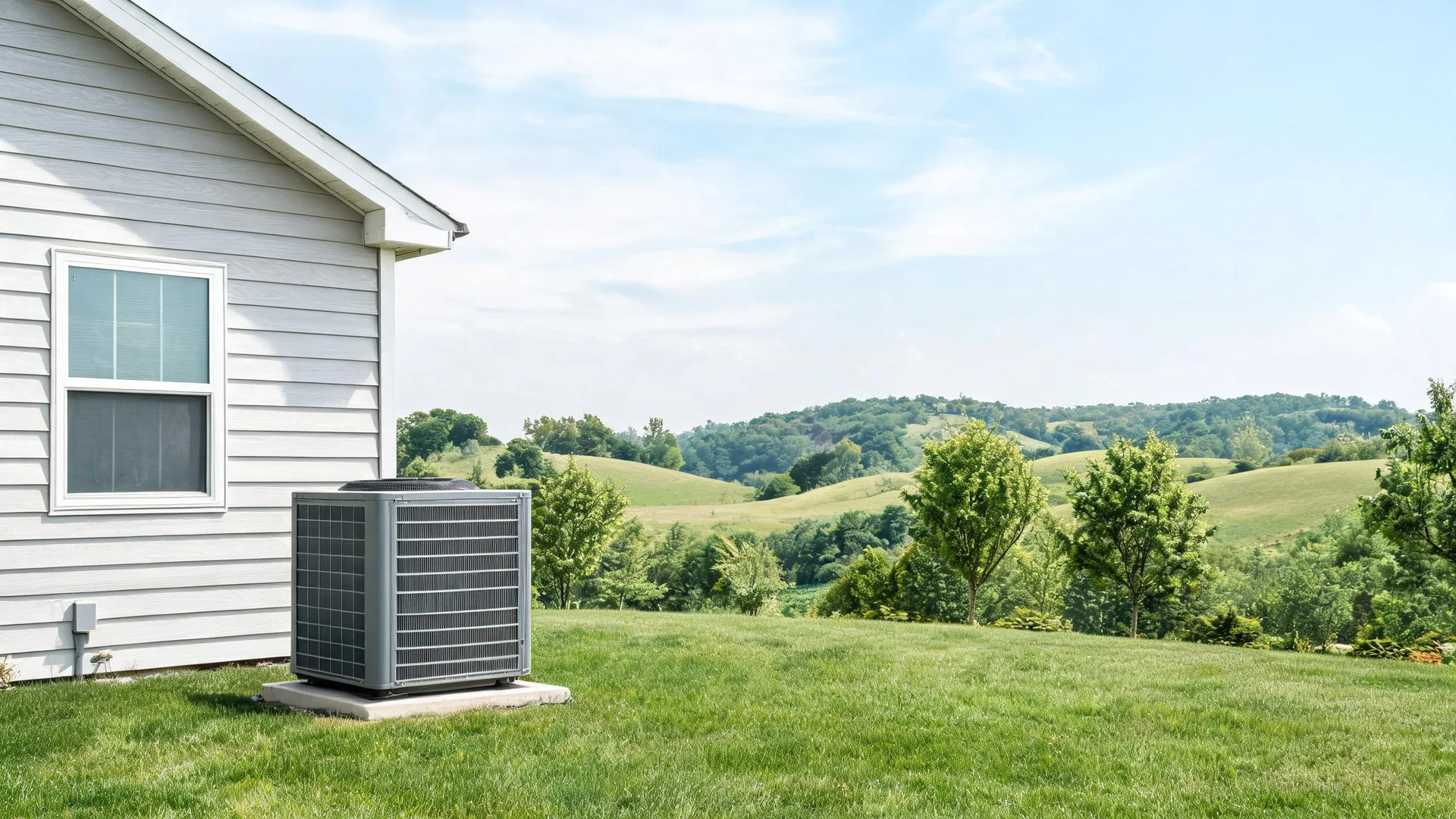
Most of Anderson heats with gas
Utility gas heats 66.4% of occupied homes in Madison County, with electricity a distant second at 26.3%. That split points to central air paired with a gas furnace as the system most homes here already have.
Takes about a minute. No obligation.
Utility gas heats 66.4% of occupied homes in Madison County, with electricity a distant second at 26.3%. That split points to central air paired with a gas furnace as the system most homes here already have.
If your house already has gas heat, a new AC unit goes in alongside the furnace you have, sharing the same ductwork and the same indoor coil location. That keeps the job a straightforward swap instead of a rebuild.

NOAA nClimDiv, 1991–2020 normals
Madison County sees its share of damaging wind and hail, 68 wind events and 36 hail events over the past decade.
None of that changes what size or efficiency your AC needs to be. A standard system sized right for your home holds up fine here.




Summer here is short. Madison County runs about three months of real cooling, June through August, with afternoon highs averaging 83°F. That's not a heavy load compared to what the furnace handles the rest of the year, and it's why a standard-size, standard-efficiency system is the right call for most homes in the county. Heating is the bigger job in this climate zone, so there's no case for oversizing the AC or paying up for a tier of efficiency built for hotter places. Size it to the house, not the weather.
Madison County falls in zone 5A, where heating carries the bigger load and summer is the shorter season. Federal rules still set a floor for the AC itself. Any split system under 45,000 Btu/h has to meet 13.4 SEER2. That's the standard efficiency tier, and it's what most homes here need. A federal tax credit is available on top of that.
Find a contractorAsk what your ductwork and electrical setup can actually take before you pick a system. In a house built around 1965 or earlier, the ducts were sized for the furnace and AC that came with the place, not necessarily for what's on the market now. A contractor sizing your install should be running a load calculation on your house, not just swapping in whatever matches the old unit's tonnage.
Square footage alone doesn't size a system. A proper load calculation accounts for window area and direction, ceiling height, insulation levels, and how much shade the house gets. Houses built the same size can need different tonnage depending on how they're built.
A system that's too big for the house shuts off before it finishes pulling moisture out of the air. You get a room that drops in temperature quickly but still feels clammy. The right size runs longer, gentler cycles and leaves the air dry along with cool.
Estimates for a typical Madison County home, from EIA household energy data, Indiana fuel prices and NOAA climate normals. Your home will differ.
Install day starts with the old equipment coming out. The outdoor unit, the indoor coil, and the line set get disconnected and hauled off. If the ductwork is staying as is, the new coil ties into that same connection point. A tech will braze the new line set, then pull a vacuum on it to clear out air and moisture before any refrigerant goes in. Refrigerant gets weighed in to the amount the system calls for, not judged by pressure alone. The coil sits on top of the furnace or air handler, and it needs a tight seal there so air isn't leaking around it. Once everything is connected, the system gets a startup check. A tech reads the temperature drop across the coil, checks airflow at the vents, and compares refrigerant pressures against what the manufacturer specifies. That check is what tells you the system is sized and charged right, not just sitting in place.