A quiet residential street at dusk lined with illuminated two-story brick houses and mature trees.

Mini Split Installation in Indianapolis, IN

Tell us about the job

Takes about a minute. No obligation.

New system or replacementMini-splitMarion County, IN
Step 1 of 2

What ZIP code is the job in?

Marion County sees its share of storms

Marion County logged 227 severe weather events between 2015 and 2024, including 140 damaging wind events, 67 hail events, and 4 tornadoes. Winter storms with heavy snow and ice hit 12 times in that same stretch. Statewide, 17% of Indiana households lost power for 24 hours or more in 2024.

An outdoor unit lives outside in all of it

A mini-split's outdoor unit sits exposed to wind and hail year round, and a power outage stops the indoor head along with it. Where the outdoor unit goes and how it's mounted matters here more than in a place with calmer weather.

8 months
October through May, your system heats
4 months
June through September, it cools
23°F
the average winter night it heats against
83°F
the average summer afternoon it cools against
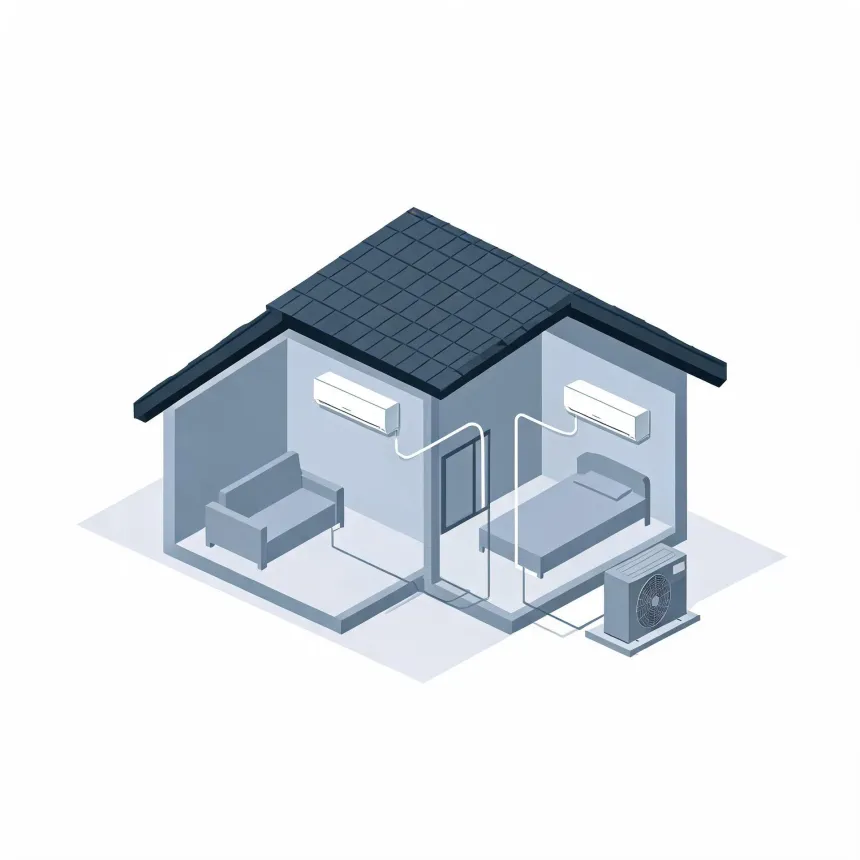
Isometric illustration of a cutaway house with two rooms, showing two wall-mounted indoor air conditioning units connected by lines to a single outdoor condenser unit outside the building.
Your system heats October through May and cools June through September.

NOAA nClimDiv, 1991–2020 normals

Half the homes in Marion County were built in 1973 or earlier.

An older home wasn't built with a mini-split in mind, so the install has to work around the walls and wiring that are already there.

Gas heats most homes here, so a mini-split usually joins a furnace instead of replacing it

55.6% of homes heat with gas
Cooling runs June through September
Summer afternoons average 83°F
Get it installed before JuneCooling runs June through September here, with May the month to get a mini-split in place first.

Marion County falls in climate zone 4A, which asks real work of both a heating system and a cooling system over the year. Any mini-split installed here has to meet the federal minimum for that equipment type. Units built from January 1, 2023 onward must deliver at least 14.3 Btu of cooling for every watt-hour of electricity and at least 7.5 Btu of heat for every watt-hour in heating mode. That standard applies to the system as a whole, not just the compressor, so it narrows the field before a contractor ever sets foot in the house. There's no separate rule for ductless systems. A mini-split has to clear the same bar as any other split-system heat pump sold today.

Plan the mount and the outage backup now, not after a storm hits

The outdoor unit and the mounting decide how this system holds up through a storm or an outage. Get those placed and planned before install day, not after.

Find a contractor
A white mini-split air conditioner outdoor condenser unit mounted on metal brackets against a beige stucco exterior wall, with a blue sky and scattered clouds in the background.

Working with a wall someone else built

A mini-split installed now will run for years in whatever wall it goes on. In a house built in 1973 or earlier, that wall has wiring and framing nobody on the install crew put there. The indoor head needs a flat section that will take the mounting plate, and the line set needs a real path to the outside unit, not just the nearest clear spot to drill. Before anything goes up, a contractor should walk that route and check what's behind the wall where the plate will sit.

How many rooms it has to reach

A single outdoor unit can run one indoor head or several. Each extra head, each extra zone to cool and heat on its own, adds another line set and another piece for the contractor to size correctly. A system sized for one room doesn't just scale up by adding heads to it. The whole thing has to be matched from the start.

What the line set has to get through

The refrigerant lines run from the outdoor unit to each indoor head through a hole in the wall, and sometimes up through a chase or along a soffit to reach the spot that makes sense inside. A straight shot through one wall is a quick job. A run that has to clear framing, turn a corner, or travel between floors takes longer and takes more material, and that work shows up in what the install runs.

Comparing mini-splits usually turns into comparing brands, but the more useful questions are about what each contractor is proposing to do with the equipment. Ask how they arrived at the size they're quoting, and ask them to walk through the room or rooms it's covering, not just hand over a number. A unit too big for the space cycles on and off instead of running steady, and one too small runs constantly and still doesn't keep up on the hardest days. Ask what the warranty covers on the compressor versus the rest of the system, since those terms often differ. Ask whether the quote includes the line set run and the electrical work, or just the two boxes, because that's where quotes that look identical on paper stop being identical. And ask what happens if the outdoor unit needs service years from now, whether parts for that specific model are something a contractor can actually get. The equipment matters less than how well it's matched and installed.

Install day starts outside. The contractor mounts a bracket to an exterior wall or a pad, sets the outdoor unit level, and runs the line set, the refrigerant lines, a condensate drain, and the electrical whip to the spot picked for the indoor head. That line set gets drilled through the wall in one run, then flared and connected at both ends. Once the lines are joined, the system gets evacuated with a vacuum pump to pull out air and moisture before any refrigerant moves, because trapped moisture in the lines will damage the compressor over time. Inside, the head goes up on its mounting plate, gets leveled, and ties into the same lines and drain. After everything is connected, the contractor checks refrigerant charge against what the line length calls for, confirms the condensate drains properly, and runs the system in both heating and cooling mode before calling it done.