






Three illuminated two-story brick houses on a tree-lined residential street photographed at twilight, with warm window light and landscape uplighting visible against a deep blue evening sky.

AC Installation in South Bend, IN

Tell us about the job

Takes about a minute. No obligation.

New system or replacementCentral ACSt. Joseph County, IN
Step 1 of 2

What ZIP code is the job in?

Cooling here runs June through August, about three months a year. May is the month to get a new system in, before the first hot stretch hits. Wait until June and you're choosing a unit while your house is already warm, maybe going a few days without cooling if the install has to wait for a slot. Put it in during May and the contractor has room to size it right and run the startup checks without rushing. Given how often storms knock out power in this area, a system that's already been through a proper commissioning is one less thing to worry about when the weather turns.

3 months
June through August, your air conditioner is on duty
81°F
the average summer afternoon it cools against
51 hail events
in ten years, and hail bends the fins on outdoor coils
13.4 SEER2
the federal minimum any new unit must meet
Isometric line illustration of a cutaway house showing interior rooms, ceiling ductwork connected to an indoor air handler, and an outdoor condenser unit linked by refrigerant lines.
Your air conditioner works hardest from June through August.

NOAA nClimDiv, 1991–2020 normals

The old condenser and coil stay put until the new system is ready to run.

Swapping them in that order means the house is never without cooling in between.

Electricity here runs 14.77 cents a kWh, below the national average, so a pricier high-efficiency unit takes longer to earn back its cost here than in most places.

Power costs 14.77 cents a kWh statewide
Cooling runs June through August
Summer afternoons average 81°F

St. Joseph County falls under zone 5A, a cool, humid climate where the furnace carries more of the year's work than the air conditioner. Any split-system air conditioner installed here still has to meet the federal minimum of 13.4 SEER2 if it was built after January 1, 2023, so that floor applies whether the system is a basic replacement or something larger. A federal tax credit is available for qualifying high-efficiency equipment, worth checking against whatever unit you're considering. Given electricity rates here, it's worth weighing that credit against how long a higher-efficiency model actually takes to pay off in this area.

Match your new AC to the gas furnace already running your ducts

Gas heats 81 percent of homes in this county, and central air almost always shares the ducts and thermostat that furnace already uses. If that's your setup, matching a new condenser and coil to it is the simplest path, and it's worth confirming the furnace and air handler can run with whatever system you choose before the install date.

Find a contractor
A man in a cap, dark shirt and tan work pants, seen from behind, carries a worn canvas tool bag up porch steps toward an orange front door, with a potted shrub beside the entry.
A gray residential air conditioning condenser unit mounted on a concrete pad outdoors, surrounded by green grass under a partly cloudy blue sky.

An older house needs the ductwork checked, not just the unit replaced

Half the homes in this county were built in 1968 or earlier. A house that age wasn't built with central air in mind, and whatever ductwork is up there now may have been added or modified after the fact. Before a new condenser goes in, that ductwork is worth having checked for leaks or a size mismatch. A system sized off the nameplate alone, without looking at what it's actually tied into, can end up working harder than it should for as long as it runs.

Bigger isn't better, it's worse

An oversized condenser cools the air fast and shuts off before it pulls the moisture out of it, so the house ends up cold and damp. It also cycles on and off more than it should, and every start puts wear on the compressor. A system sized right runs longer, steadier stretches, and that's what actually keeps a house comfortable.

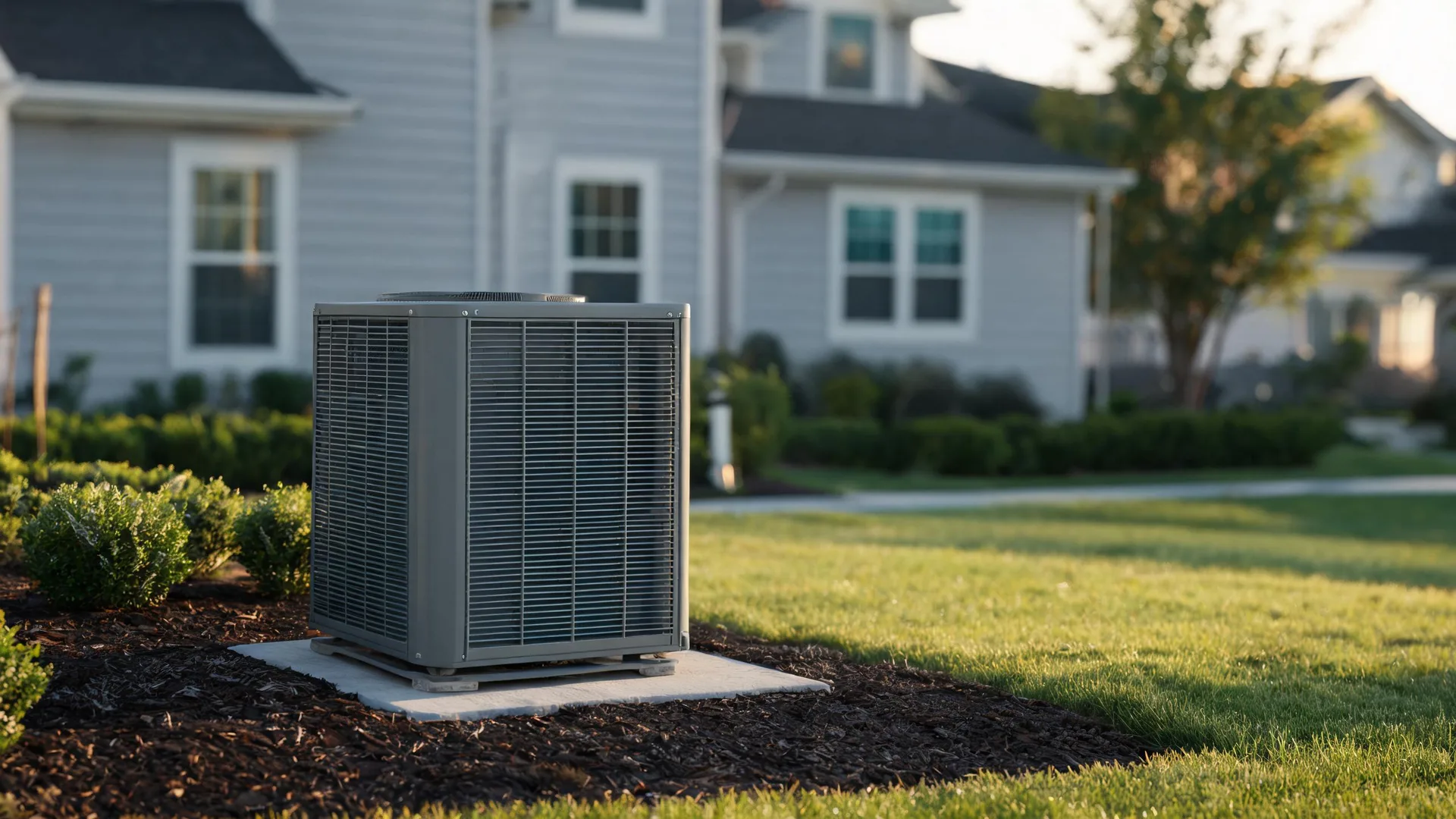
The nameplate on the old unit isn't the answer

A contractor works out the right size with a load calculation, room by room, based on square footage, window area, insulation, and ceiling height. The old unit might have been wrong from the day it went in, or the house might have changed since, new windows, added insulation. Sizing off what's already there just carries the mistake forward.

Aerial view of a gray outdoor air conditioning condenser unit mounted on a concrete pad next to a house with vinyl siding.

Going above the federal minimum saves little here, about $20 a year.

  • A higher-efficiency unit$170 a year
  • A new unit at the federal minimum, 13.4 SEER2$190 a year

Estimates for a typical St. Joseph County home, from EIA household energy data, Indiana fuel prices and NOAA climate normals. Your home will differ.

Once the new condenser and coil are in place and ready, a tech pulls a vacuum on the line set to clear out moisture and air before any refrigerant goes in. That step matters more than people think, because trapped moisture turns into acid inside the system over time and trapped air throws off the pressures a compressor needs to run correctly. After charging to the weight the manufacturer specifies, a tech checks the pressures, the airflow across the coil, and the temperature split between the air going in and the air coming out. None of that shows up on the nameplate. A unit sized exactly right can still run worse than it should if that startup check gets skipped.