A row of dark-sided single-story houses with gray shingled roofs behind large leafy trees, a trimmed hedge at left and mown lawn with a narrow walkway in front.

AC Installation in Richmond, IN

Tell us about the job

Takes about a minute. No obligation.

New system or replacementCentral ACWayne County, IN
Step 1 of 2

What ZIP code is the job in?

Gas furnaces are the norm here

Just over half of Wayne County homes heat with utility gas. A new AC usually gets paired with the furnace already in place, so your installer is more likely to be matching a coil to a gas furnace than working around electric heat.


What that means for your install

If your home runs on gas heat, the furnace and the air handler are separate questions. The AC installer still needs to check that the existing ductwork and the indoor coil match up with whatever size unit goes in, whether your heat comes from gas, electric, propane or oil.

3 months
June through August, your air conditioner is on duty
83°F
the average summer afternoon it cools against
14 hail events
in ten years, and hail bends the fins on outdoor coils
13.4 SEER2
the federal minimum any new unit must meet
Isometric cutaway illustration of a small house showing interior rooms, ductwork, an indoor air handler, and an outdoor condenser unit connected by lines, on a plain white background.
Your air conditioner works hardest from June through August.

NOAA nClimDiv, 1991–2020 normals

Cooling runs June through August here.

Install in May and the new system is ready before the first hot week, not scrambling to catch up with it.

Half the homes in Wayne County were built in 1960 or earlier, and a new AC has to match the house it's going into

Half the homes here were built by 1960
Cooling runs June through August
Summer afternoons average 83°F

Ask what size unit they're proposing and how they got that number. A proper contractor measures the house, the windows, the insulation, and runs a load calculation. Someone who quotes a size based on the old unit or a quick walkthrough is guessing. Ask about the indoor coil too, not just the outdoor unit. The coil has to match the air handler or furnace it's paired with, and it has to match the refrigerant the new system uses. Ask what happens to the ductwork. If the ducts were sized for a different unit, moving more or less air through them can mean rooms that don't cool evenly, or a system that runs longer than it should.

Any new system here has to meet 13.4 SEER2

Wayne County falls in climate zone 5A, and any split-system air conditioner installed here, under 45,000 Btu/h, has to meet a federal minimum of 13.4 SEER2. That sets a floor on what an installer can offer you. There's a federal tax credit available for qualifying high-efficiency equipment, worth checking against whatever system you're considering.

Find a contractor
A man in a cap, gray long-sleeve shirt and brown pants carries a worn canvas tote bag up porch steps toward an orange front door beside a potted olive tree.
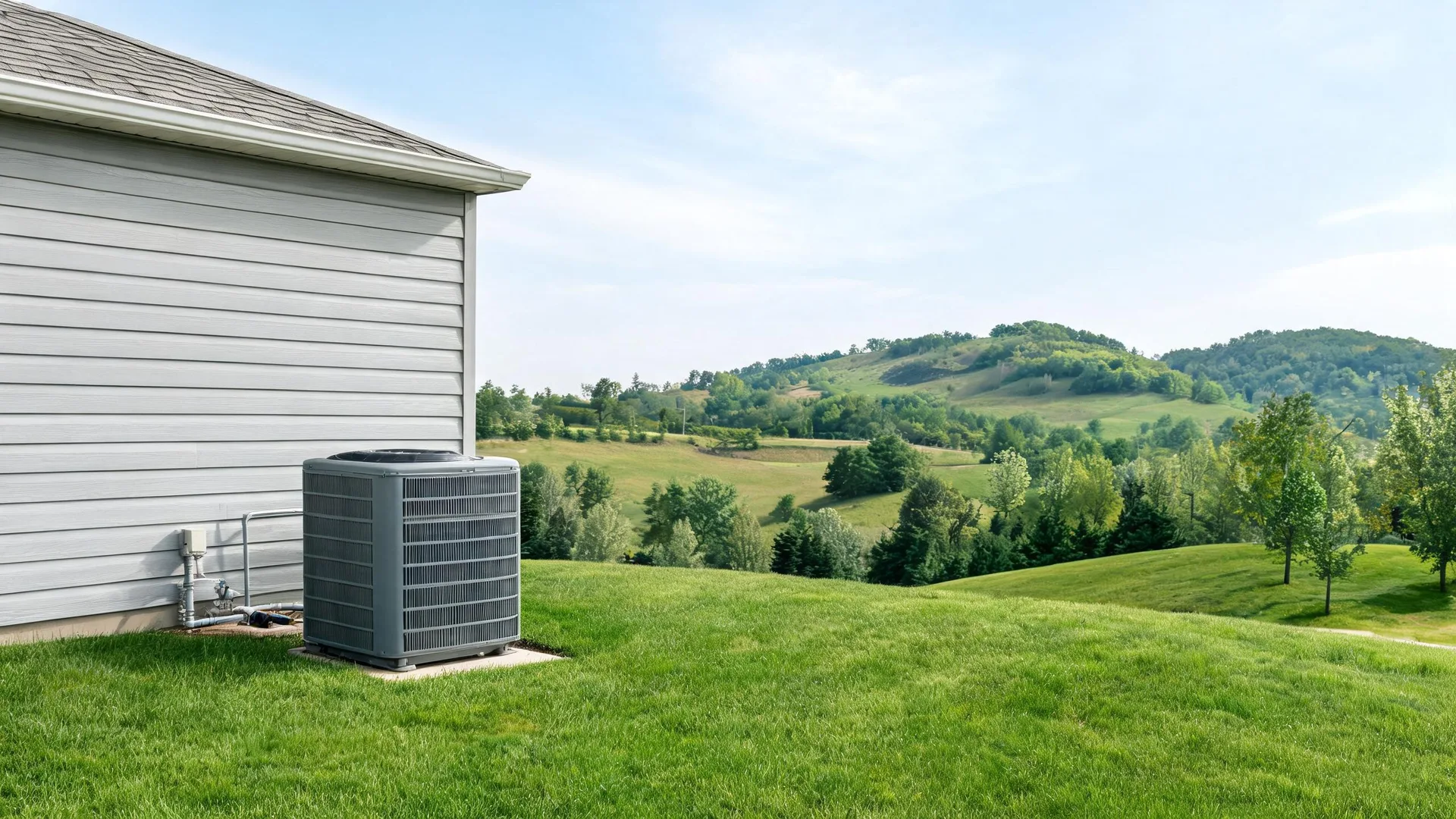
A gray metal air conditioning condenser unit mounted on a concrete pad in a flat grassy field under a partly cloudy sky.

What drives the price

Size drives most of the cost. A unit that's too big cools the air fast but doesn't run long enough to pull the moisture out, so rooms feel damp even at the right temperature. One that's too small runs constantly trying to reach a setpoint it can't hold. Getting the size right takes a load calculation that looks at the house itself, not a guess based on the unit being replaced. The coil and the air handler or furnace have to match each other and match the refrigerant the new system uses, and that's a second decision beyond just picking an outdoor unit. If the ductwork was sized for the old system, moving a different amount of air through it may call for changes there too. Line length between the outdoor unit and the indoor coil matters, and so does whether the electrical panel can carry the new load. None of this is extra. It's what makes the system cool the way it's supposed to.

The old unit gets hauled away, refrigerant and all

The refrigerant in the old system has to be recovered into a tank before the unit can be disconnected. That's a legal requirement, not a courtesy, so a licensed installer handles it as part of the job rather than just unbolting the cabinet and leaving.

The slab or pad usually stays

Most installers set the new outdoor unit on the existing pad if it's still level and in good shape. If the new unit is a different size or the pad has cracked or sunk, that gets addressed before anything is set on it, since an uneven unit can wear its own compressor mounts over time.

Overhead view of an outdoor AC condenser unit on a concrete pad next to a house with a dark shingle roof.

A higher-efficiency unit would save about $30 a year to run in Wayne County compared with a new unit at the federal minimum.

  • A higher-efficiency unit$190 a year
  • A new unit at the federal minimum, 13.4 SEER2$220 a year

Estimates for a typical Wayne County home, from EIA household energy data, Indiana fuel prices and NOAA climate normals. Your home will differ.

Installation day starts with the old system coming apart. The refrigerant gets recovered first, then the lines, the coil and the outdoor unit come out. From there it's mounting the new outdoor unit, setting or connecting the indoor coil, and running new line set if the old one doesn't match the new refrigerant. The electrical connections get made, the system gets evacuated to pull moisture and air out of the lines, then it's charged with refrigerant to the manufacturer's spec. Once it's running, a tech checks airflow at the vents, checks the temperature split between the air going in and the air coming out, and confirms the charge is correct. A system that's low on charge or has air trapped in the lines might turn on and blow cold at first, but it won't hold up, so that check at the end is what tells you it's actually done right.