






Aerial view of a square outdoor air conditioning condenser unit on a concrete pad beside a house wall with a sliding glass door.

AC Installation in Columbia City, IN

Tell us about the job

Takes about a minute. No obligation.

New system or replacementCentral ACWhitley County, IN
Step 1 of 2

What ZIP code is the job in?

Gas heats about half the homes in Whitley County, with electricity and propane splitting most of the rest. Most AC installations here pair with a gas furnace already in place. That furnace and its ductwork have a say in which air conditioner or coil fits, since the new equipment has to match what is already moving air through the house. If your home runs on propane or electric heat instead, the same logic holds. The cooling side gets matched to whatever system is already there, not swapped in on its own.

3 months
June through August, your air conditioner is on duty
82°F
the average summer afternoon it cools against
3 hail events
in ten years, and hail bends the fins on outdoor coils
13.4 SEER2
the federal minimum any new unit must meet
Isometric cutaway illustration of a house interior showing ducted HVAC piping, an indoor air handler unit, and an outdoor condenser with fan connected by a line, rendered in grey tones on a white background.
Your air conditioner works hardest from June through August.

NOAA nClimDiv, 1991–2020 normals

Summers in Whitley County run about three months, June through August, with afternoon highs around 82°F.

An air conditioner here is not working against the heat most of the year, so a well-matched standard system is enough.

A normal-sized system handles summers here

Power costs 14.77 cents a kWh statewide
Cooling runs June through August
Summer afternoons average 82°F

Whitley County falls under zone 5A, a cool, humid zone where heating carries the bigger load. That still sets a floor for any air conditioner going in here. Split-system units under 45,000 Btu/h have to meet 13.4 SEER2 at minimum, no matter how mild the summers run. A contractor sizing a system for your home is working from that number up, not down. A federal tax credit is also available on qualifying high-efficiency equipment, worth asking about alongside the SEER2 rating itself.

Get it installed in May, before June asks anything of it

Cooling in Whitley County runs June through August. May is the month before that starts, the last stretch where a new system can go in before anyone needs it running. A contractor has time to size it right and match it to the furnace and ductwork already in place, instead of fitting that in around a house that is already warm.

Find a contractor
A man in a cap, dark shirt and tan work pants, seen from behind carrying a worn canvas tool bag, steps up onto a porch toward an orange front door beside a potted shrub.
An outdoor residential air conditioning condenser unit mounted on a concrete pad, surrounded by gravel with a blue sky in the background.

The old unit doesn't linger once the new one's in

When a new condenser goes in, the old one comes out, and so does the coil sitting on top of the furnace. That coil matters as much as the outdoor unit. An old coil run with new refrigerant wears fast, and leaks show up within a season. Most of what happens next is disposal and recovery. Refrigerant gets reclaimed from the old lines before anything is cut loose, since venting it isn't legal and isn't safe. The copper lines get checked too. Some get reused if they're sized right for the new system, others get replaced because the old diameter was matched to a different unit. None of this is work the homeowner has to manage. A contractor handles the teardown the same visit as the install, so the old equipment is gone before the new system ever runs.

The coil and condenser have to match

An outdoor condenser is rated to work with a specific coil, matched for the refrigerant charge and the airflow between them. Pair a new condenser with an old or mismatched coil and the system can still run, but it won't cool the way it's rated to, and it puts strain on the compressor that shortens its life. This matched pairing is a bigger driver of what the job costs than the condenser alone.

The ductwork decides what else gets done

An air conditioner can only move as much air as the ducts allow. If the existing ductwork is undersized or leaky for the new system's output, a contractor has to address that as part of the job, not after it. Sealing joints, adding a return, or resizing a duct run all add work beyond setting the new equipment in place, and that work is specific to what's already behind the walls.

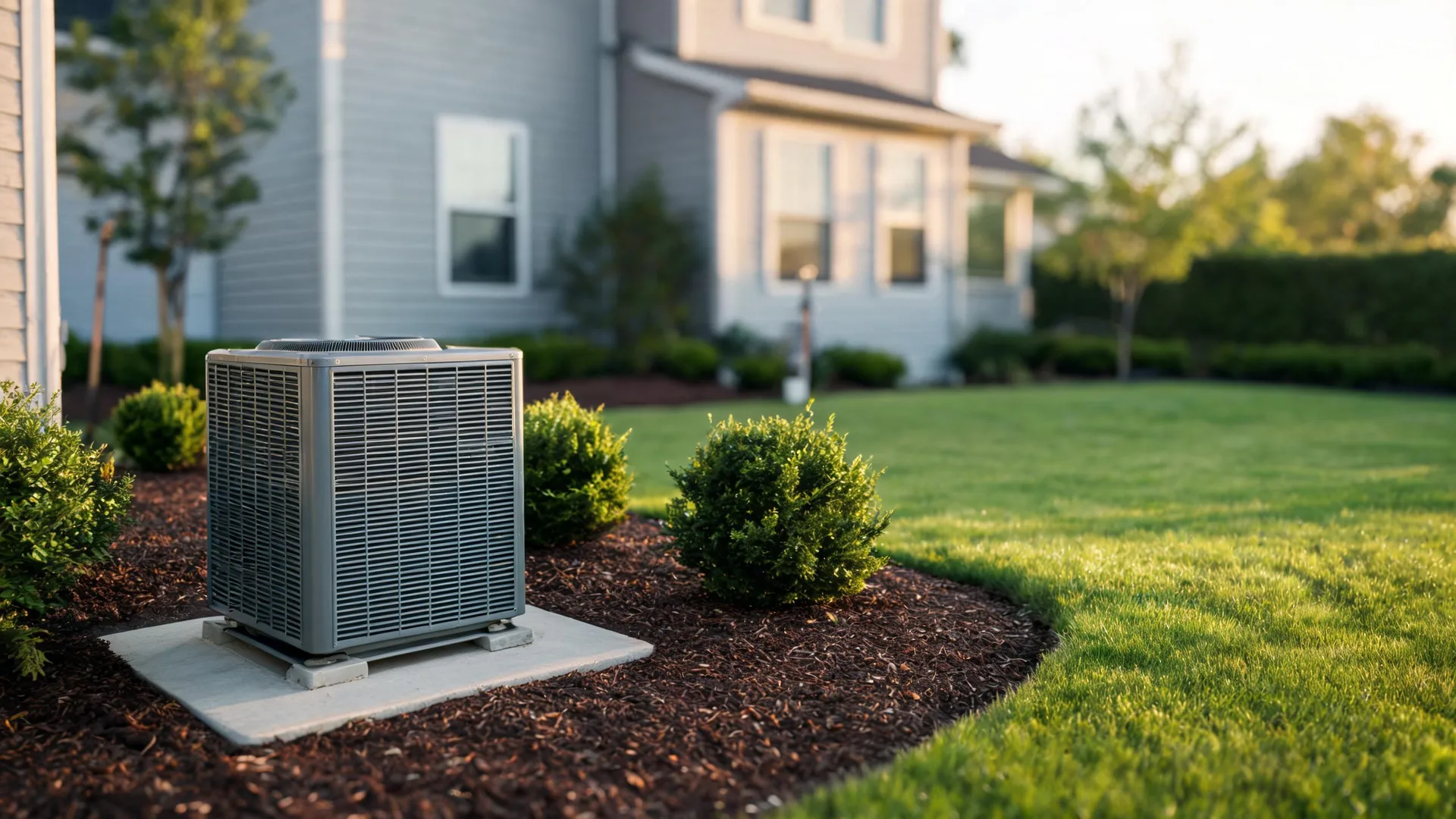
Overhead view of a gray residential air conditioning condenser unit mounted on a concrete pad beside a house with asphalt shingle roofing.

A higher-efficiency unit would save about $30 a year to run in Whitley County compared with a new unit at the federal minimum.

  • A higher-efficiency unit$170 a year
  • A new unit at the federal minimum, 13.4 SEER2$200 a year

Estimates for a typical Whitley County home, from EIA household energy data, Indiana fuel prices and NOAA climate normals. Your home will differ.

Installation day starts outside. The old condenser gets disconnected and set aside while refrigerant is recovered from the lines, then the new unit goes on the pad in its place. Inside, the coil above the furnace comes out too, and the new one gets set and sealed so it mates with the furnace's airflow. Line sets get checked for the right diameter. Some get reused, others get swapped, then they're brazed and pressure tested before anything gets charged. Once the system holds pressure, it gets charged to the exact weight the manufacturer specifies for that line length, not just topped off and left. Near the end a contractor checks static pressure and the temperature split across the coil, because that confirms the system is actually moving the air it's rated for. A system that runs but doesn't hit that split isn't finished yet, even if it's cooling the room.