





A row of dark-painted single-story houses with gray shingled roofs behind a tall trimmed hedge, with mown lawn, a walkway, and leafy trees under an overcast sky.

AC Installation in Auburn, IN

Tell us about the job

Takes about a minute. No obligation.

New system or replacementCentral ACDeKalb County, IN
Step 1 of 2

What ZIP code is the job in?

Gas furnaces heat 55.2 percent of the homes in DeKalb County, and that matters for an AC install because most of those homes already have the ductwork a central air system needs. If your furnace sits in a closet or basement with supply ducts running to every room, adding or replacing an AC unit means matching a new condenser and coil to what's already there. Electric heat runs 23.9 percent of homes here, and LP or bottled gas another 16.8 percent, so the setup varies some house to house. What stays the same is the duct system doing the work of moving the cooled air, whatever heats the place in winter.

3 months
June through August, your air conditioner is on duty
82°F
the average summer afternoon it cools against
18 hail events
in ten years, and hail bends the fins on outdoor coils
13.4 SEER2
the federal minimum any new unit must meet
Isometric cutaway illustration of a single-story house showing interior ductwork and an air handler connected by lines to an outdoor condenser unit on a pad beside the building.
Your air conditioner works hardest from June through August.

NOAA nClimDiv, 1991–2020 normals

Half the homes in DeKalb County were built in 1975 or earlier, half in 1975 or later.

Either way, a standard size and efficiency unit does the job, matched to the space it has to cool.

Cheap power here means the pricier high-efficiency unit takes longer to earn back its cost

Power costs 14.77 cents a kWh statewide
Cooling runs June through August
Summer afternoons average 82°F

DeKalb County sits in climate zone 5A, a zone built around cold winters more than hot summers. Any split-system central air conditioner installed here under 45,000 Btu/h has to meet 13.4 SEER2 at minimum, the federal floor for units made from 2023 on. That number measures efficiency, not how much space a unit can cool, so it narrows which models qualify without deciding the size your home needs. A federal tax credit is available for qualifying high-efficiency equipment, worth asking about alongside whatever unit you're considering. The zone rating is about the climate, not the house, so it holds regardless of when the place was built.

Get it installed before June, not in the middle of a heat wave

Cooling in DeKalb County runs June through August. Put a new system in before June and it's set up and running right on your schedule, not during the first hot week when you need it most.

Find a contractor
A man in a dark gray t-shirt and brown work pants, seen from behind, carries a worn leather tool bag up wooden porch steps toward an orange front door.
An outdoor air conditioning condenser unit mounted on a concrete pad surrounded by gravel, photographed against a partly cloudy blue sky.

The old condenser doesn't get repaired. It gets replaced, whole

When the new condenser goes in, the old one comes out, along with the coil sitting on top of the furnace. A compressor that's run for years has usually lost some of the charge it started with, and it's done most of the efficient work it's going to do. Refrigerant in the old system has to be recovered before anything gets disconnected, that's a legal requirement, not a courtesy. Once it's out, a contractor checks the line set running between where the condenser sat and where the coil was. An old line set can stay if it's the right diameter and free of pinholes or kinks, but a lot of installers replace it anyway, since a leak in a buried or wall-run line is miserable to chase down later. The pad under the old condenser usually stays, or gets releveled if the ground's shifted under it.

The SEER2 number is a best-case average, not a guarantee

A unit rated at a given SEER2 hits that efficiency under specific test conditions. Run it on the hottest afternoons, with ducts that leak or a coil that's undersized for the condenser, and the system works harder than the label implies. The rating tells you what the equipment is capable of, not what it will actually deliver in your house.

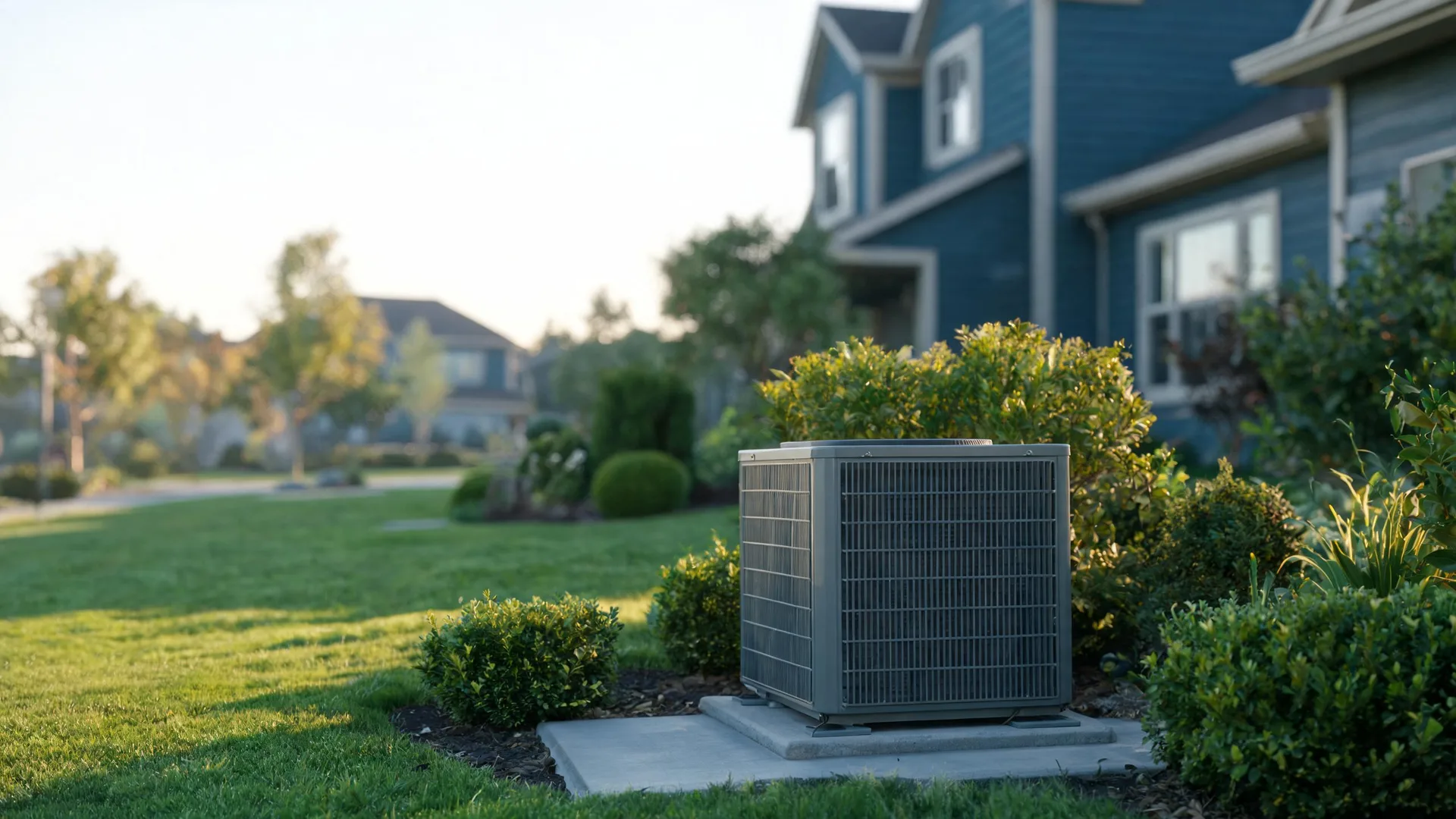
The rating only holds if the rest of the system matches it

The condenser is one part of the pair. The coil inside has to be rated to work with it, and the ductwork has to move enough air across that coil for the system to perform the way the label says. Put a high-efficiency condenser on a mismatched coil or undersized ducts and the unit won't reach the number printed on it.

An outdoor air conditioning condenser unit installed beside the exterior wall of a blue vinyl-sided house at sunset.

A higher-efficiency unit would save about $30 a year to run in DeKalb County compared with a new unit at the federal minimum.

  • A higher-efficiency unit$160 a year
  • A new unit at the federal minimum, 13.4 SEER2$190 a year

Estimates for a typical DeKalb County home, from EIA household energy data, Indiana fuel prices and NOAA climate normals. Your home will differ.

Contractors can quote the same tonnage and still hand you different equipment, so ask what's actually different before you compare prices. Ask what coil they're pairing with the condenser, since a mismatched coil is the easiest way to lose the efficiency you're paying for. Ask how they're sizing the unit. A proper load calculation looks at square footage, windows, and insulation, not just a guess based on what's coming out. Ask what happens to the line set, and whether the new connections get pressure tested before the system is charged. Ask about the warranty on the compressor and the warranty on labor separately, since those often run different lengths and only one of them is on the contractor. Someone who answers all of this without hesitation has done the job enough times to get it right.