

Why your AC is running but not cooling in Indiana

RepairCentral ACIndiana
Step 1 of 2

What ZIP code is the job in?

Why is my AC running but not cooling my house in Indiana?

You walk by the vents and feel air moving, so the system is clearly on, but the house still feels sticky and the thermostat won't budge. In Indiana, a muggy July evening makes that gap between "running" and "cooling" obvious fast, and it's the kind of thing you want sorted out tonight, not after another week of the same.

Your AC is running low on refrigerant or the airflow across its coil is blocked

An air conditioner cools by moving heat out of your house through refrigerant, and that only works if the charge is correct and air can pass freely over the indoor coil. A low refrigerant charge, usually from a leak, means the coil can't pull enough heat out of the air moving over it. A dirty filter or a frozen coil does the same thing by blocking that air entirely. Either way, the blower keeps pushing air and the compressor keeps running, so it sounds and feels like the system is working, but what comes out of the vents is barely cooler than what went in. In Indiana's humidity, that difference shows up fast because the air holds so much moisture to begin with.

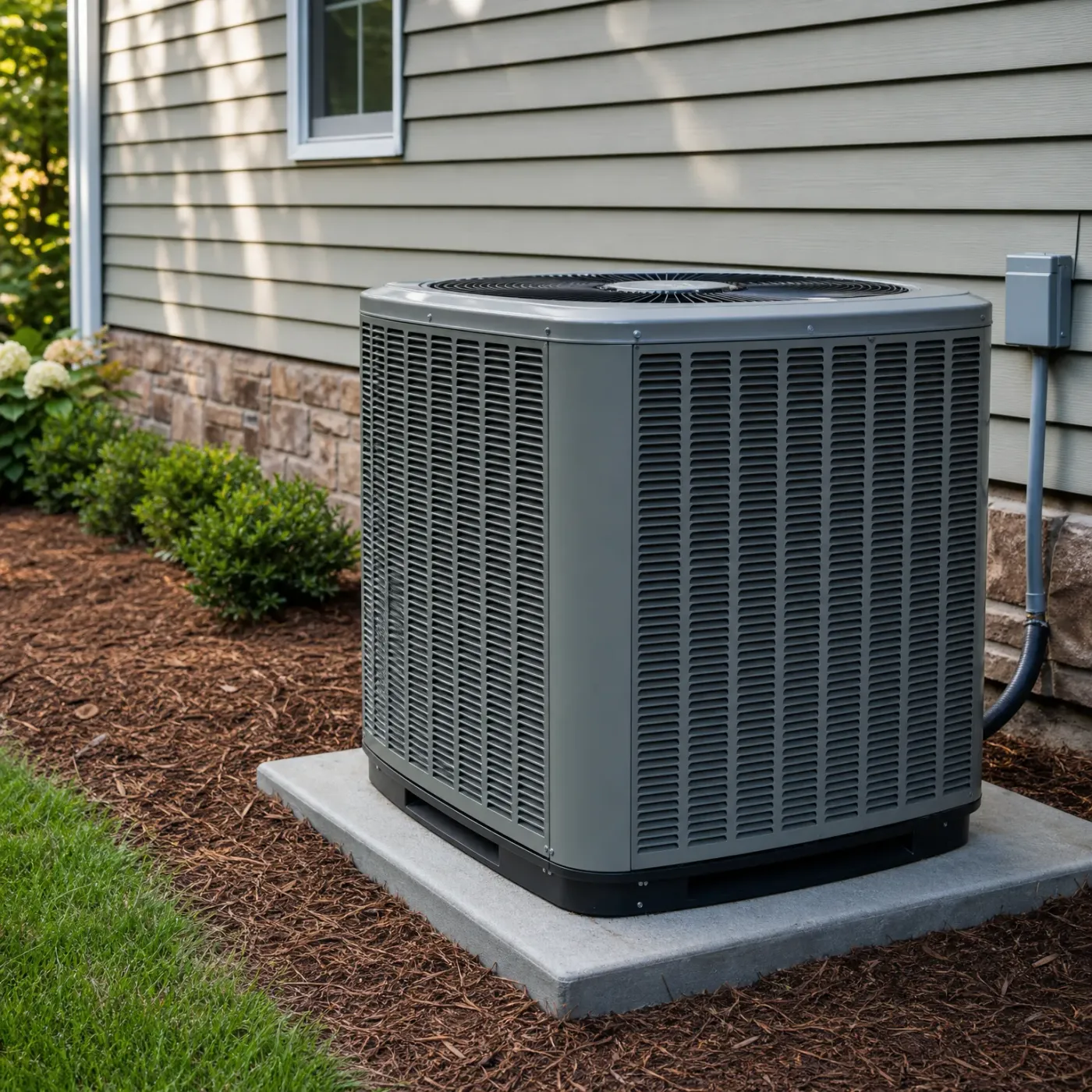
A gray outdoor air conditioning condenser unit on a composite pad beside a house with horizontal lap siding, with a wall-mounted disconnect box, refrigerant lines, and a wooden fence and shrubs to the left.

Running the way it should

Air comes out of the vents cold enough that you notice it on your arm. The condenser outside cycles on, runs for a while, then shuts off once the house catches up. The thermostat number and the way the room feels actually match.


An outdoor air conditioning condenser unit on a concrete pad beside a house with light vinyl siding, with electrical conduit running to a wall-mounted disconnect box and a shrub in mulch to the right.

Running but not keeping up

The condenser outside is on, the fan inside is moving air, and the house still feels thick by evening. That usually points to something inside the cabinet or the lines running up the wall, not the thermostat setting. A contractor can tell you which part it is.

What You Can Check, What Needs a Pro

Something you can fix tonight

  • A dirty filter chokes off airflow across the coil, and swapping it is a five-minute job with no tools.
  • A thermostat set to "on" instead of "auto" keeps the fan blowing even when the system isn't cooling, so check that switch first.
  • A tripped breaker on the outdoor unit will leave the indoor fan running while the condenser outside sits dead quiet.
  • Vents closed or blocked by furniture in a couple of rooms won't stop cooling, but they push warm air into the rooms you're trying to cool.
  • If the outdoor unit is caked in grass clippings or buried in leaves, clearing the sides can restore airflow the condenser needs.

Something only a contractor can reach

  • A refrigerant leak means the system is low on charge, and only a licensed contractor can find the leak, repair it, and recharge it to the right level.
  • A frozen evaporator coil, which happens often once Indiana humidity climbs in July, has to thaw out before anyone can even diagnose what caused it.
  • A failing capacitor or contactor in the outdoor unit can let the fan run while the compressor never actually starts.
  • Ductwork that's come loose or disconnected in a crawlspace or attic sends cooled air somewhere other than your rooms, and finding that takes someone crawling the line.
  • A compressor nearing the end of its life may run constantly without building enough pressure to actually cool, and that diagnosis takes gauges and experience.
A smiling bearded man in a dark green henley shirt sits on a blue-gray couch in a living room, with a bowl of popcorn in the foreground and a houseplant and window behind him.
A smiling man in a dark sweatshirt reclines on a gray sofa in a living room, with a wooden bowl of popcorn on a table in the foreground and a dining area, shelving, and pendant lamp behind him.
A smiling man in a navy long-sleeve shirt reclines on a sofa in a living room, with a bowl of popcorn on a wooden coffee table and framed pictures on the wall behind him.
A smiling man in a dark green long-sleeved shirt sits on a gray sofa in a living room, with a bowl of popcorn in the foreground and windows and a potted plant behind him.

Is this actually hurting anything, or just uncomfortable

Walk through your house and you'll notice which rooms feel worse. Upstairs bedrooms stay warm while the main floor is closer to normal. The air coming out feels room temperature instead of cold, maybe even warm to the touch. You might hear the outside unit running almost constantly instead of cycling off. Check around the indoor unit for water on the floor or a musty smell, since a frozen coil thawing out can leave a puddle. None of this is urgent the way a gas leak is, but a system that runs without cooling is still pulling power and still straining the compressor, and ignoring it long enough can turn a repair into a replacement.

A gray outdoor air conditioning condenser unit sits on a concrete pad beside a house with horizontal siding, connected by insulated lines to a wall-mounted disconnect box, with a shrub and gravel bed to the right.

Clean and holding steady

The coil fins are clear, so air moves through them the way they're built for. The disconnect box and lines sit against the wall doing nothing unusual. A unit that looks like this is pulling heat out of your house the way it's supposed to, cycling on and off instead of running straight through a sticky evening.

An outdoor air conditioning condenser unit sits on a concrete pad beside a house with horizontal vinyl siding, with a gray electrical disconnect box and insulated refrigerant line on the wall above, surrounded by bare mulched ground.

Caked in grime

Dirt and grime cover the coil fins and the housing around them. That buildup sits between the refrigerant and the outside air, so the heat your house is shedding has nowhere to go. A unit left like this can run all evening and never bring the thermostat down.

An outdoor air conditioning condenser unit with a dirty mesh coil guard sits on a concrete pad beside a house with horizontal lap siding, a wall vent, and conduit running to an electrical disconnect box.
Before you get your air conditioner repair
A gray outdoor air conditioning condenser unit on a concrete pad beside a house with horizontal vinyl siding, a brick foundation, downspout, electrical disconnect box, mulch bed and a green shrub.
After you get your air conditioner repair
A gray outdoor air conditioner condenser unit on a concrete pad beside a house with horizontal siding and a stone veneer base, surrounded by mulch, shrubs and grass.

Hand off the search today

Describe your air conditioner job once, to one pro.

Send the request today and let an air conditioner pro reach out to you.

Hand off my repair

There's no charge for the request.

An outdoor air conditioning condenser unit on a concrete pad beside a house with horizontal lap siding, with a gray electrical disconnect box and conduit on the wall, mulch bed and shrub to the right, and mown grass in the foreground.
The coil guards are clean, so the unit pulls outside air through without a fight.
An outdoor air conditioning condenser unit on a concrete pad beside a house with light blue horizontal siding, with a shrub to the left and a conduit and disconnect box on the wall to the right.
Dust packed into the coil guards blocks airflow, and the system works harder to move less heat.

What's actually happening inside the system

  • Refrigerant runs in a closed loop, so low cooling almost always means a leak somewhere in the lines or coil.
  • The indoor coil absorbs heat from air blowing across it, and ice forming there blocks airflow instead of cooling it.
  • A contactor stuck or burned out in the outdoor unit can leave the compressor silent while the indoor fan still runs.
  • The compressor is what actually moves refrigerant and does the cooling work, not the fan you hear outside.
  • A clogged condensate line can trip a safety switch that shuts the compressor off while leaving the blower running.
  • Low airflow from a dirty coil or blocked return makes the system remove heat far slower than it's built to.

The parts you can hear working are not the parts that do the cooling. The outdoor fan and the indoor blower move air, but the compressor is what pressurizes refrigerant and sends it through the lines to pull heat out of your house. If the compressor isn't running, or refrigerant has leaked out of the loop it travels in, the fans still spin and the air still moves, it just isn't cold. A contactor in the outdoor unit controls power to the compressor, and when it sticks or burns out, the compressor goes quiet while everything else keeps going like normal. Refrigerant itself doesn't get used up. It stays in a sealed loop between the indoor coil and the outdoor unit, so if levels are low, something let it out, usually a slow leak at a joint or in the coil itself. The indoor coil is where the heat exchange happens, cold refrigerant inside the coil pulls warmth out of the air blowing across it. If that coil ices over, from low refrigerant or from poor airflow, the ice itself blocks air from passing through, so even a working system stops cooling. Airflow problems compound this. A dirty coil or a blocked return starves the system of the air volume it needs to transfer heat at the rate it's designed for. And a clogged condensate line can trip a float switch meant to prevent water damage, shutting the compressor off as a safety measure while the blower runs on, which looks a lot like the system just gave up.

A woman with dark hair in a bun sits on a beige sofa under a knit blanket with her eyes closed and an open book in front of her, with a lit lamp and houseplant in the background.
A smiling bearded man in a dark sweater sits at a dinner table with lit candles, a glass of red wine, and bowls of food, in a dimly lit room with a lamp and houseplant behind him.
A two-story house with light horizontal siding, a covered front porch and white door, fronted by a wet concrete walkway, trimmed hedges, a green lawn and leafy trees under a clear sky.

The National Weather Service puts the average summer dew point for Indiana at 64°F across June, July and August. That's the number that tells your AC how hard it has to work, more than the temperature on the thermostat does. Past 60, the air holds enough moisture that your system has to pull a lot of it out before the house feels dry, not just cool. A unit low on refrigerant or clogged with dust can drop the air a few degrees and stop there, leaving the house cold-ish but still clammy. That's the sticky feeling you get even when the vents are blowing.

NASA POWER T2MDEW county cells weighted by homes

Air moving through the vents without cooling the house almost always traces back to one of a short list of causes: a dirty filter, a frozen coil, a low refrigerant charge, or a failing part in the outdoor unit. Which one it is determines what happens next, and that's not something to guess at while the house sits at 78 with the thermostat set to 72. Instead of searching through contractors, calling a few, explaining the same thing about warm air and a running system to each one, then sitting with quotes trying to compare apples to oranges, you send one form. A licensed contractor in your area takes it from there. You stop carrying the problem of finding someone qualified, and you get to hand off the actual diagnosis, the coil, the charge, the part, to someone who can look at your system directly instead of guessing with you over the phone.

A beige upholstered armchair with a dark green pillow sits beside a woven basket holding a cream fringed throw, with a potted leafy plant in a second basket near a window.
Sunlit living room corner with a beige upholstered sofa and striped linen cushion, a potted small-leaved tree in a woven basket beside sheer curtains, a framed artwork on the wall, and a jute rug on a wood floor.
A wooden storage bench with a long linen bolster cushion sits against a pale wall beneath hanging jackets, beside a doorway showing a plant and chair in sunlight, with a woven rug on the wood floor.
A dark wood sideboard holding a shallow wooden bowl and a pale ceramic vase with leafy branches, against a beige wall with a framed artwork and a window showing a sunset sky and trees.
A lit ceramic table lamp with a tapered fabric shade sits on a wooden side table beside a small wooden bowl, with a woven basket on the shelf below, next to a gray upholstered sofa and a dark-framed window at dusk.

Hand off the air conditioner problem

Fill out one short form instead of calling around.

Send it today

You only hire the pro if you want to.