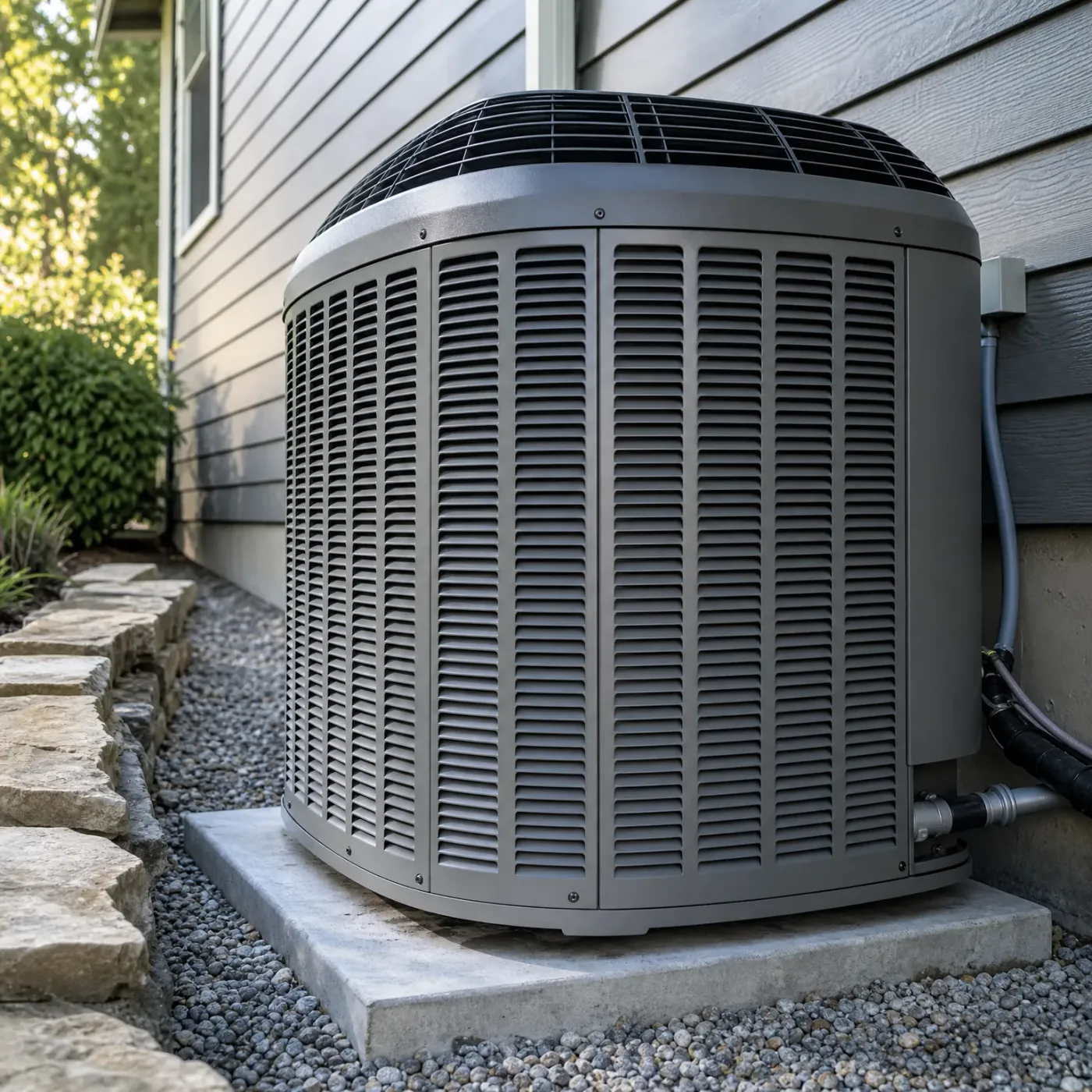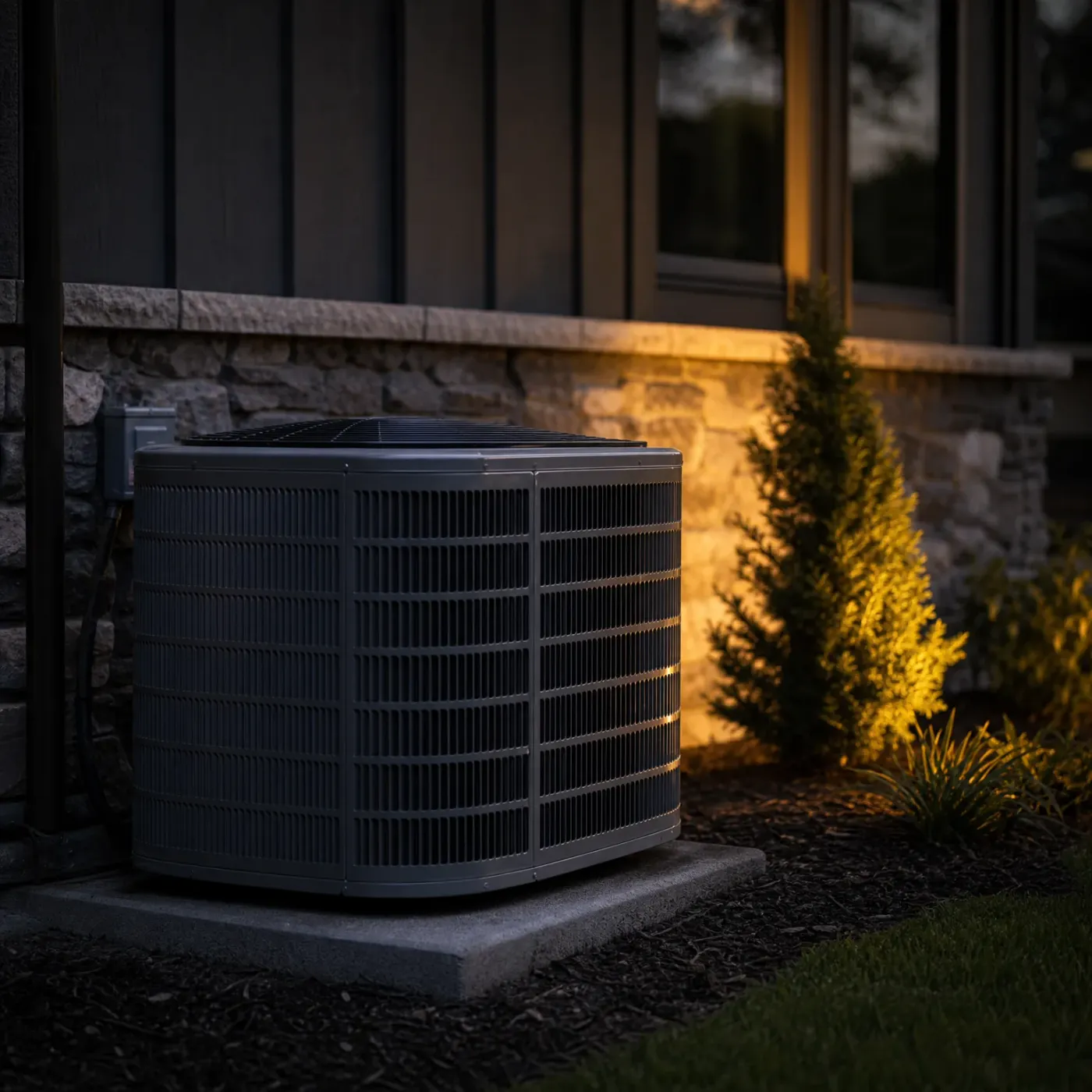






An outdoor air conditioning condenser unit on a concrete pad beside a house with stone veneer and vertical board siding, with a small shrub and mulch bed lit by a ground light at dusk.

Hand off the search today

Signs your AC is low on refrigerant in Indiana

Your AC runs hard all summer here, and when it's low on refrigerant it struggles to keep up, runs longer, and still leaves the house warm. This page walks through what that actually looks like, from weak cold air to ice on the lines. Send the form once and skip calling around to find someone who can check the charge.

Hand it over

A low refrigerant charge shows up as warm air that never quite gets cold, ice forming on the copper line outside, and a system that runs for hours without the house catching up. Refrigerant doesn't get used up like fuel. If the level is low, it's leaking out somewhere in the coil or lines, and the charge will keep dropping until that leak gets found and sealed. You might also hear a hissing or bubbling sound near the indoor unit, or notice the outside unit blowing air that isn't as cold as it should be even when it's running constantly. In Indiana summers, a system fighting a refrigerant leak can run most of the day and still lose ground once the heat and humidity build up. The longer it runs low, the harder the compressor works, and that's the part most expensive to replace. Catching this early, before the compressor takes the strain, is what keeps a refrigerant problem a small repair instead of a big one.

An outdoor air conditioner condenser unit on a concrete pad beside a house with beige horizontal siding and a stone-veneer base, with refrigerant lines running to a gray wall-mounted electrical box, surrounded by dark mulch, a flowering shrub and an evergreen on the left.
The unit here is clean and clear, running on a normal cycle without ice or frost anywhere on the lines or coil.
An outdoor air conditioning condenser unit on a concrete pad beside a house with light vinyl siding, an electrical disconnect box and conduit on the wall, bare shrubs and mulch to the right, and a concrete walkway in the foreground.
This is the same unit low on charge, with bare winter shrubs nearby and the kind of strain that calls for a look before it gets worse.

Refrigerant moves through a sealed loop between the indoor coil and the outdoor unit. It doesn't burn off or wear down. If the level drops, it's because it found a way out, usually at a coil seam, a fitting, or a joint in the line set. Once the charge is low, the indoor coil runs colder than it should, cold enough that moisture in the air freezes onto it instead of draining away as condensation. That ice covers more of the coil as it builds, which blocks airflow and cuts cooling further, so the slide from minor to serious can happen over a single hot stretch. The compressor feels it too. It's built to compress refrigerant, and with less of it in the line, it ends up pulling mostly vapor, which pushes its operating temperature up the longer it runs. Sometimes the leak announces itself, a hiss or a soft bubbling sound near the indoor unit, right at the point where refrigerant is escaping. Push the system hard on a 90-plus day and a small leak that was holding steady can turn into a system that won't keep the house cool at all.

How a low charge actually plays out

  • Refrigerant runs in a closed loop, so a low charge almost always means a leak at a coil, a fitting, or a line joint.
  • The indoor coil carries refrigerant that absorbs heat from the air, and a low charge drops the coil's temperature below freezing, where moisture in the air turns to ice on contact.
  • That ice blocks airflow across the coil, so even less heat gets absorbed, and the problem speeds up instead of staying steady.
  • A compressor built to move refrigerant ends up moving mostly vapor when the charge is low, which raises its operating temperature over time.
  • The sound a low-charge system makes is often a hiss or bubbling near the indoor unit, coming from refrigerant escaping at the leak point itself.
  • Outdoor temperatures above 90 make a marginal leak show up faster, since the system has to work harder to keep the same indoor setpoint.
A smiling man in a blue denim shirt over a white tee sits at a light stone kitchen counter with a grey mug and a bowl of oranges and bananas, with pendant lights and shelving behind him.
A smiling bearded man in a grey long-sleeved shirt sits at a kitchen counter with a dark mug, with a dining table, pendant light and glass doors onto greenery behind him.
A bearded man in a dark green knit sweater smiles and looks off to the side while standing at a kitchen counter with a white mug of coffee, with open shelving, a potted tree, and a dining table near large windows behind him.
A man with dark curly hair in a dark green sweater stands smiling and looking to the side in a kitchen with white cabinets, a potted plant, a stone countertop with a ceramic mug, and a dining area with framed art in the background.

Why the bill climbs first

A low charge makes the compressor run longer to move the same amount of heat out of the house. That extra runtime shows up on the electric bill before anyone notices the house feels warmer. A system that used to cycle off every twenty or thirty minutes starts running for an hour or more at a stretch. Indiana summers already push the compressor hard, so a leak just adds hours onto a system that was already working. The thermostat setting hasn't changed, the house hasn't gotten bigger, but the unit outside is working harder to hit the same number.


Why it won't just fix itself

Refrigerant doesn't burn off or wear out the way oil or gas does. The amount sealed in the lines when the system was installed is the amount that should still be there years later. If the level has dropped, it left through a crack, a worn fitting, or a corroded spot on a coil, and it keeps leaving until that spot is sealed. Adding refrigerant without finding the leak buys a few weeks at most. The level will drop again, usually faster than the first time, because the opening doesn't close on its own.

An outdoor air conditioner condenser unit on a concrete pad beside a house with light horizontal lap siding, with an electrical disconnect box and conduit on the wall behind it.
Before you get your air conditioner repair
An outdoor air conditioning condenser unit on a concrete pad beside a house with white horizontal lap siding, with an electrical disconnect box and insulated refrigerant line on the wall and a shrub over mulch to the right.
After you get your air conditioner repair

What a low charge does to your house

A low charge means the house loses the argument with a sticky Indiana afternoon. The air coming out of the vents feels cool but not cold, so the thermostat never quite gets satisfied, and the system keeps running past the point where it used to shut off. Upstairs rooms lag behind the rest of the house. Humidity sits in the air instead of getting pulled out, so the house feels heavier than the thermostat number suggests. None of this fixes itself. A leak that is small today is still a leak, and the charge keeps dropping until the system is working on half of what it needs.

What happens if it keeps running low

Ice builds on the indoor coil when there is not enough refrigerant to keep it above freezing, and once that ice forms, less air moves through the house even though the system is working harder than ever. Left running that way, a compressor can take damage that turns a refrigerant leak into a much bigger repair. The part of the search you can skip is finding someone who handles this. Send the form once, and the work of calling around Indiana, explaining the ice and the warm air twice over, and sorting through quotes stops being something you have to do.

A bearded man in a navy T-shirt sits on a light-colored couch indoors, smiling while looking down at a laptop screen in the foreground, with a framed picture and a potted plant blurred behind him.
A bearded man in a plaid flannel shirt stands indoors beside a wood-framed, frost-covered window, looking outside, with a steaming brown mug on the sill and a wooden cabinet behind him.
A gray outdoor air conditioning condenser unit with louvered sides and a black top grille sits on a concrete pad beside a house with horizontal lap siding, surrounded by gravel and a stone border.

Hand off the air conditioner problem

One form replaces the calls you'd make to find an air conditioner pro.

After this form, you can stop searching for an air conditioner pro.

Hand off my repair

You only hire the pro if you want to.

Is your house just not getting as cold as it used to

You set the thermostat to 72 and the house settles in around 76, and it stays there no matter how long the system runs. Upstairs rooms feel worse than the main floor. The air at the vent is moving but it's lukewarm, not the cold blast you remember. Outside, the unit runs almost nonstop on a hot afternoon instead of cycling off and on. You might notice a hissing sound near the outdoor unit, or frost on the copper line even though it's 90 degrees out. A few people in the house start saying it's warm and nobody argues with them. Left alone, the compressor keeps working harder to do less, and that's the part that tends to fail outright.

  1. Refrigerant seeps out slowly at a coil, fitting, or line joint.

  2. The remaining charge can no longer absorb heat properly.

  3. Pressure inside the system drops along with the charge.

  4. Low pressure lets the indoor coil fall below freezing.

Power costs 15.96 cents per kilowatt-hour statewide

At 15.96 cents a kilowatt-hour, every extra hour your compressor runs to chase a low charge lands on the bill. A unit that's low on refrigerant can run most of the afternoon without the house cooling down, and you're paying for all of it.

EIA-861 2025 statewide residential average

A gray outdoor air conditioner condenser unit on a concrete pad beside a house with white horizontal siding and a brick foundation, with a wall-mounted disconnect box and conduit, and a green shrub with mulch at left.

Running clean

This is what a unit with a full charge looks like. The grille is clear, the coil underneath is clean, and the lines running up to the disconnect carry refrigerant without any sign of strain. Nothing on the outside tells you it's working harder than it should.

An outdoor air conditioning condenser unit on a concrete pad beside a house with white horizontal vinyl siding, with a gray electrical disconnect box and refrigerant lines on the wall behind it.

Caked in grime

Dirt built up like this on the grille and top cover blocks airflow the unit needs to shed heat. It won't cause a refrigerant leak by itself, but a unit already fighting a low charge has even less margin when it's also coated in grime like this one.

Low on Charge vs Full Charge

Low on charge

  • The air at the vent feels cool, not cold, no matter how long the system runs.
  • Ice builds up on the copper line outside, sometimes thick enough to see from across the yard.
  • The system runs for hours at a stretch and the house still doesn't hit the thermostat setting.
  • Upstairs rooms stay warmer than the main floor because the system can't move enough heat out.
  • The electric bill climbs before anyone notices the house feels different.
  • A hissing or bubbling sound near the lines points to where the refrigerant is getting out.

Full charge

  • Cold air comes out of the vents and stays cold the whole time the system runs.
  • The outdoor unit and coil stay clean and dry, with no ice or frost anywhere on the lines.
  • The system cycles off once the house reaches the temperature on the thermostat.
  • Every room cools at close to the same rate, so there's no upstairs and downstairs gap.
  • The compressor isn't working overtime, so the electric bill reflects normal summer use.
  • The lines running to the disconnect are quiet, with no hissing or bubbling sound.
A two-story gray horizontal-siding house with gabled roof and covered entry, fronted by a lawn, trees, a wet concrete walkway and sidewalk, and a wet street in low sunlight.

Indiana summers carry a dew point around 64°F across June, July and August, per NOAA climate data. That's the kind of air that feels heavy the moment you step outside, and it's harder on your AC than the temperature alone. A system pulling moisture out of thick air like that works more to get a house cold, and a unit low on refrigerant has even less capacity to spare. That's when you'll notice the house sitting warm and a little damp even with the system running, not just on the hottest afternoon but most of the summer.

NASA POWER T2MDEW county cells weighted by homes

A closed silver laptop and a white cup of coffee on a saucer sit on a wooden table in front of a wooden chair, a plain beige wall, a potted leafy plant and a window with greenery outside.

What to do with a low charge

A low refrigerant charge doesn't fix itself. It means a leak somewhere in the line, and the only way to stop it is to have someone find the leak, seal it, and bring the charge back to what the system needs. Warm air at the vents, ice on the line, a bill that climbed before the house felt warm. All three point the same direction.

You already deal with small problems before they turn into big ones, so you know the next step isn't guessing or waiting out August. It's getting a contractor out to look at it. Send the form once and you're done with the part that usually eats the time: searching around, calling a few places, explaining the same ice-on-the-line story three times over, then sorting through quotes to figure out who to trust. That work goes away. The diagnosis and the repair are still ahead of you, but finding who does it isn't your job anymore.

A light-colored ceramic vase holding green leafy branches sits on a round wooden table, with a wooden-framed armchair draped in a cream throw, a tripod floor lamp, and sheer curtains blurred in the background.
A modern two-story house with dark siding and stone base at dusk, with lit soffit lights, a path of large rectangular pavers set in dark gravel, planting beds, a lawn, and an orange and blue sunset sky above distant trees and water.

Air Conditioner Repair

Finding a pro stops being your job

RepairCentral ACIndiana
Step 1 of 2

What ZIP code is the job in?

  • A ceramic vase holding leafy green branches and a shallow wooden bowl sit on a wooden window ledge beside a sunlit window, with a cream upholstered chair and knit throw in the foreground.
    • A local pro who knows air conditioners gets your details and gets in touch.
    • Tell a local repair pro what your air conditioner is doing.
  • Sunlit living room corner with a beige upholstered sofa, a round wooden side table holding a ceramic vase of olive branches, linen curtains at a window, a floor vent in the baseboard, and a woven jute rug on hardwood flooring.
    • Send the request today and let an air conditioner pro reach out to you.
    • Get the air conditioner repair search off your mind today.
  • A wooden side table with a single drawer holds a shallow carved wood bowl and a white ceramic vase of green eucalyptus stems, beside a window and an upholstered chair draped with a cream knit throw.
    • Answer a few questions instead of calling shop after shop.
    • Describe your air conditioner job once, to one pro.
  • Corner of a house with horizontal siding, a white-framed window and stone veneer base, beside a covered entry with wooden steps, a potted plant, mulched beds of green shrubs and a flagstone path.
    • Only one pro gets your request, so you hear from one company.
    • Your request stays with one local pro.