A low-angle view across a mown lawn and trimmed hedge toward a dark two-story house with a covered porch, framed by large leafy trees under an overcast sky.

Heat Pump Repair in Plymouth, IN

Tell us about the job

Takes about a minute. No obligation.

RepairHeat PumpMarshall County, IN
Step 1 of 2

What ZIP code is the job in?

September is when a weak heat pump shows itself

Heat in Marshall County starts up in October, and the switch from cooling to heat is when a strained compressor or a bad defrost control gets found out. If your heat pump struggled last winter, the first cold mornings of fall are when the same problem comes back.

Get it looked at before the cold settles in

A heat pump here runs eight months a year, October through May. That is most of the year on one system, so a repair put off in September often turns into a harder call once the temperature drops and stays down.

8 months
October through May, your system heats
3 months
June through August, it cools
20°F
the average winter night it heats against
82°F
the average summer afternoon it cools against
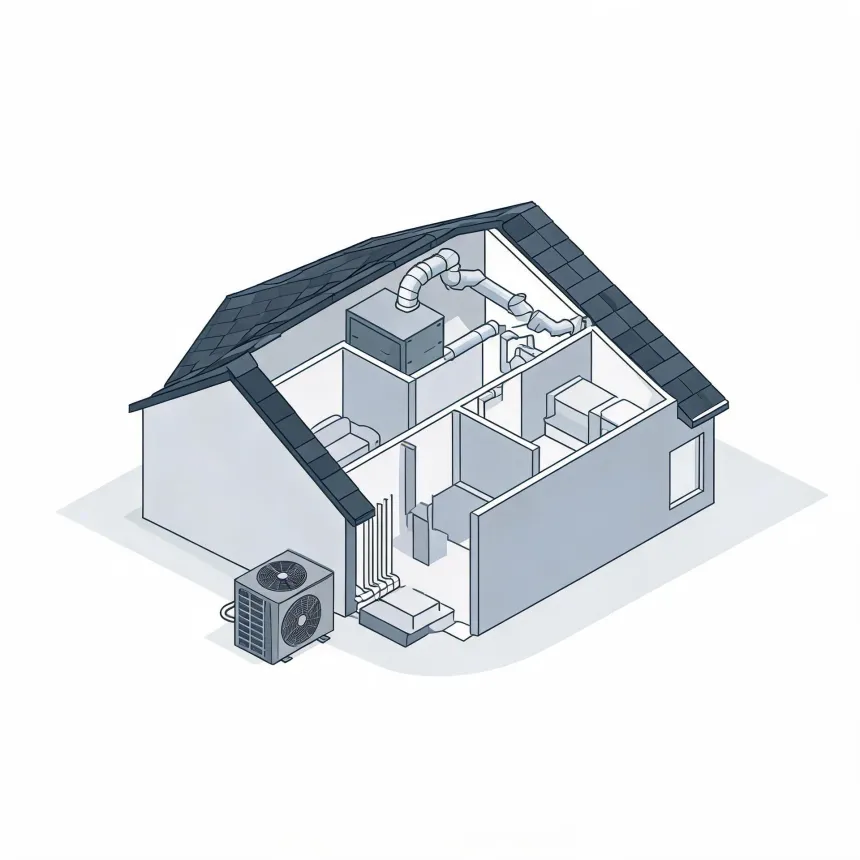
Isometric line illustration of a cutaway house showing interior rooms, an air handler with ductwork in the attic space, and an outdoor condenser unit beside the exterior wall.
Your system heats October through May and cools June through August.

NOAA nClimDiv, 1991–2020 normals

Check the thermostat is set to heat and the temperature is actually above room temperature before anything else.

Go outside and look at the outdoor unit. If the coil is caked in ice or buried in leaves, that alone can stop a heat pump cold.

Half the homes in Marshall County are older than your heat pump's design life

Half the homes here were built by 1973
76 damaging wind events from 2015 to 2024
17 hail events from 2015 to 2024

Electricity in Indiana runs 14.77 cents per kilowatthour. A heat pump that's short on refrigerant or struggling to defrost doesn't just heat poorly, it pulls more power trying to get there. That extra draw shows up on every bill for as long as the problem sits there. Running a weak system through the winter doesn't save you the repair. It just adds the cost of the bad months on top of it.

This heat pump hasn't had a hard life. Fixing it still makes sense.

Marshall County doesn't put much strain on a heat pump. Winters are cold, with overnight lows averaging 20°F, but the system isn't fighting severe heat the rest of the year the way it would further south. When one of these breaks down here, age or a neglected part is usually the reason, not a machine worn out from overwork. That's the kind of problem a repair fixes for good.

Find a contractor
A man in a dark cap and shirt carries a worn leather tool bag up wooden porch steps toward an orange front door, with a potted shrub in a terracotta planter to the right.
A dark gray heat pump unit mounted on a concrete pad next to a house with gray siding and a stone veneer wall.

Know the age before you pay for the repair

If this heat pump came with the house, check how old it actually is before paying for a big repair. A compressor or defrost board replacement only makes sense if the unit has years left in it. A contractor can check the age off the nameplate and tell you straight whether you're looking at a repair or a system close to done.

It blows air that isn't warm

A heat pump's supply air normally feels warm, not hot, so that alone isn't a problem. But if the air coming from the vents feels cool or barely different from room temperature, the system may be stuck in defrost, low on refrigerant, or running on backup heat strips alone while the compressor sits idle.

It won't stop running

A heat pump that cycles on and off normally is doing its job. One that runs constantly without the house reaching temperature is losing the fight, often because of a dirty outdoor coil, a failing compressor, or a stuck reversing valve that won't let it switch modes properly.

A heat pump that's struggling still moves heat, just not enough of it, so the easy thing to do is turn up the thermostat and let it run longer. That's usually the worst thing for it. A compressor that's low on charge runs hotter than it should, and the longer it runs that way, the more it wears the bearings and windings inside it. A reversing valve that's starting to stick gets worse with every cycle, not better. Backup heat strips will cover for a weak system without complaint, so the house stays warm while the real problem goes unnoticed and unfixed. By the time the compressor quits outright, it's often because it spent weeks running in a condition that was already killing it.

A diagnostic visit starts outside at the unit itself. A tech hooks up gauges and checks the refrigerant charge, since low charge is the most common reason a heat pump runs long and still can't keep up. They watch how the system behaves switching between heat and defrost, because a reversing valve that's starting to stick shows up in how it cycles, not in how it looks sitting still. A meter on the compressor tells its own story. A compressor drawing more current than it should is usually on its way out, even if it's still running today. The defrost board and its sensor get checked too. A bad sensor can send the system into defrost when it doesn't need it, or keep it from defrosting when it does. None of this takes guesswork once the gauges and meters are on it. It takes going through each part in order instead of guessing at the first thing that looks wrong.