





A nighttime street view of several illuminated two-story red brick homes with front porches, flanked by a large tree.

Heat Pump Repair in Michigan City, IN

Tell us about the job

Takes about a minute. No obligation.

RepairHeat PumpLaPorte County, IN
Step 1 of 2

What ZIP code is the job in?

Winter nights in LaPorte County average 20°F. That's cold enough that a heat pump has to work hard to keep a house warm, but it's not unusual weather for the equipment. These systems are built to pull heat from cold air all winter. If yours is blowing cool air or running nonstop without catching up, the cause is usually one of a few things a technician sees all the time. A thermostat set wrong. Low refrigerant. A frozen outdoor coil. A reversing valve stuck in one mode. Nothing about this county makes those problems more likely. It's most likely a known issue with a known fix.

8 months
October through May, your system heats
3 months
June through August, it cools
20°F
the average winter night it heats against
81°F
the average summer afternoon it cools against
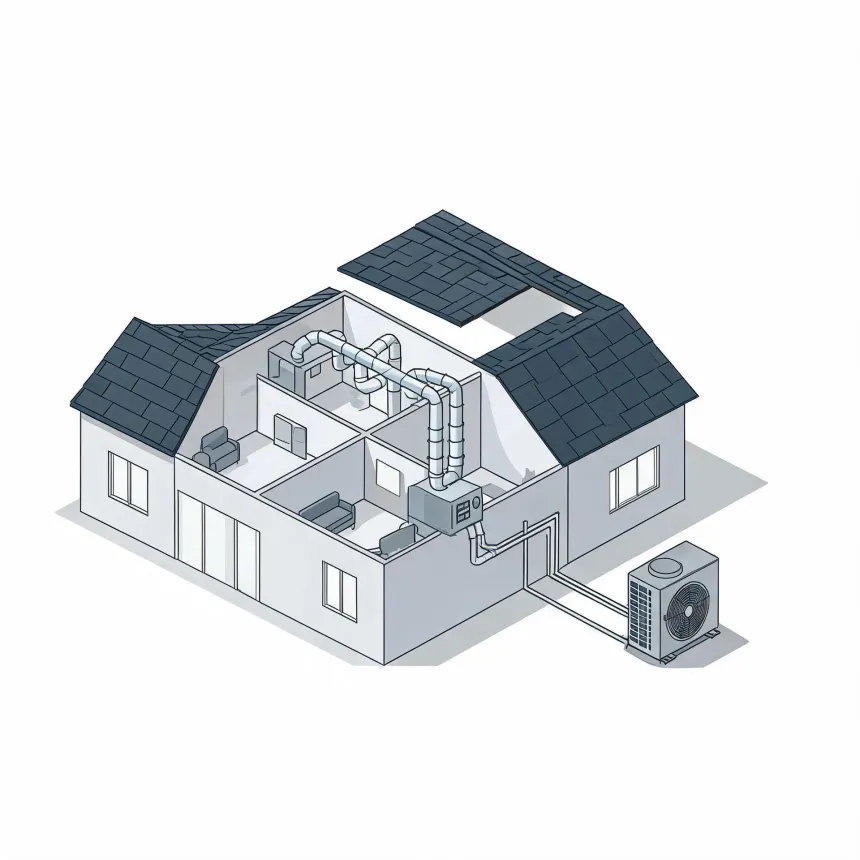
Isometric line illustration of a cutaway single-story house showing interior rooms, ceiling ductwork connected to an indoor air handler, and refrigerant lines running to an outdoor condenser unit on a pad.
Your system heats October through May and cools June through August.

NOAA nClimDiv, 1991–2020 normals

Heat here starts up in October, after September sits unused.

The first cold snap finds whatever was already weak in the system.

At 14.77 cents a kilowatt-hour, a heat pump running wrong keeps costing you until it's fixed

Power costs 14.77 cents a kWh statewide
60 damaging wind events from 2015 to 2024
32 hail events from 2015 to 2024
Half these homes were built in 1969 or earlierIf the heat pump came with the house, ask how much life it has left before paying for the repair.

A heat pump that's short cycling or running nonstop is pulling power the whole time it does it. At 14.77 cents a kilowatt-hour, that shows up on the bill before you've pinned down what's wrong. Waiting a few weeks to see if it sorts itself out just means paying that rate on a system that isn't heating the house right anyway. If it's stuck in one mode or low on refrigerant, a technician can usually find that in one visit. The sooner it's looked at, the sooner you're paying for heat instead of paying for the problem.

If your heat pump is original to the house, ask what it's got left

A system that's been heating the same house since before it was replaced once is getting close to the end either way. Before paying for a major repair, have the technician give you a straight answer on how much life is left in it. That's what decides whether it's worth fixing.

Find a contractor
A gray heat pump outdoor unit mounted on a concrete pad next to the stone-accented exterior wall of a house.

It runs every day, all winter. Trouble shows up fast.

A heat pump runs more hours per year than almost anything else in the house, because it doesn't shut off for the season the way a furnace or an AC does. All that run time shows up in specific ways. Short cycling, where it kicks on, runs a few minutes, and stops, points at a refrigerant leak or a failing sensor. Ice building up on the outdoor coil and not clearing during defrost points at a stuck defrost board or a bad reversing valve. A system that runs constantly but never quite gets the house to temperature is losing the fight somewhere, often low charge or a compressor that's wearing out. Strange noises matter too. A hum with no start is usually a capacitor. A clicking that repeats without the unit kicking on is often a failed relay or contactor. None of these get better left alone. A compressor working against low refrigerant or a bad valve is wearing itself out faster than it should, and what starts as a fixable part failure can end as a compressor replacement if it runs that way for months.

What you can check safely

Look at the thermostat first. Make sure it's set to heat and the set temperature is actually above room temperature. Check the circuit breaker for both the indoor air handler and the outdoor unit, since a tripped breaker on either side will stop the system. Walk outside and look at the outdoor unit. If the coil is caked in ice or buried in snow, that's worth noting for the technician, but don't chip at the ice yourself. Check your air filter. A clogged filter restricts airflow and can make a heat pump struggle even when nothing else is wrong.

What to leave alone

Don't open the outdoor cabinet or touch the refrigerant lines. Low charge has to be found and fixed by someone with the right gauges, and the lines run high voltage right next to them. Don't try to clear coil ice with hot water or tools, since that can bend the fins or crack the coil. If the system is making a clicking or humming noise, don't keep cycling the thermostat to try to force it to start. That just puts more strain on a part that's already failing.

A heat pump that keeps running with a fault doesn't just stay broken the same amount. Low refrigerant means the compressor is working harder to move less heat, and that extra strain is what wears it out early. A frozen coil that never defrosts blocks airflow across it, so the system pulls in cold air and can't shed it anywhere, and the ice only builds from there. A reversing valve stuck in one position forces the compressor to push against pressure it isn't built to handle for long stretches. None of this fixes itself by running longer. The part that's already struggling just struggles more, until the compressor is what needs replacing instead of the valve or sensor that caused it.

A repair makes sense when one part failed and the rest of the system is sound. A bad capacitor, a stuck relay, a reversing valve that won't switch. Those are isolated failures. Fixing the one part brings back a system that's otherwise fine. Replacement starts to make more sense when the compressor itself is the problem. It's the most expensive part in the unit and the hardest to justify replacing on its own. It also makes sense when the same system keeps coming back for different faults in a short stretch of time. That pattern usually means the whole unit is wearing out at once, not just the part that failed this time. A technician can tell you which situation you're in by checking the compressor's condition and the refrigerant circuit before quoting anything. That answer matters more than the age of the equipment by itself.