A row of dark-sided single-story houses with brown shingled roofs behind a tall trimmed hedge, surrounded by large leafy trees and mown grass under an overcast sky.

Heat Pump Repair in Marion, IN

Tell us about the job

Takes about a minute. No obligation.

RepairHeat PumpGrant County, IN
Step 1 of 2

What ZIP code is the job in?

Winters here work a heat pump hard, but the summers don't

Grant County sits in zone 5A, a cool climate where heating carries the bigger load. Overnight lows average 22°F through December, January and February, so the heat pump runs often in the cold months. But it isn't fighting extreme heat come summer, which is the other side of the strain a heat pump sees over the year.


A repair is usually worth making

A heat pump that hasn't been pushed to its limits in both directions tends to hold up well mechanically. When one of these breaks down, age or a specific worn part is the more likely reason than the system being used up. That's worth knowing before deciding whether to fix it or replace it.

8 months
October through May, your system heats
3 months
June through August, it cools
22°F
the average winter night it heats against
83°F
the average summer afternoon it cools against
Isometric cutaway illustration of a single-story house showing interior rooms, ceiling ductwork, an indoor air handler, and an outdoor condenser unit connected by lines on the ground.
Your system heats October through May and cools June through August.

NOAA nClimDiv, 1991–2020 normals

Heat here starts in October, with September the month to get a heat pump checked.

A weak part can get through May fine, then fail the first cold morning the system has to work.

A heat pump that's struggling still runs up a 14.77 cent-per-kWh bill

Power costs 14.77 cents a kWh statewide
43 damaging wind events from 2015 to 2024
21 hail events from 2015 to 2024

Most heat pump trouble shows up as something the system can't do anymore, not a dramatic failure. Warm air in winter that isn't actually warm, just less cold than outside. A unit that runs constantly but never quite gets the house to temperature. Ice building up on the outdoor coil and staying there past a normal defrost cycle. Short cycling, where it kicks on, runs a few minutes, and shuts off again before it's done anything. A hissing sound near the lines usually points to refrigerant escaping somewhere it shouldn't. Any of these is worth a call before the mild days end, since the same weak part that gets by on a mild afternoon can quit outright the first morning it has to work hard.

This is probably a fix, not a replacement

A heat pump that isn't fighting extremes in both directions tends to hold up well, so when yours breaks down, it's more likely one worn part than a system at the end of its life. Getting a tech to find that part now is worth more than guessing.

Find a contractor
A man in a dark shirt and tan work pants carries a waxed canvas bag up wooden porch steps toward an orange front door, with a potted shrub to the right.
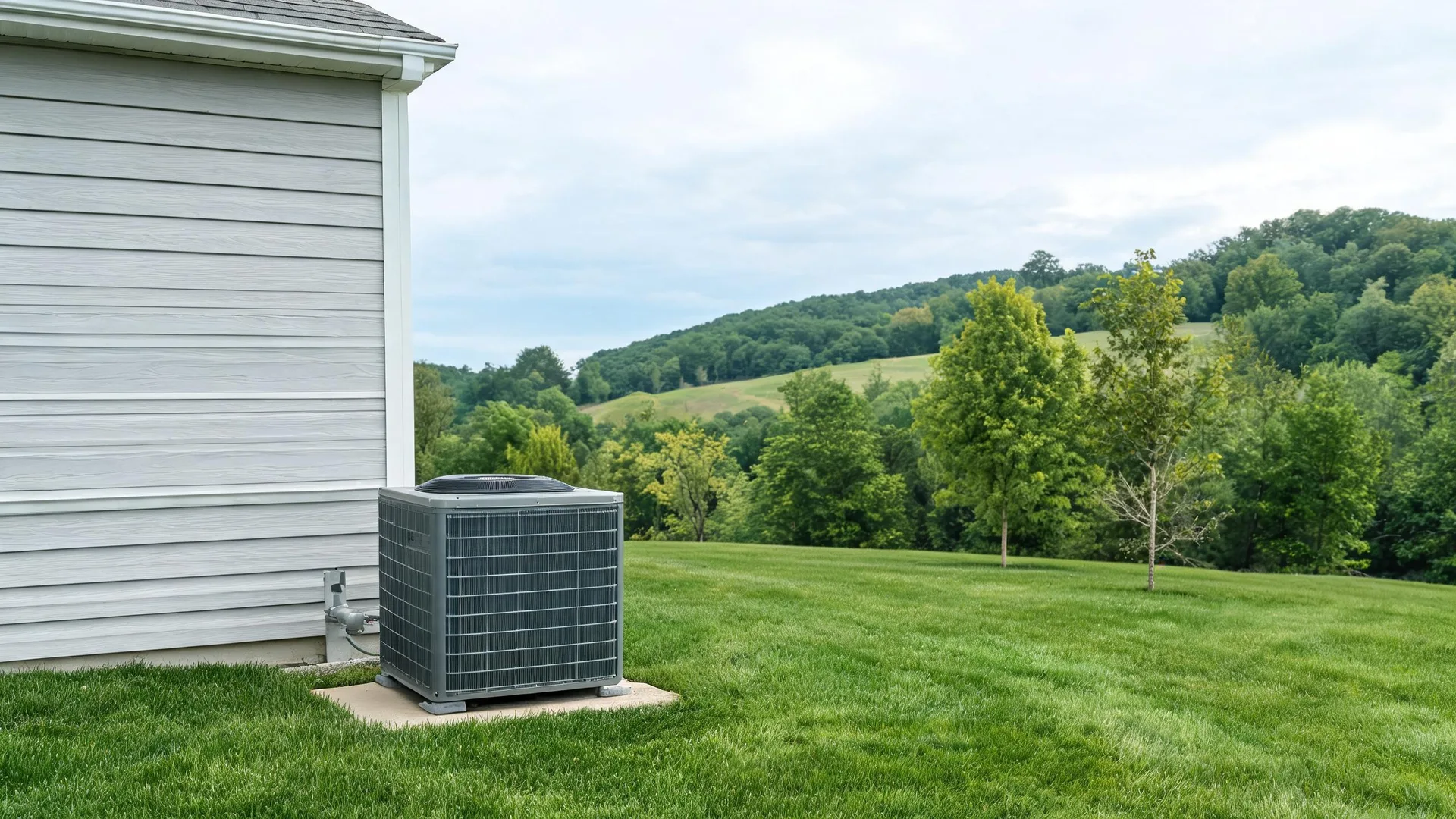
A gray heat pump outdoor unit mounted on a concrete pad next to a residential house with lap siding and stone accents.

What age to mention

If your heat pump came with a house built in 1963 or earlier, say so when the tech comes out. It won't change the mild-use case made above, but it does change where they start looking. An older unit is more likely to be running original parts that are just worn out, and a tech can check whether replacements are even still made for it. That's a quick answer to get, and it tells you whether you're paying for a part or a whole system.

A refrigerant leak gets worse, not better

A heat pump low on refrigerant makes the compressor work harder to pull the same warmth out of the air. Run it like that for a week and the compressor runs hotter than it was built to. That shortens its life or ends it outright, and it's the hardest part in the system to replace.

A noise you ignore today can be a seized part tomorrow

A grinding or squealing sound usually means a bearing or motor mount is wearing out. Left alone, that part can seize while the system is running, and when it does it can take the motor around it down too. Caught early, a tech replaces one part. Caught late, a tech replaces that part and whatever it damaged on the way out.

A lot of heat pump failures trace back to the reversing valve, the part that switches the system between heating and cooling. It's a part a furnace never needs, and it takes on wear every time the system changes direction. When it starts sticking, the unit may blow air that isn't as warm as it should be, or get stuck in one mode. The defrost cycle is another weak point. A heat pump has to melt frost off the outdoor coil through the winter, and that depends on a sensor and a control board talking to each other correctly. If the sensor reads wrong, the coil can ice over and airflow drops off. Outside, the fan motor and the compressor take the brunt of the work since the outdoor unit runs in both seasons. A capacitor going weak is a common way for either one to start failing, often with a humming sound before the fan or compressor quits outright.

A tech weighing repair against replacement is really asking one question. Is this part isolated, or is it a sign the system as a whole is wearing out. A new capacitor or a new sensor fixes the unit in front of them. A failing compressor is a different conversation, since it's the most expensive part to replace and often isn't worth replacing on its own. Refrigerant type matters too. Some older systems run on refrigerant that's being phased out, and if a leak means a full recharge, that can tip the decision toward replacement even when the rest of the unit is sound. None of this is guesswork a homeowner can do from the kitchen table. It comes from opening the unit up and checking the part against the system around it.