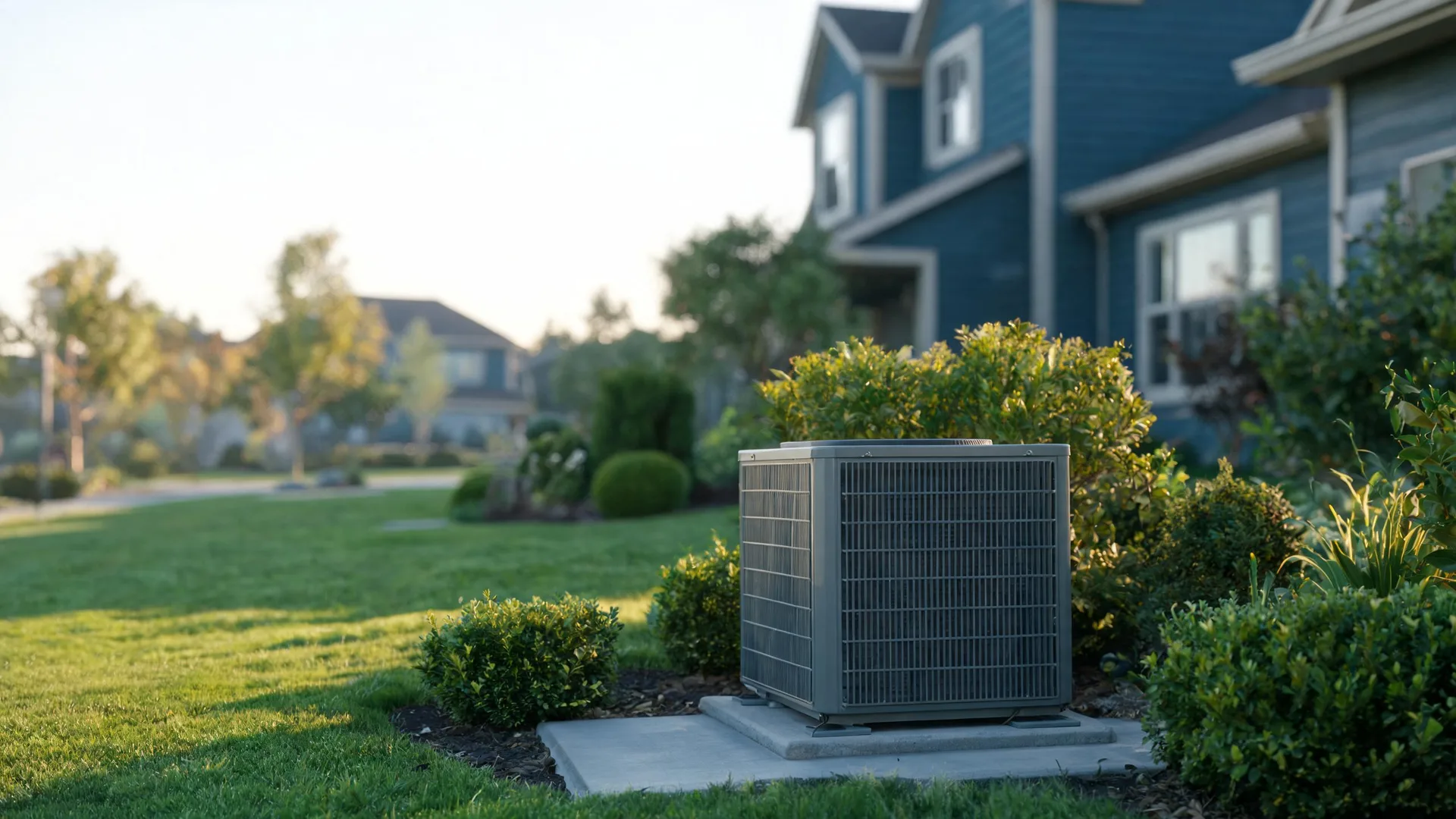
An outdoor heat pump unit mounted on a concrete pad in front of a single-story suburban house with beige siding.

Heat Pump Repair in Jasper, IN

Tell us about the job

Takes about a minute. No obligation.

RepairHeat PumpDubois County, IN
Step 1 of 2

What ZIP code is the job in?

October and May are when trouble shows up

A heat pump in Dubois County switches over to heat in October and back to cooling in May. Whatever weakness was sitting quiet in the off months gets tested the first cold night or the first warm stretch, and that's when it fails.


What that means for the fix

A system that quit in the first week of a new season was already due to quit. The job is to find what gave out this time, a contactor, a capacitor, a low charge, rather than just getting the unit running again so it can quit the same way next season.

7 months
October through April, your system heats
5 months
May through September, it cools
25°F
the average winter night it heats against
86°F
the average summer afternoon it cools against
Isometric cutaway illustration of a single-story house showing interior ductwork, an indoor air handler, and an outdoor condenser unit connected by lines along the exterior wall.
Your system heats October through April and cools May through September.

NOAA nClimDiv, 1991–2020 normals

Dubois County asks real work of a heat pump both ways, muggy summers and cold winters, which is just what zone 4A means.

A heat pump built for this area is built for exactly this load, so a breakdown points to a worn part, not a place too tough for the machine.

Weather here tests the power grid, not the heat pump

120 severe weather events from 2015 to 2024
17% of homes statewide lost power a day or more in 2024
96 damaging wind events from 2015 to 2024

Half the homes in Dubois County were built in 1980 or later. If yours is one of them, the heat pump probably isn't old enough to be the reason it's acting up. These systems are built to run for well over a decade, and a newer house usually means the unit hasn't had time to wear out on its own. That points away from replacement and toward a specific part that failed, something a contractor can find and fix. Even in an older farmhouse outside town, age alone doesn't explain a breakdown. Something made it fail now, and that's what's worth tracking down.

The heat pump needs a diagnosis, not a guess

Electricity in Dubois County runs about 12.96 cents a kilowatt-hour, ordinary for the area and nothing that strains a heat pump on its own. A breakdown here isn't about the power rate or the county. It's a part that wore out or gave out, and finding which one is what makes the fix hold.

Find a contractor
A gray heat pump condenser unit mounted on a concrete pad against the gray lap-siding exterior wall of a house.

A newer house means repair makes sense

If your house dates to the newer half of the county, that heat pump has likely been running at most a couple decades. A failure at that age is almost always one part, not the whole system. Have the contractor name the part before anyone talks about replacing the unit.

A refrigerant leak shows up as weak heat or weak cooling

A heat pump moves heat instead of making it, so it depends on having the right charge of refrigerant to do that. A leak at a fitting or a worn coil lets that charge drop, and the system starts running longer to reach the same temperature. Left alone, the compressor ends up working harder than it was built for, and that is a far bigger repair than sealing the leak would have been.

A failed part is usually behind a system that won't switch or won't start

The reversing valve is what lets a heat pump flip between heating and cooling, and when it sticks, the system keeps doing one or the other no matter what the thermostat asks for. A bad capacitor or contactor shows up differently, as a unit that hums but won't start, or one that trips the breaker. Both are single parts doing a specific job, and both are things a contractor tests for directly instead of guessing at.

Before calling anyone, look at the thermostat first. Set it to heat or cool, whichever isn't working, and move the temperature well past the room reading. You should hear the system click on within a minute. If nothing happens, check the breaker panel. A heat pump has more than one breaker, sometimes for the outdoor unit and the air handler separately, and it only takes one tripped to shut the whole thing down. Next, look at the outdoor unit itself. Ice covering the coil, or leaves and debris packed against it, both block the airflow it needs to work. Inside, check the air filter. A filter clogged with dust makes the whole system struggle, and it's the one thing on this list that's entirely on the homeowner to maintain. None of this fixes a bad capacitor or a refrigerant leak, but it rules out the simple stuff before a contractor has to.

A diagnostic visit starts before the panels come off. The contractor asks what the system was doing right before it quit, whether it was blowing weak air, running nonstop, or not responding to the thermostat at all. That history narrows things down fast. Then come the gauges and the meter. Refrigerant pressure, electrical draw at the compressor, voltage at the contactor, resistance across the capacitor, each reading points toward some parts and rules out others. Airflow gets checked too, since a coil that's iced over or a filter packed with dust can mimic a failing compressor without being one. The goal is to end up with one part named as the cause, not a unit that's merely running again.