







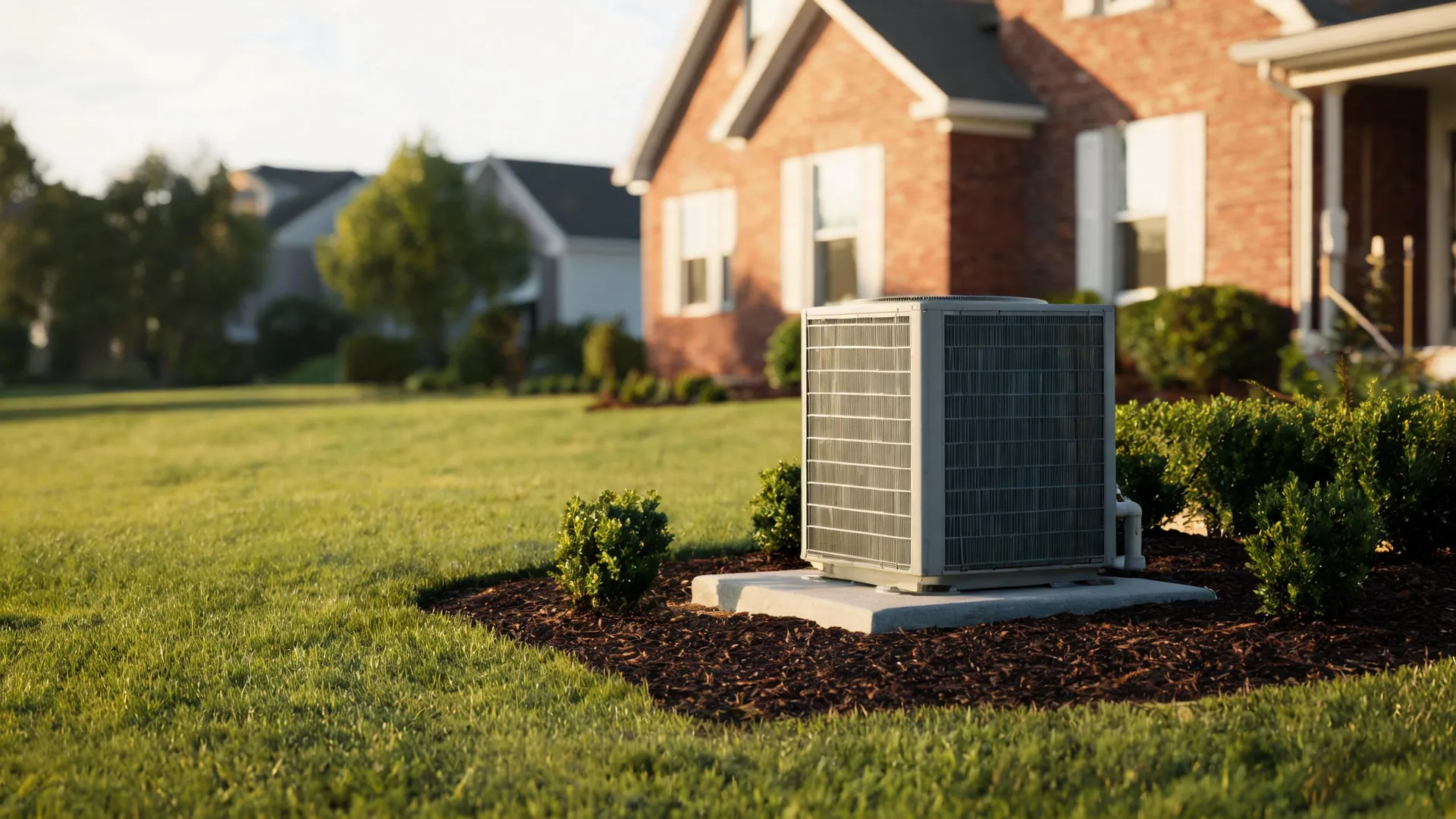
An outdoor heat pump unit mounted on a concrete pad in front of a two-story suburban house.

Heat Pump Repair in Greenfield, IN

Tell us about the job

Takes about a minute. No obligation.

RepairHeat PumpHancock County, IN
Step 1 of 2

What ZIP code is the job in?

Zone 5A means winter does most of the work here, not summer. Your heat pump spends its energy pulling heat into the house, not fighting it back out. Overnight lows average 23°F across December, January and February, and that's cold but steady, not the wild swings that wear a system down fast. When one part fails after years of that kind of load, it's usually the one part, not a sign the whole unit is giving out. That's worth knowing before anyone tells you to replace it.

8 months
October through May, your system heats
3 months
June through August, it cools
23°F
the average winter night it heats against
83°F
the average summer afternoon it cools against
Isometric cutaway illustration of a single-story house showing interior ductwork, an indoor air handler and furnace unit, and an outdoor condenser connected by a line, on a white background.
Your system heats October through May and cools June through August.

NOAA nClimDiv, 1991–2020 normals

Half the homes in Hancock County were built in 1991 or later.

A heat pump that came with a newer house hasn't logged many years of run time, and repair usually makes sense over replacement.

September and May are when a weak part finally gives out

Cooling runs June through August
Heat runs October through May
Climate zone 5A
Electricity here runs 14.77 cents a kilowatt-hourA heat pump that's struggling to heat or cool costs you more here than it would most places

If your heat pump came with the house, check when that was before you assume the worst. A system installed in the last decade or so has plenty of life left in it. Ask the contractor what part failed and why, not just whether the unit is old. A single failed part on a younger system is usually just that, one part that wore out and needs replacing, not a sign to start over.

Get the part fixed, not the system replaced

One worn part doesn't mean a worn-out system, especially on a heat pump that hasn't had to fight much. Get the failed part named and replaced before anyone talks you into more than that.

Find a contractor
A man in a cap, dark shirt and tan work pants walks up concrete steps toward a red front door, carrying a canvas tool bag with tools in its side pocket.
A residential heat pump outdoor unit mounted on a concrete pad next to a house with gray vinyl siding.

What you can check before anyone comes out

Before anyone comes out, walk the outdoor unit and look at the coil. If it's caked with grass clippings, dryer lint, or ice that hasn't melted in a day, that's airflow being choked off, not a failed part. Check the air filter inside too. A clogged filter makes the whole system work harder and can trip it into shutting down. Look at the thermostat next. Make sure it's set to heat or cool as you expect and the batteries aren't dead, since a blank or frozen display sometimes isn't the heat pump at all. Check your breaker panel for a tripped switch before you assume the worst. If the outdoor fan isn't spinning but you hear a hum, don't keep flipping the breaker. That hum usually means a capacitor is failing, and cycling the power won't fix it, just leave it off and call. If you see ice covering the outdoor coil in a shape that doesn't melt during the defrost cycle, that points to a refrigerant or sensor problem, not something to chip at yourself.

A part that's struggling runs longer to do the same job

A heat pump losing refrigerant or fighting a bad capacitor takes more cycles to heat or cool the house. More cycles means more hours pulling power at 14.77 cents a kilowatt-hour, every day it sits unfixed.
Get the part named before another bill hits

Ask the contractor what failed as soon as they find it, not after a second visit. A heat pump running on a bad part costs you while it waits, so there's no reason to let the diagnosis drag.

A heat pump that's starting to fail doesn't usually quit outright. It gives you warning signs first. Short cycling is one, where it kicks on, runs a few minutes, and shuts off before the house feels any different. Warm air coming from the vents during a heating call is another, since a heat pump's air never feels as hot as a furnace's but it shouldn't feel barely warm either. Listen for clicking at startup that doesn't resolve into a steady hum, or a new rattle that wasn't there before. If one room won't hold temperature while the rest of the house is fine, that's worth a look too. Any of these on its own might be minor. Several together usually mean a part is on its way out.

When a contractor tells you a part failed, ask what that part actually does before you decide anything. A reversing valve stuck in one position is a different situation than a contactor that welded shut from years of normal arcing. Both get called a failure, but one tends to mean a system that's aging across the board, and the other just means a cheap switch wore out doing its job. The compressor is the one part worth asking about by name. If that's what failed, replacement is a fair question to raise. If it's anything else, a contactor, a capacitor, a control board, a blower motor, that's a repair on a system that's otherwise fine. Age matters less than which part gave out.