A low-angle view across a mown lawn toward a two-story dark-sided house with a covered front porch, flanked by large green trees under an overcast sky.

Heat Pump Repair in Evansville, IN

Tell us about the job

Takes about a minute. No obligation.

RepairHeat PumpVanderburgh County, IN
Step 1 of 2

What ZIP code is the job in?

Wind, not weather extremes, is the usual story here

Vanderburgh County saw damaging wind 103 times between 2015 and 2024. That's enough to knock a unit out of alignment or loosen a panel over the years, but it's ordinary wear for an outdoor unit, not a sign the climate here is hard on heat pumps.

So the fix is usually a known one

A heat pump that's stopped heating or cooling right in Evansville is more likely dealing with a refrigerant leak, a failed capacitor, or a dirty coil than anything tied to the area. A contractor can usually find the actual cause and repair that part rather than replace the system.

7 months
October through April, your system heats
5 months
May through September, it cools
27°F
the average winter night it heats against
87°F
the average summer afternoon it cools against
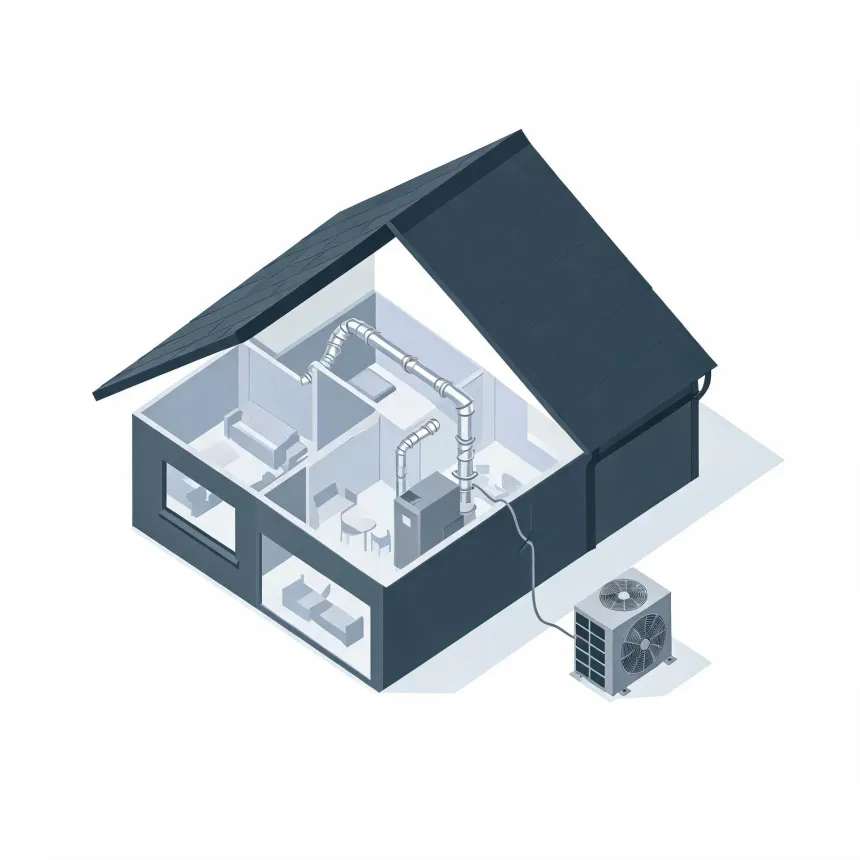
Isometric illustration of a cutaway house showing interior rooms with furniture, a furnace and ductwork, connected by a line to an outdoor condenser unit on the ground outside.
Your system heats October through April and cools May through September.

NOAA nClimDiv, 1991–2020 normals

Heat pumps here switch over and start earning their keep in September and April.

A weak part that made it through summer often fails the first cold week it has to produce heat instead.

Evansville sees its share of wind and storms, but that's not what's wrong with your heat pump

148 severe weather events from 2015 to 2024
17% of homes statewide lost power a day or more in 2024
103 damaging wind events from 2015 to 2024

A heat pump here doesn't cost more to fix than one anywhere else, but Indiana homes paid 14.77 cents per kilowatt-hour in 2024, and that number matters more once a part starts failing. A weak component makes the system lean on backup heat strips to hit the same temperature. That shows up on the electric bill before most people notice anything else is wrong. It's a sign worth paying attention to, not a sign the system needs replacing. The fix is the same one a contractor would make anywhere else, finding the part that failed and replacing it.

Half the homes here were built in 1970 or earlier, yours may be on borrowed time

Half the homes in Vanderburgh County were built in 1970 or earlier. If your heat pump came with a house that age, it's worth finding out how much life is left in it before you put money into this repair.

Find a contractor
A man in a cap, gray long-sleeve shirt and brown pants carries a worn canvas tote bag up porch steps toward an orange front door beside a potted olive tree.
A gray heat pump outdoor unit mounted on a concrete pad next to the stone-accented exterior wall of a house.

What a contractor actually checks, and in what order

A diagnostic call starts outside, not at the thermostat. A contractor checks the outdoor unit first, the reversing valve, the capacitor, the coil, before touching the controls inside. They run the system in both modes, heating and cooling, to see where it actually fails rather than going on what you describe alone. Pressure readings on the refrigerant lines come next, since that shows whether there's a leak and roughly where to look for it. Electrical testing on the capacitor and contactor takes a few minutes with a meter, and it either rules those parts out or confirms them right away. None of this is guesswork. A heat pump either holds pressure or it doesn't, and a capacitor either tests within range or it's failing.

The reversing valve fails more than most parts

The reversing valve switches a heat pump between heating and cooling, and it's one of the first things to go. A stuck valve can blow cold air when the system should be heating, or run nonstop without reaching the set temperature. That's a repair, not a reason to replace the unit.

Low refrigerant means a leak, not a top-off

A heat pump doesn't use up refrigerant over time the way a car uses gas. If the charge is low, there's a leak somewhere in the coil or the line set. Adding refrigerant without finding the leak just means paying for the same service call again next season.

Short cycling is one of the easier signs to catch. The system kicks on, runs briefly, then shuts off before the room temperature has changed at all. That's often a sensor telling the system something is wrong, or a compressor struggling to start, and it wears on parts that are hard to replace once they fail completely. Ice on the outdoor unit during a defrost cycle is normal. Ice that stays after the cycle ends is not, and it usually means airflow is blocked or refrigerant is low. If the air from the vents is cool when it should be warm, check that the thermostat is set to heat before assuming the worst. If it's set right and still blowing cool, that's worth a call. A burning smell the first time the system runs after sitting idle is common and usually clears on its own. A smell that lingers is not.

Most of the time, repair is the right call. A heat pump is built with parts that fail one at a time, a capacitor, a contactor, a valve, and a contractor can replace any one of them without touching the rest of the system. What changes the math is how many of those parts have already failed, and how close the compressor is to going. The compressor is the one part that usually isn't worth replacing on its own. If a contractor tells you the compressor is failing, that's the point where putting money into the unit stops making sense. Short of that, a heat pump that's otherwise sound is almost always worth fixing.