A trimmed hedge borders a mown lawn in front of single-story houses with dark siding and shingled roofs, surrounded by large leafy trees under an overcast sky.

Heat Pump Repair in Bloomington, IN

Tell us about the job

Takes about a minute. No obligation.

RepairHeat PumpMonroe County, IN
Step 1 of 2

What ZIP code is the job in?

Zone 4A asks for real heating and real cooling

Monroe County is rated zone 4A, a mixed climate under the 2021 energy code. That means winter nights that average 24°F and summers humid enough to keep a heat pump working both sides of the year. It is steady demand, not the extreme swings that wear a system out fast.


A fixable machine is a good bet here

A heat pump that has not been run into the ground by brutal winters or scorching summers is usually still sound underneath whatever is going wrong now. When a breakdown shows up in a system that has had a reasonable life, the odds favor a repair over a replacement.

7 months
October through April, your system heats
4 months
June through September, it cools
24°F
the average winter night it heats against
84°F
the average summer afternoon it cools against
Isometric line illustration of a cutaway single-story house showing interior rooms with furniture and ceiling ductwork, connected to an outdoor condenser unit on the ground outside the left wall.
Your system heats October through April and cools June through September.

NOAA nClimDiv, 1991–2020 normals

Half the homes in Monroe County were built in 1986 or later.

A heat pump that came with a newer house has usually not been run for decades, so a repair is worth a look before anyone talks replacement.

A broken heat pump costs more to ignore here than most places

Power costs 14.77 cents a kWh statewide
44 damaging wind events from 2015 to 2024
32 hail events from 2015 to 2024
The first cold nights find what was already wrongHeat here starts in October, and June through September is cooling. A weak heat pump usually shows it in the first weeks of either one.

At 14.77 cents a kilowatt-hour, Indiana runs above the national average, and a heat pump that's struggling pulls more power to do the same job. A failing capacitor, a low charge, a stuck reversing valve, all of them make the system run longer and harder for the same degree of comfort. That shows up on next month's bill before it shows up as a full breakdown. Since the repair is likely worth doing anyway, the sooner it happens the less this costs you in the meantime.

A newer system is worth getting fixed

If your heat pump came with the house and the house is from the last few decades, it hasn't had time to wear out. Get it looked at before anyone brings up replacing it.

Find a contractor
A man in a cap, brown jacket and tan pants, seen from behind, carries a canvas tool bag up concrete steps toward an orange front door.
A white mini-split heat pump outdoor unit mounted on a concrete pad beside a gray-sided house, surrounded by gravel and green shrubs.

What to check before anyone drives out

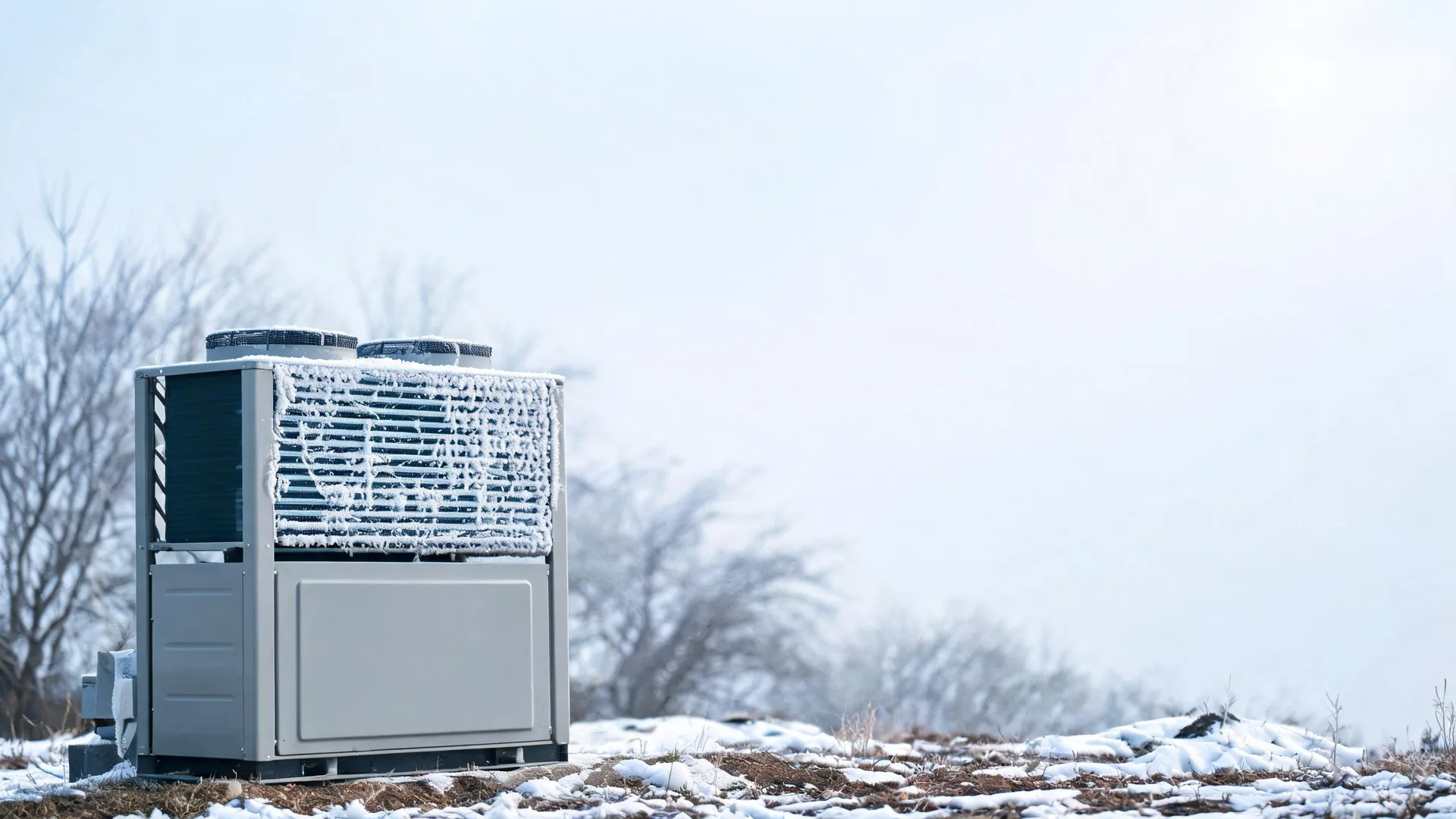
Before anyone comes out, check the thermostat is set to heat and the setpoint is actually above room temperature. Look at the outdoor unit. If ice is covering the coil and it's not in a defrost cycle, or if the fan isn't spinning at all, that's worth noting. Go to the breaker panel and check nothing has tripped, both for the indoor air handler and the outdoor unit, since they're usually on separate breakers. Inside, pull the air filter and hold it up to light. If you can't see through it, replace it before doing anything else, because restricted airflow alone can make a heat pump run constantly without heating the house. Check that every supply vent in the house is open and nothing is stacked in front of a return. If the system is running but blowing air that doesn't feel warm, let it run a few minutes longer than usual, since heat pumps put out air that feels cooler than a furnace even when it's working right. None of this fixes a bad capacitor or a stuck reversing valve, but it rules out the causes that don't need a technician at all.

It runs, but it's not keeping up

A heat pump that cycles on and off fast, or runs nonstop without getting the house to temperature, usually has a charge problem or a failing compressor. Either way it's working harder to do less, and that strain tends to get worse, not better, on its own.

Noises and smells mean something specific

A grinding or screeching sound points to a motor bearing going bad. A burning smell points to an electrical problem, often at the contactor or a wire connection. Neither of those gets quieter with time, and running the system while they're happening can turn a minor repair into a bigger one.

A refrigerant leak is the clearest example. Once the charge drops, the compressor starts pumping refrigerant mixed with more oil than it was built to handle, since the refrigerant is what carries the oil through the system. Run it low long enough and the compressor wears without enough lubrication, and a compressor is not something anyone can repair, only replace. A failing capacitor works the same way. It makes the compressor or fan motor draw more current to start and run, and that extra heat shortens the life of the motor windings every time it happens. Ice on the outdoor coil is another one. A little frost is normal, but if something is keeping the unit from defrosting, the ice builds, airflow drops further, and the system works harder for less heat until it finally can't keep up at all.

Age is one way to think about this, but how the system has been treated is another. A heat pump that's had its filter changed and its coils kept clean tends to fail in small, fixable ways. One that's been ignored tends to fail in ways that take other parts down with it. That's the real question behind repair versus replacement. Not just how old the unit is, but whether the breakdown in front of you is an isolated part giving out or the first sign that several things are wearing out together. A single failed component in a system that otherwise runs fine is almost always worth fixing. A unit where the technician finds corrosion, a weak compressor, and a leak all at once is telling you something different, even if no single one of those would be a reason to replace it on its own.