






A two-story dark-sided house with a covered front porch behind a trimmed hedge, framed by large green trees, photographed from ground level with blurred grass in the foreground.

Heat Pump Repair in Auburn, IN

Tell us about the job

Takes about a minute. No obligation.

RepairHeat PumpDeKalb County, IN
Step 1 of 2

What ZIP code is the job in?

A heat pump in DeKalb County works about eight months a year, October through May, then switches over and runs cooling in June. That changeover is when weak parts tend to fail. A reversing valve or a capacitor that barely got through last season often gives out in the first cold snap of October or the first warm stretch of June, right when the system first asks more of it. If yours is struggling now, it is worth having someone look at it before the next shift in weather, not after.

8 months
October through May, your system heats
3 months
June through August, it cools
20°F
the average winter night it heats against
82°F
the average summer afternoon it cools against
Isometric line illustration of a cutaway house showing interior rooms with furniture, ceiling ductwork, and an outdoor condenser unit connected by lines along the exterior wall.
Your system heats October through May and cools June through August.

NOAA nClimDiv, 1991–2020 normals

A heat pump that won't hold its reversing valve or keeps tripping on a failing capacitor is still a repair, most of the time.

But once the compressor itself is going, or the repairs keep stacking up year after year, replacing it is usually the cheaper road.

Electricity here runs 14.77 cents a kilowatt-hour, so a heat pump limping along costs you more every month it goes unfixed

Power costs 14.77 cents a kWh statewide
38 damaging wind events from 2015 to 2024
18 hail events from 2015 to 2024

Half the homes in DeKalb County were built in 1975 or earlier, and half in 1975 or later. Either way, a heat pump problem here is usually the same handful of things going wrong, not something particular to an older house or a newer one. A failing capacitor, a stuck reversing valve, a dirty coil, a low charge. The age of your house does not tell you which one it is. What it came with, and whether anyone has serviced it since, is worth checking before you guess at the cause.

Your heat pump has had a fair winter here. Most problems are still worth repairing.

Winters here average 20°F overnight, cold enough that your heat pump works for its keep, but DeKalb County isn't hit with the wind and hail that wear a unit down early. The damage that shows up is usually just age catching up with a part, a capacitor or a reversing valve that's done its job for years and is finally quitting. That's almost always worth fixing.

Find a contractor
A man in a cap, dark shirt and tan work pants, seen from behind, carries a worn canvas tool bag up porch steps toward an orange front door, with a potted shrub beside the entry.
A gray air-source heat pump mounted on a concrete pad next to a house with gray vinyl siding, surrounded by gravel and flanked by green shrubs and white hydrangea flowers.

What you can rule out yourself

Before anyone comes out, check the thermostat first. Make sure it's set to heat and not accidentally switched to cool or off, and swap the batteries if it's been a while. Next, go to the air filter. A filter packed with dust starves the system of airflow, and a heat pump running on weak airflow can freeze up or short cycle just like one with a bad part in it. Change it if it looks gray or clogged. Walk outside and look at the unit itself. Clear away leaves, mulch or anything stacked against it, since the outdoor coil needs open air moving through it to work at all. If it's covered in ice, don't chip at it. Flip the breaker off, let it sit, and see if it clears on its own once the system isn't fighting itself. Check that breaker while you're there. A tripped breaker or one that's merely loose in the panel can look exactly like a dead system. None of this fixes a bad capacitor or a stuck reversing valve, but it rules out the things that aren't actually broken before someone looks at the things that are.

A small electrical problem can take out the compressor

A weak capacitor makes the compressor struggle to start. Every hard start heats the windings more than a normal one. Keep running it that way and the windings can short, and a shorted compressor is a different repair than a capacitor, usually a much bigger one.
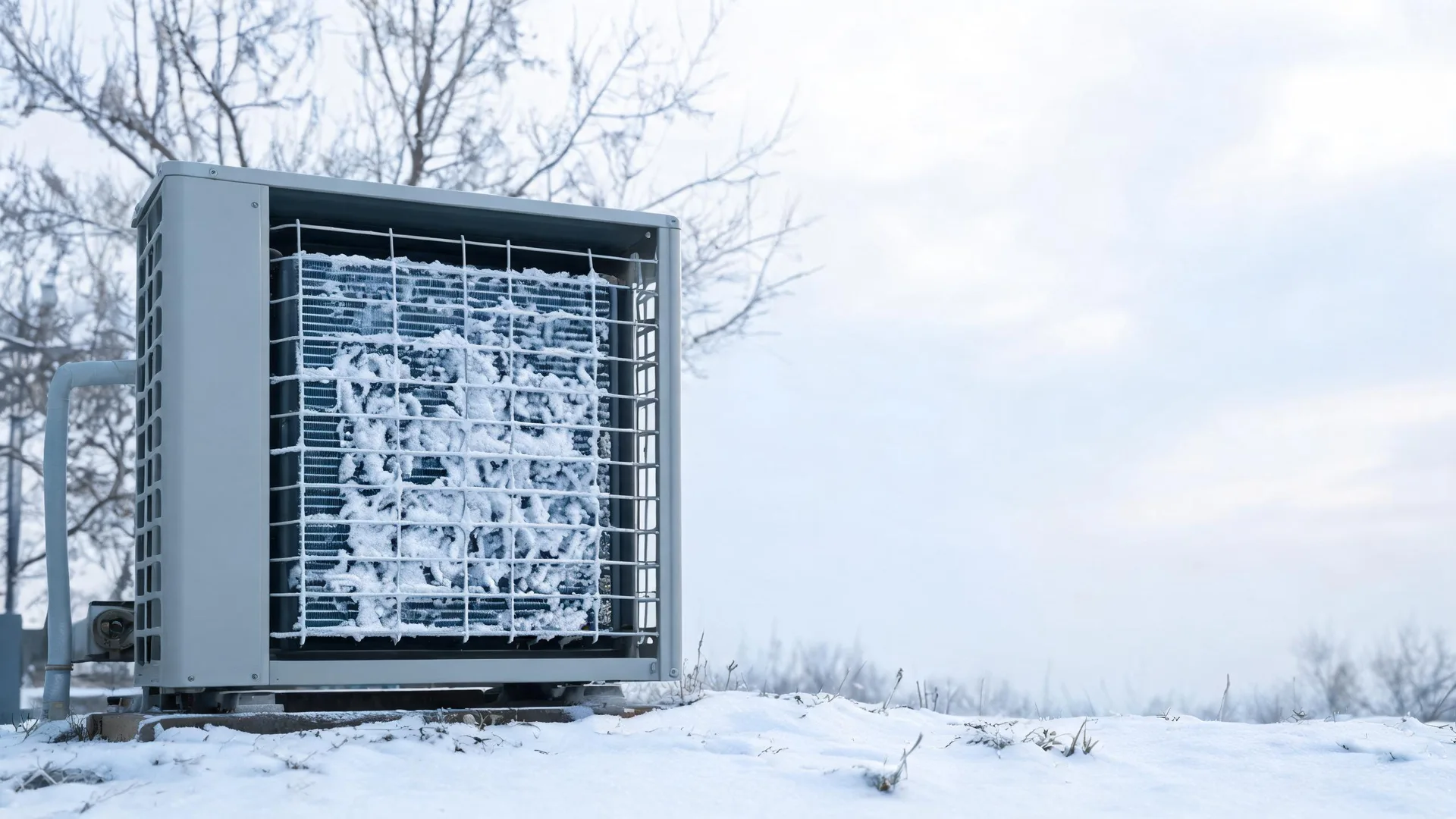
A frozen coil needs airflow, and running it starved makes that worse

If the defrost cycle isn't clearing the outdoor coil, ice builds up instead of melting off. A heat pump buried in ice can't pull heat from outside air no matter how long it runs. Left alone, the ice packs in tighter and the system works against itself until something downstream, like the compressor, takes the strain.

You usually hear a heat pump before you see what's wrong with it. A clicking sound at the outdoor unit when it tries to start, then nothing, often means the capacitor is on its way out. Warm air coming out of the vents when you're expecting heat can mean the reversing valve isn't shifting into position anymore. If the outdoor unit is caked in ice and stays that way, the defrost cycle isn't doing its job. Short cycles, where the system kicks on and off every few minutes instead of running a normal stretch, usually point to something electrical rather than a dirty filter. Any of these is worth a call. None of them get better by waiting.

A diagnostic visit starts outside, at the unit itself. A tech checks the refrigerant charge, the pressures on both the high and low side, and whether the compressor is drawing the current it should. Electrical parts get tested directly rather than guessed at, since a capacitor can look fine and still be weak. Inside, the tech checks airflow at the coil and the filter, because a heat pump that's low on airflow can mimic the symptoms of a low charge. The reversing valve gets tested in both directions, not just the one it happens to be stuck in. None of this takes apart the system to find the problem. It isolates which part is actually failing before anything gets replaced.