May is a good time to get it looked at
Cooling in Dearborn County starts up in June and runs through September. A unit that struggled back in September has sat idle all winter, and whatever was wrong with it then is still wrong with it now.

Takes about a minute. No obligation.
Cooling in Dearborn County starts up in June and runs through September. A unit that struggled back in September has sat idle all winter, and whatever was wrong with it then is still wrong with it now.
A capacitor or contactor that's already failing can usually make it through mild weather fine. It's the jump to real heat in June that it can't handle.

NOAA nClimDiv, 1991–2020 normals
Check the thermostat batteries and the breaker before anything else.
A tripped breaker or a dead thermostat screen looks exactly like a dead air conditioner.



Most AC repair calls in Lawrenceburg trace back to a worn part, not a design problem with the house or the unit. A failing capacitor, a dirty condenser coil, a low refrigerant charge from a slow leak. These happen in every climate, to every brand, and Dearborn County summers don't push the system any harder than normal. That matters for the repair bill. Indiana homes paid 14.77 cents per kilowatt-hour in 2024, and a struggling AC draws more power to do less cooling, so a quick fix on the real cause is worth finding rather than guessing at.
If your AC came with the house, it's probably not old enough to be the problem. Get the actual part diagnosed and fixed rather than planning around a replacement.
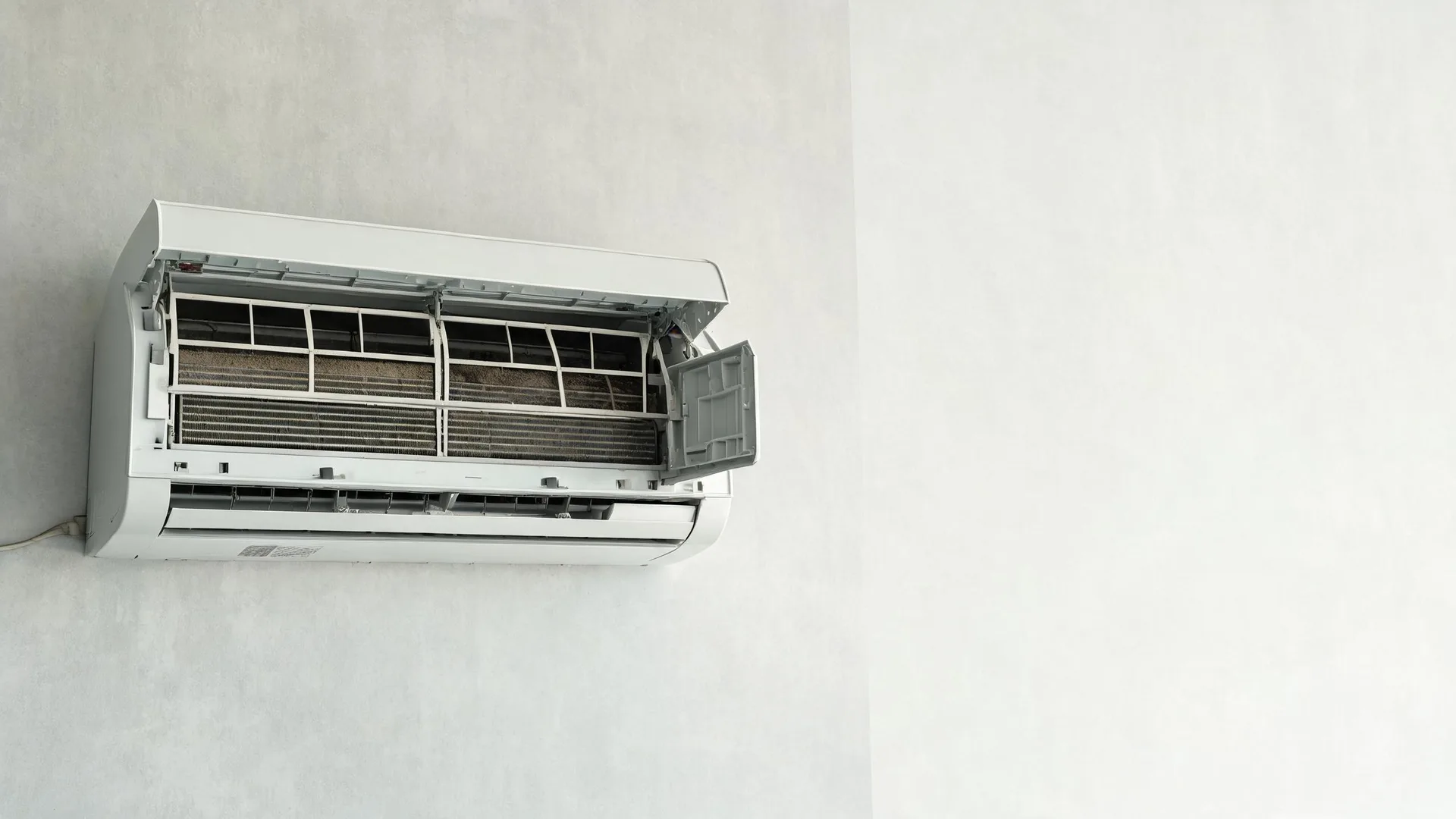
Find a contractorAn air conditioner fails the same way most years, and it's almost always wear, not age. The capacitor gives the compressor and fan motor their starting kick, and it weakens a little every time the system cycles on. After enough cycles, it can't deliver that kick anymore, and the unit hums or clicks but won't start. The contactor, which switches power to the outdoor unit, pits and burns with every cycle too, until it sticks or stops closing. Dirt is the other steady cause. A condenser coil caked with grime can't shed heat well, so the system runs longer to do the same job and strains everything in it. A dirty air filter does similar damage from the other end, starving airflow until the evaporator coil frosts over. None of this is sudden. It builds for months, cycle after cycle, until the day it finally gives out.
When airflow is choked by a dirty filter or low refrigerant, the evaporator coil frosts over. Keep running it and that ice spreads, blocking airflow further. Eventually liquid refrigerant can slug back into the compressor, and the compressor is the one part in the system a contractor can't just swap in an afternoon.
A failing capacitor makes the compressor struggle to start each cycle. Every hard start heats the motor windings more than a clean start would. Run it like that long enough and the motor insulation breaks down for good, and a compressor with failed insulation doesn't get fixed, it gets replaced.
Estimates for a typical Dearborn County home, compared with an older unit built to the previous federal minimum, from EIA household energy data, Indiana fuel prices and NOAA climate normals. Your home will differ.
Repair makes sense when a part like a capacitor or contactor has failed.
Replacement makes sense when the compressor has failed or the system uses R-22 refrigerant, which is no longer made.
A repair decision usually comes down to the compressor. Everything else on the outdoor unit, the capacitor, the contactor, the fan motor, can be swapped out on its own without touching the rest of the system. The compressor is different. It's sealed, it's the most expensive part in the cabinet, and when it fails the honest advice is often to replace the whole outdoor unit rather than put a new compressor in an old one. So the real question when something breaks isn't just what's wrong, it's whether the compressor is still healthy. A unit that trips a breaker, blows warm air, or won't start is worth fixing. A unit where the compressor itself is grinding, seized, or burned out is a different conversation entirely.