







Aerial view of a gray outdoor air conditioning condenser unit mounted on a concrete pad next to a house with vinyl siding.

AC Repair in Evansville, IN

Tell us about the job

Takes about a minute. No obligation.

RepairCentral ACVanderburgh County, IN
Step 1 of 2

What ZIP code is the job in?

A refrigerant leak is a good example. Run the system low on charge and the compressor works harder to move heat, building up pressure and heat inside itself that it was not built to handle. Keep going and that heat can burn out the compressor. A failing capacitor does the same kind of damage to the fan motor. The capacitor gives the motor its starting kick, and without a strong one the motor strains every time it tries to spin up. Ice on the coil points to another chain reaction. Once ice forms, airflow drops, so the coil gets colder, so more ice forms, and left alone that ice can crack the coil itself. None of these start as serious failures. They get there because the system kept running while the real problem sat untouched.

5 months
May through September, your air conditioner is on duty
87°F
the average summer afternoon it cools against
19 hail events
in ten years, and hail bends the fins on outdoor coils
103 wind events
in ten years, and wind drives debris into outdoor units
Isometric line illustration of a cutaway house showing interior rooms, ceiling ductwork connected to an indoor air handler, and an outdoor condenser unit linked by refrigerant lines.
Your air conditioner works hardest from June through August.

NOAA nClimDiv, 1991–2020 normals

Summers here run May through September, with afternoon highs averaging 87 in June, July and August.

An AC in Evansville earns its keep five months straight, so a weak capacitor or low charge shows up fast.

Half the homes here are old enough that their AC isn't the original

Half the homes here were built by 1970
Cooling runs May through September
Summer afternoons average 87°F
Nothing unusual about the weather here148 severe weather events hit Vanderburgh County between 2015 and 2024, mostly wind

Indiana households paid 14.77 cents per kilowatthour in 2024. Run a system low on charge or on a weak capacitor and the compressor or fan motor draws harder to do the same job, so that rate applies to more power every single day it keeps running that way. A unit working against a refrigerant leak or failing part does not use a little more power. It uses a lot more, for as long as the real problem goes unfixed. That cost shows up on the next bill whether or not the system gets looked at.

The longer it runs like this, the more it costs you

A system straining against a weak capacitor or low charge keeps drawing that extra power until someone finds the actual problem. Getting it diagnosed now stops the waste instead of paying for it on every bill until it does.

Find a contractor
A man in a cap, dark shirt and tan work pants, seen from behind, carries a worn canvas tool bag up porch steps toward an orange front door, with a potted shrub beside the entry.
A gray residential air conditioning condenser unit mounted on a concrete pad outdoors, surrounded by green grass under a partly cloudy blue sky.

Know what you're fixing before you fix it

If your AC came with the house, ask the repair tech how much life is left in it before you pay for the fix. Half the homes here were built in 1970 or earlier, old enough that plenty of these systems are not the originals. An old compressor or a cracked coil does not owe you the same repair a newer one does. Find out which you have before deciding what to spend on it.

What you can check yourself

Look at the outdoor unit first. If the fan isn't spinning at all, check the breaker before anything else. Pull the air filter and hold it up to light. If you can't see light through it, that's choking the airflow and can be behind both the warm air and the ice on the coil. Walk the vents inside and feel whether air is moving at all of them. A thermostat with dead batteries or one set to the wrong mode causes more service calls than people expect.

What to leave alone

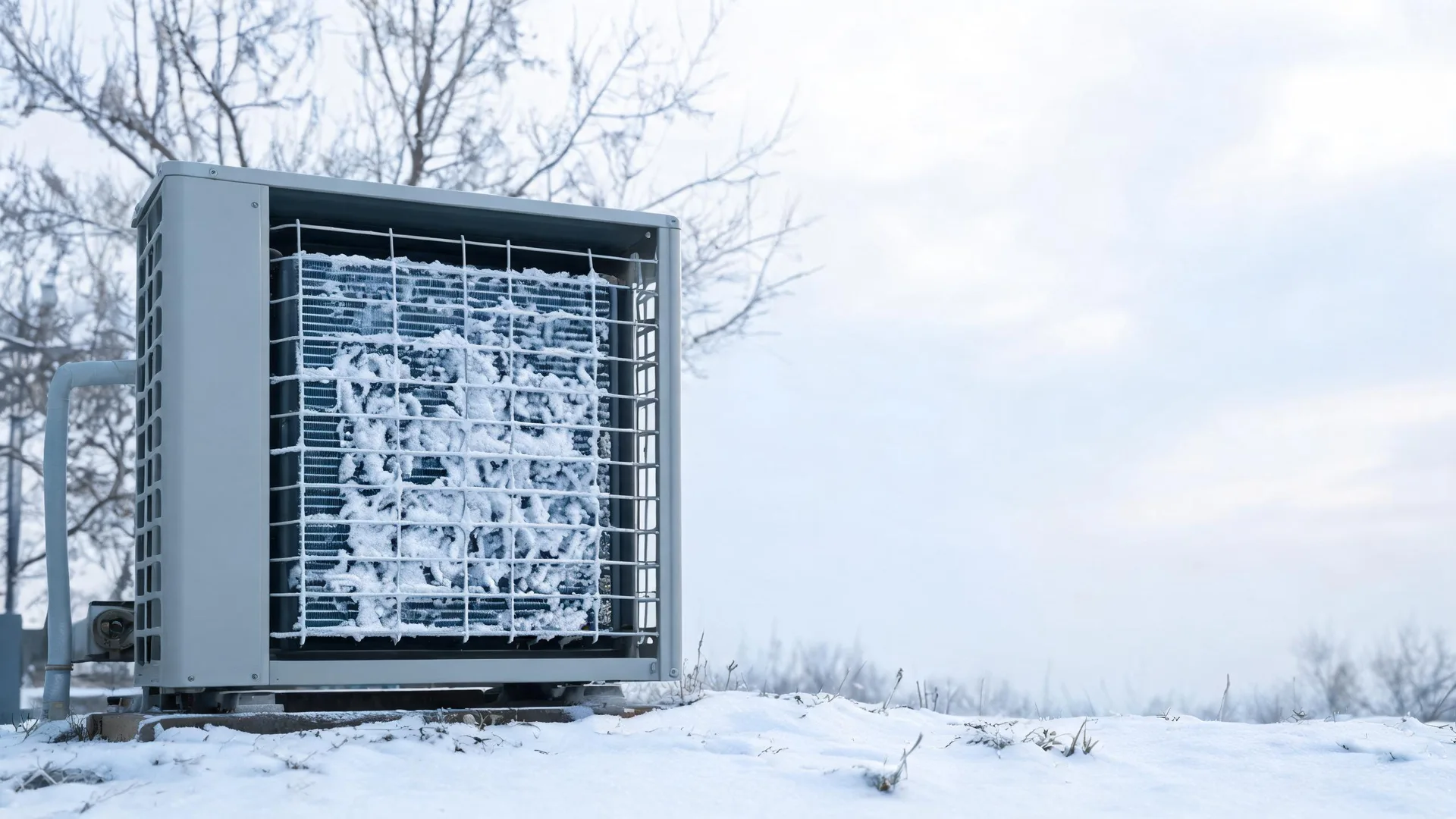
Don't pull panels off the outdoor unit or touch anything inside it. The capacitor in there holds a charge even with the power off, enough to hurt you. If you see ice on the coil, shut the system off and let it melt rather than chipping at it. Running the system while it's iced up or while it's making a new noise just turns a repair into a bigger one.

An overhead view of a residential air conditioning condenser unit mounted on a concrete pad next to a house with vinyl siding.

A new air conditioner would cut about $30 a year off cooling for a typical Vanderburgh County home.

  • A new one at the federal minimum, 13.4 SEER2$380 a year
  • An older air conditioner$410 a year

Estimates for a typical Vanderburgh County home, compared with an older unit built to the previous federal minimum, from EIA household energy data, Indiana fuel prices and NOAA climate normals. Your home will differ.

Repair makes sense when a part like a capacitor or contactor has failed.

Replacement makes sense when the compressor has failed or the system uses R-22 refrigerant, which is no longer made.

A compressor that fails once, gets repaired, and runs fine for years after is a different machine than one that keeps coming back with the same complaint. A repeat leak usually means the first fix didn't hold, or the metal nearby is wearing thin somewhere new. A coil with one small crack can be patched and left alone after that. A coil corroding in more than one spot is telling you the rest of it is headed the same way, just not there yet. The question worth asking isn't only what broke this time. It's whether this system has a pattern of failing or whether this is the first real problem it's had.