A lit residential street at dusk featuring large two-story brick houses with glowing windows, mature trees, and a street lamp.

AC Repair in Corydon, IN

Tell us about the job

Takes about a minute. No obligation.

RepairCentral ACHarrison County, IN
Step 1 of 2

What ZIP code is the job in?

A normal five-month season

AC in Corydon runs May through September. Afternoon highs average 86°F in June, July and August. That is a regular cooling load, not an extreme one. A unit struggling now is more likely dealing with a worn part than weather it can't handle.


So look for the usual cause

When a system acts up in a season like this, the cause is usually something specific. A weak capacitor. A low charge. A dirty coil. Finding which one it is matters more than guessing, and that's what a repair call is for.

5 months
May through September, your air conditioner is on duty
86°F
the average summer afternoon it cools against
33 hail events
in ten years, and hail bends the fins on outdoor coils
69 wind events
in ten years, and wind drives debris into outdoor units
Isometric line illustration of a cutaway house showing an indoor air handler with branching ducts in the attic space, connected by a line set to an outdoor condenser unit beside the building, with simple furniture in two rooms.
Your air conditioner works hardest from June through August.

NOAA nClimDiv, 1991–2020 normals

AC season in Corydon starts in May.

If your system is struggling in the first weeks of running, something was already weak before the heat hit it.

Harrison County gets its share of storms, but that is a power problem, not an AC problem

118 severe weather events from 2015 to 2024
17% of homes statewide lost power a day or more in 2024
69 damaging wind events from 2015 to 2024

Electricity in Indiana ran 14.77 cents per kilowatthour in 2024. A struggling AC unit does not use less power because it is running poorly. A weak capacitor forces the compressor to work harder to start. A low charge makes the system run longer to reach the same temperature. Either way, the unit draws power the whole time it is on, and a repair that fixes the actual cause is what stops that. Waiting usually means paying more to run a unit that still is not cooling right.

Half the homes here were built in 1990 or later

Half the homes in Harrison County were built in 1990 or later. If your system came with a house that age, it's likely still within its working life. A unit like that is usually worth repairing, not replacing.

Find a contractor
A man in a dark long-sleeved shirt and brown work pants, seen from behind, climbs porch steps toward an orange front door while carrying a canvas tool bag.
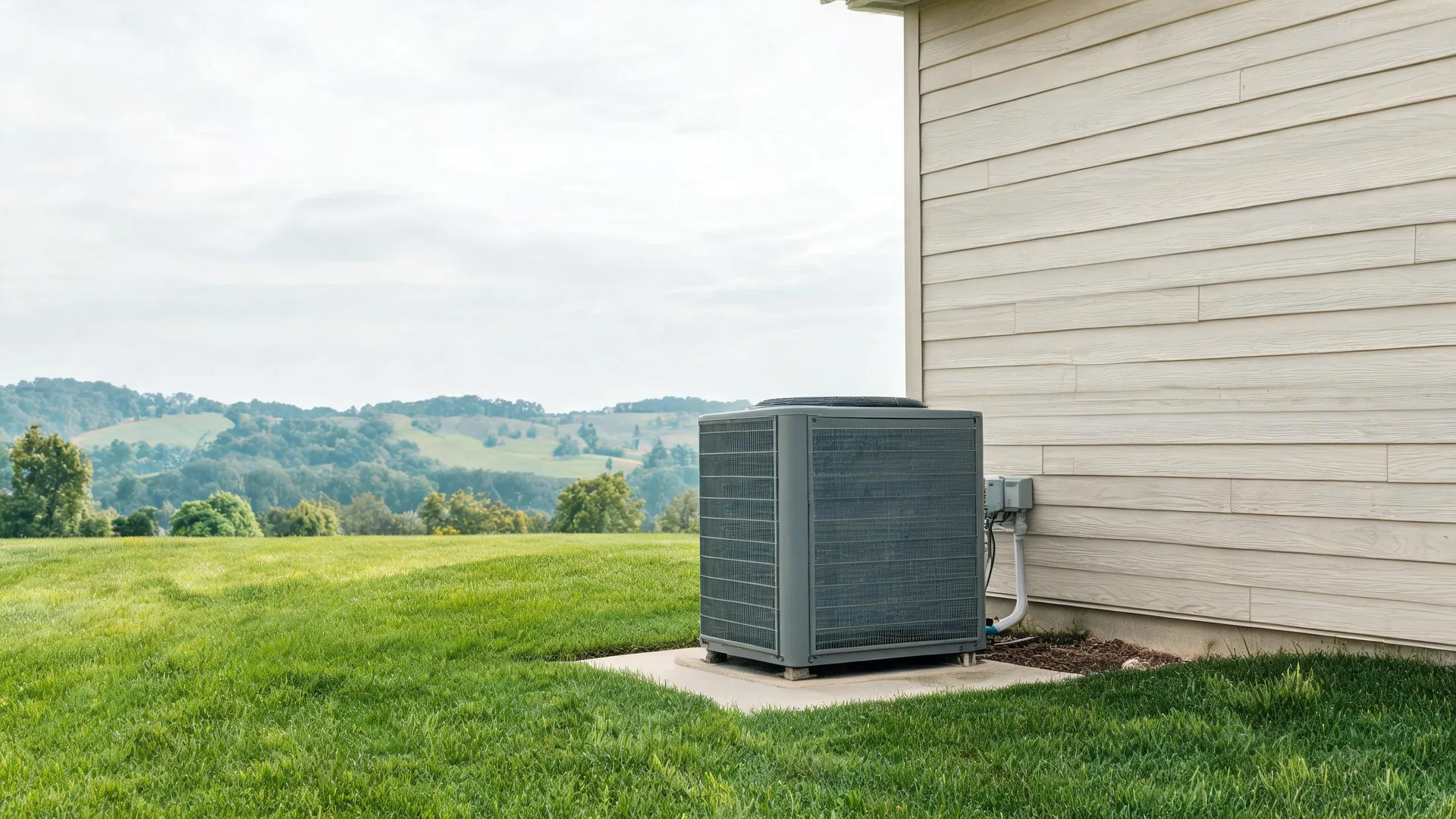
An outdoor air conditioning condenser unit mounted on a concrete pad surrounded by gravel, photographed against a partly cloudy blue sky.

Worth knowing what you're working with

Check the paperwork from when you moved in, or the sticker on the unit itself. If the system is original to the house and the house is newer, that history is worth knowing before you spend money on a repair call. A unit still inside its working life is one a technician can usually bring back with a part, not a reason to start pricing a replacement.

The capacitor takes the strain first

Every time the compressor or fan motor starts, the capacitor gives it the jolt to get moving. That part wears down with heat and years, and once it's weak, the motor it serves strains to start each cycle. That strain is what shows up as a unit that hesitates, hums, or trips a breaker before it gets going.

A dirty coil makes the whole system work harder

The outdoor coil has to shed heat for the system to work, and the indoor coil has to pick up heat from the air passing over it. Dirt or a clogged filter on either one blocks that exchange. The compressor keeps running the same cycle, but it does less cooling for the same effort, and that's often what's behind a system that runs long without bringing the temperature down.

Overhead view of a gray outdoor AC condenser unit on a concrete pad beside a mulched garden bed and a house with vinyl siding.

A new air conditioner would save little on running costs in Harrison County, so the repair decision comes down to the unit's condition.

  • A new one at the federal minimum, 13.4 SEER2$320 a year
  • An older air conditioner$340 a year

Estimates for a typical Harrison County home, compared with an older unit built to the previous federal minimum, from EIA household energy data, Indiana fuel prices and NOAA climate normals. Your home will differ.

Repair makes sense when a part like a capacitor or contactor has failed.

Replacement makes sense when the compressor has failed or the system uses R-22 refrigerant, which is no longer made.

A diagnostic visit starts with questions. When did it start acting up, and what does it do differently. Blowing warm air, cycling on and off, tripping the breaker, making a new noise. A tech checks the easy things first, the filter and the airflow, before touching anything electrical. From there it's gauges on the refrigerant lines and a meter on the capacitor and the wiring, checking actual readings against what the system is supposed to show. A weak capacitor and a low charge can both make a unit struggle, but they show up differently on a meter, and that's how one gets told apart from the other. The visit ends with a straight answer. Which part is failing, why, and what it takes to fix it.