





A lit residential street at dusk featuring large two-story brick houses with glowing windows, mature trees, and a street lamp.

Heat Pump Repair in Plainfield, IN

Tell us about the job

Takes about a minute. No obligation.

RepairHeat PumpHendricks County, IN
Step 1 of 2

What ZIP code is the job in?

A heat pump in Hendricks County works both sides of the year, but not hard on either side. Zone 4A means real heating demand and real cooling demand, not an extreme of either one. Summer humidity here averages a 64°F dew point through June, July and August, which is muggy but not the kind of load that runs a system into the ground. So when a heat pump here starts acting up, it's rarely because the machine has been overworked for years. More often it's a part that failed, a sensor that's off, or something that got neglected. That's usually a straightforward repair, not a sign the whole system is worn out.

8 months
October through May, your system heats
3 months
June through August, it cools
22°F
the average winter night it heats against
82°F
the average summer afternoon it cools against
Isometric illustration of a cutaway single-family house showing interior ductwork and an air handler, with an outdoor condenser unit connected by lines along the exterior wall.
Your system heats October through May and cools June through August.

NOAA nClimDiv, 1991–2020 normals

Half the homes in Hendricks County were built in 1998 or later.

A heat pump that came with a newer house still has working life in it, which is a good reason to fix it instead of replace it.

Heat runs October through May, cooling runs June through August, and trouble shows up right when each one starts

Cooling runs June through August
Heat runs October through May
Climate zone 4A

Electricity in Hendricks County runs about 14.68 cents per kilowatt-hour. A heat pump that's struggling, low on charge, icing up, running constantly to hit the thermostat setting, draws more power to do less work. You pay for every one of those extra hours. This isn't a machine that's failing from years of hard use, so a bad month on the electric bill usually points to something specific that went wrong, not old age catching up with it. The longer a bad part sits there, the more it costs to run the thing around it.

Worth fixing, not worth ignoring

A heat pump that's had an easier life than most still needs the broken part found. Get the repair looked at now, before a failed sensor or a bad part turns into a bigger bill or a system that can't keep up when the weather turns.

Find a contractor
A gray heat pump outdoor unit mounted on a concrete pad next to the stone-accented exterior wall of a house.

How old is the house, and how old is the unit

If your heat pump came with the house and the house is from the last twenty or so years, that's worth finding out before you decide anything. Check the age on the unit's data plate against when the house was built. A system that young hasn't put in enough time to wear out on its own, so the repair is almost always about fixing what broke, not replacing a machine near the end of its run.

Check the thermostat and the breaker first

Set the thermostat to heat or cool, whichever side is acting up, and push the setpoint well past the room temperature. Listen for the unit to kick on outside. If nothing happens, check the breaker panel for the outdoor unit and the air handler, both of them. A tripped breaker or a thermostat set to the wrong mode or a dead battery accounts for more service calls than people expect, and you can rule it out in a couple of minutes.
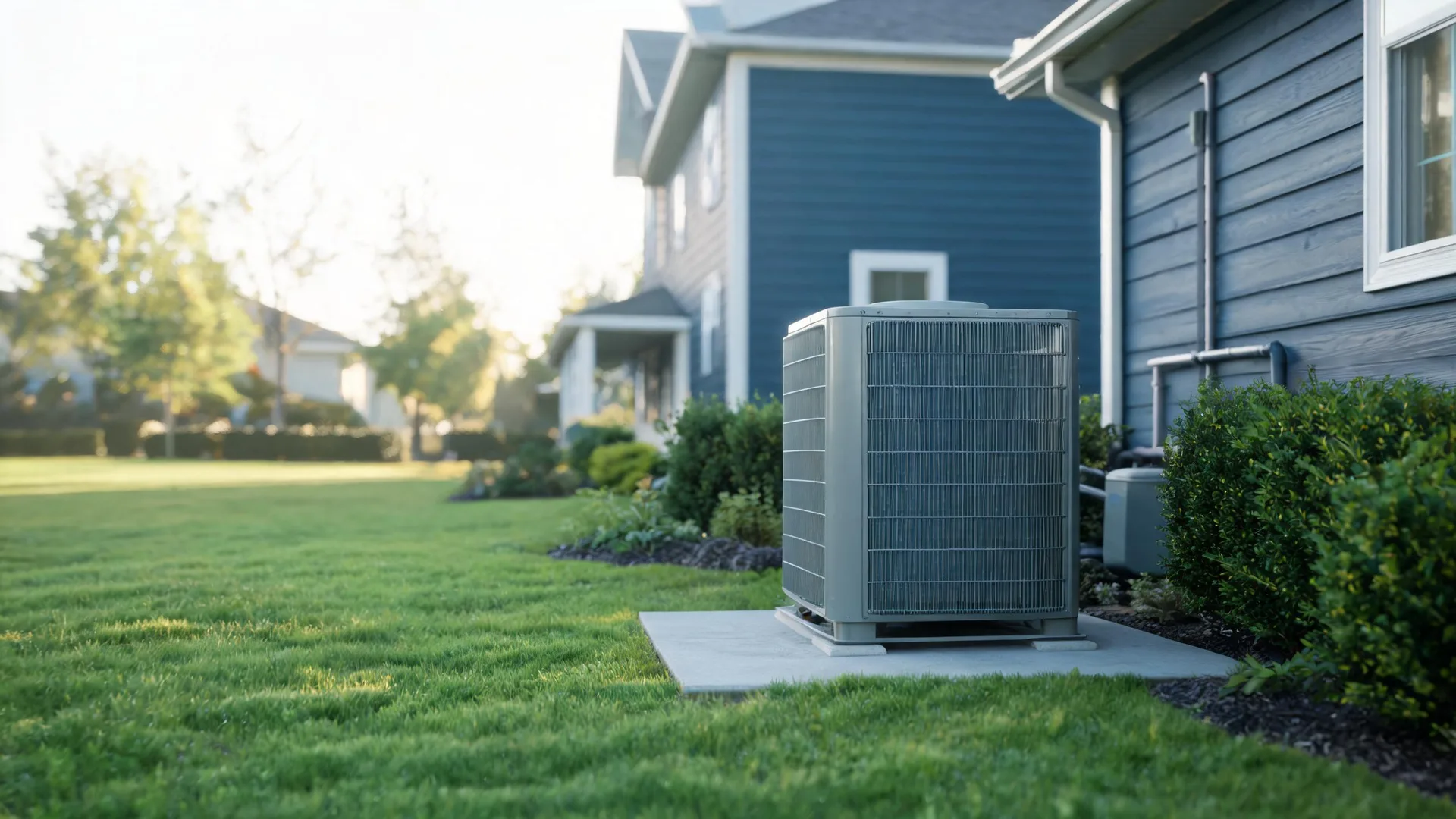
Look at the outdoor unit and the filter

Walk outside and look at the coil. If it's caked in ice or snow, or buried in leaves and grass clippings, that blocks airflow and the system can't move heat either direction. Clear what you can reach by hand, but don't chip at ice on the coil. Pull the air filter inside and hold it up to a light. If you can't see through it, swap it. A clogged filter starves the system the same way a blocked outdoor coil does, and it's the one part in this whole machine you're meant to touch yourself.

A heat pump that's icing up or short cycling doesn't fix itself by staying on. Ice on the outdoor coil blocks airflow, so the system pulls in less heat than it needs, runs longer to compensate, and that longer runtime feeds more frost onto the coil. It builds on itself. A failing run capacitor is the same story from a different angle. The compressor draws harder to start, the motor windings heat up more than they should, and a part that might have been a simple swap turns into a compressor replacement if it keeps getting asked to start that way. A refrigerant leak behaves the same. Low charge makes the compressor work to move heat it doesn't have enough refrigerant to carry, and running it low for weeks does more damage than the leak itself. None of this is the machine being fragile. It's that a system under strain usually makes its own problem worse the longer it's left to run that way, so the right move is to shut it off and get the actual fault found, not to wait and see if it clears up on its own.

Most heat pump problems aren't a sign the whole unit is done. A failed capacitor, a stuck reversing valve, a worn contactor, these are individual parts with their own lifespan, and replacing one doesn't mean the rest of the system is on the way out too. The compressor is the expensive part to replace, and it's also the part that tends to last if everything feeding it has been kept in working order. A refrigerant leak is usually a fitting or a coil pinhole, not damage to the compressor itself, and once it's found and sealed the system runs the way it did before. The question worth asking isn't how old the unit is. It's whether what failed is a contained part or the compressor itself. Most service calls are the first kind.